


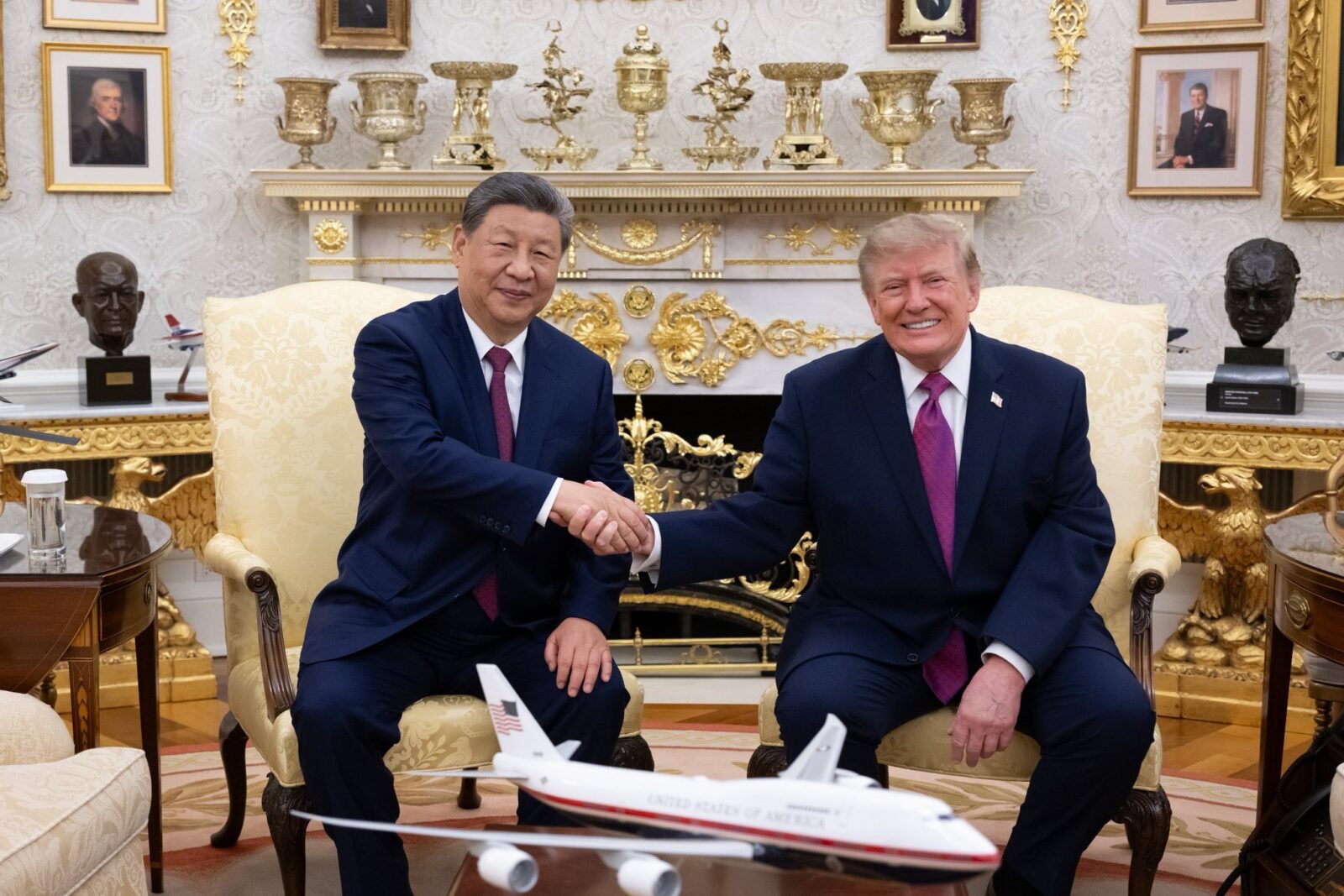
Washington DC – US President Donald Trump welcomed Chinese President Xi Jinping to the White House on Thursday for a state visit that brought the leaders of the world’s two largest economies together amid disputes over trade, Taiwan, artificial intelligence and the war in Iran.
Xi’s visit to Washington, his first in more than a decade, comes several months after Trump travelled to China in May for talks with the Chinese leader. The two presidents are meeting for the second time this year as Washington and Beijing seek to keep relations stable while managing several major areas of disagreement.
The issue of Taiwan emerged during the bilateral discussions, with Xi calling on the United States to oppose “Taiwan independence”, according to a readout carried by China’s state news agency Xinhua.
Taiwan remains one of the most sensitive issues in US China relations. Beijing claims sovereignty over the self governed island, while Washington maintains longstanding security ties with Taipei without formally recognising Taiwan as an independent state.
Before the summit, Xi was expected to raise the issue of US arms sales to Taiwan. Trump had previously said he was holding an arms package for Taiwan worth about $14 billion in abeyance, describing it as a “very good negotiating chip”.
Trump and Xi also discussed trade, technology and artificial intelligence.
Trump described his relationship with Xi as a “truly great friendship” and said the two countries had made progress on trade since his May visit to China.
“During this visit, we will also discuss pressing issues concerning security, technology, and ‘super intelligence,’” Trump said. “The decisions we make in these areas today can promote peace and prosperity for decades and decades to come.”
Xi said competition between the United States and China should remain constructive and described it as a “healthy one”.
He said American companies were welcome in China and expressed hope that Chinese companies would receive fair treatment in the United States.
Xi also called for continued communication between the two militaries to strengthen crisis prevention and reduce the possibility of confrontation.
“The Thucydides trap can be overcome,” Xi said, referring to the theory that rivalry between an established power and a rising power can develop into open conflict.
Ceremony sets the tone
The White House visit featured an elaborate state ceremony designed to mark the importance of Xi’s trip.
Trump personally welcomed Xi at Joint Base Andrews on Wednesday evening, with the Chinese president receiving a red carpet arrival. The White House had previously announced that Thursday’s state arrival ceremony would involve 479 military personnel representing the US armed forces.
The ceremony included military honours, US and Chinese flags, musical performances and a military flyover. The White House said the programme was designed to provide an official welcome for Xi and his wife, Peng Liyuan.
A state dinner was also scheduled at the White House on Thursday evening, with government officials, members of the official delegations and business leaders among the guests.
The high profile nature of the visit has also given the summit significance in US domestic politics, with the November midterm elections approaching and Republicans defending narrow congressional majorities.
Trade remains central
Despite the ceremony surrounding the visit, major breakthroughs were not expected on the most difficult disputes between Washington and Beijing.
US Treasury Secretary Scott Bessent said after talks with Chinese Vice Premier He Lifeng that the two sides had agreed to extend a trade arrangement that had paused a tariff confrontation in which reciprocal tariffs had at one point exceeded 100%.
The extension was reported as running until January 10.
Artificial intelligence was another major issue on the agenda. Trump said “super intelligence” would be discussed but indicated that he did not want to introduce new restrictions at this stage.
“Super Intelligence (SI) will be a big topic of discussion, but I want to leave it exactly where it is,” Trump wrote on Truth Social. “That is China’s position also.”
Xi took a different tone on the governance of artificial intelligence, saying the two countries had both the capacity and responsibility to develop the technology while keeping its use under human control.
“the capability and responsibility to develop and manage AI for good, and ensure that the development of AI is always under human control.”
Competition between the two countries over advanced technology remains a major obstacle to broader cooperation, particularly as Washington maintains export controls on sensitive technologies sought by Chinese companies.
Iran and wider security issues
The war in Iran is also expected to feature in discussions between Trump and Xi.
Beijing has maintained relations with Tehran, while the Trump administration has sought international support for its position on the conflict. There has been limited indication that China is prepared to exert significant pressure on Iran in response to US demands.
The two leaders also have incentives to avoid a fresh escalation in US China tensions. Trump is dealing with the political and economic pressures linked to the Iran war, while Xi faces challenges within China’s economy.
Other potential areas of discussion include tariffs, efforts to combat drug trafficking, military to military communication and Americans detained in China.
China’s control over rare earth minerals gives Beijing an important position in negotiations involving technology and manufacturing supply chains.
Business leaders attend
The state dinner guest list includes senior executives from some of the world’s largest technology companies, including Apple CEO Tim Cook, Amazon founder Jeff Bezos, Alphabet CEO Sundar Pichai, OpenAI CEO Sam Altman, Tesla CEO Elon Musk and Nvidia CEO Jensen Huang.
Despite the presence of major technology executives, US officials are expected to maintain restrictions on the export of sensitive American technologies to China, an area Beijing has sought to see loosened.








Leave a comment