


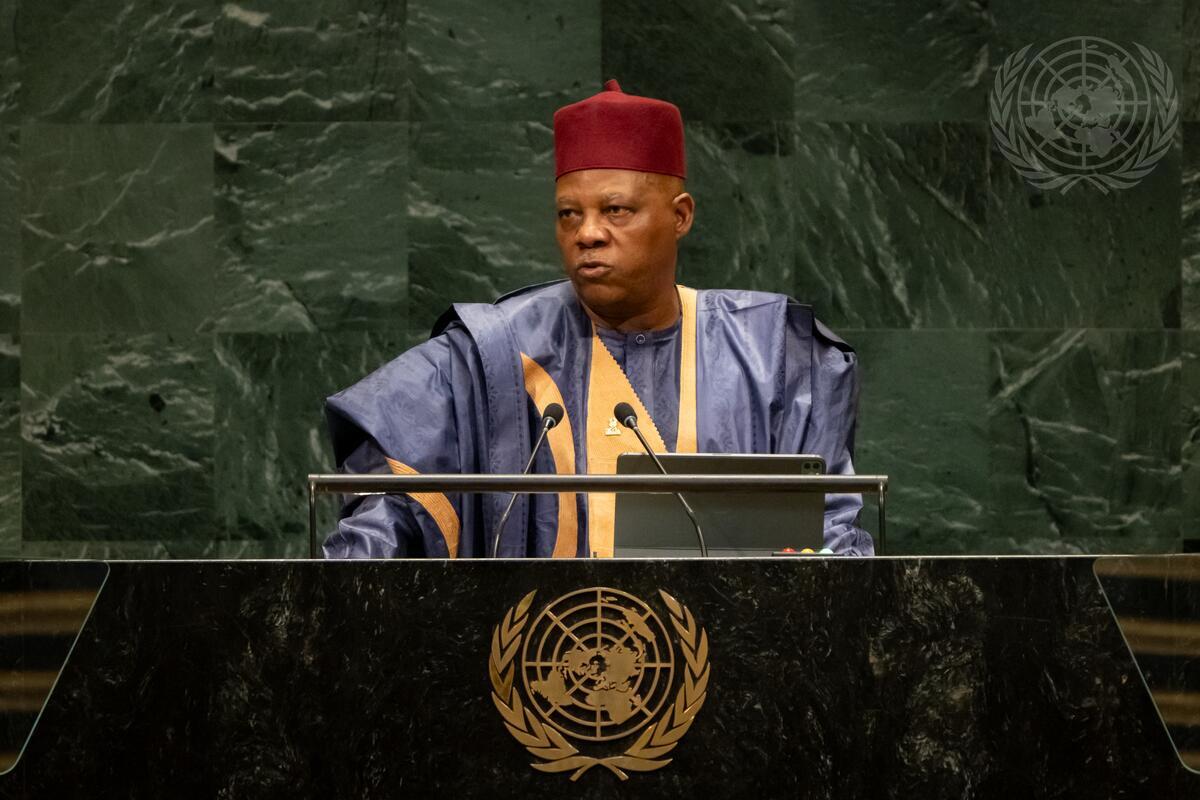
New York – Nigeria has called for major reforms to the global financial system, greater representation for Africa at the United Nations Security Council and increased financing for developing countries as Vice President Kashim Shettima addressed the 81st UN General Assembly in New York on Thursday.
Shettima, speaking on behalf of President Bola Ahmed Tinubu during the General Debate, said Africa could no longer remain central to the Security Council’s agenda while being excluded from permanent membership.
He said Nigeria supports the African Union position for at least two permanent seats for Africa, with all the rights and responsibilities attached to permanent membership, as well as five non permanent seats.
“The authority to speak for humanity carries an obligation to represent it,” Shettima told delegates.
Nigeria also said it was prepared to assume greater responsibilities within the international system, citing its contributions to peace efforts in countries including Liberia, Sierra Leone, Darfur, Mali and The Gambia.
Shettima said Nigeria had committed personnel and resources to international peace efforts and continued to support mediation, democratic governance, counter terrorism and maritime security through partnerships involving the African Union and the Gulf of Guinea.
He linked Nigeria’s foreign policy to its domestic economic reforms, including macroeconomic management, stronger institutions, private sector development and strategic public investment.
Financing development
Shettima identified inadequate financing as one of the major barriers to sustainable development, particularly for developing countries facing heavy debt servicing obligations.
“Many developing countries devote substantial resources to debt servicing at the expense of education, healthcare and infrastructure,” he said.
Nigeria therefore called for changes to the international financial architecture, wider access to concessional financing and debt sustainability frameworks that take developmental needs into account.
Shettima also backed blended finance, private capital, South South cooperation and strategic partnerships to support sustainable development, climate adaptation and resilient infrastructure.
The call for financial reform comes as African countries continue to push for changes to the global financial system, including measures addressing debt vulnerabilities and the high cost of capital. The United Nations has also identified reform of the international financial architecture as an important priority for Africa ahead of the 81st session.
Climate action
Nigeria rejected what Shettima described as a false choice between economic development and climate action.
“We reject the false choice between development and climate action,” he said.
He said developing countries needed to reduce poverty, expand energy access and pursue lower carbon development pathways with support through technology transfer, capacity building and climate finance.
Shettima noted that Africa contributes less than 4 percent of global greenhouse gas emissions while facing disproportionate consequences from climate change.
Nigeria, he said, remained committed to the Paris Agreement and an equitable energy transition that recognises historical responsibility and differences in national capacity.
Under its Energy Transition Plan, Nigeria is working towards net zero emissions by 2060 while seeking to expand access to affordable, reliable and sustainable energy.
Shettima said the approach combines renewable energy, clean cooking, gas as a transitional fuel, climate smart agriculture and nature based solutions.
“Finance must be governed by equity and shared responsibility rather than charity,” he said, calling for international commitments to be translated into accessible, predictable and adequately funded mechanisms.
AI and Africa’s young population
Artificial intelligence was another major issue in Shettima’s address, with the vice president calling for international cooperation to ensure the technology serves humanity.
He said Nigeria did not want technological development to be driven by fear and argued that artificial intelligence could either cause harm or support progress depending on how it was developed and used.
AI, he said, could be applied to healthcare, education, agriculture, governance and economic productivity.
“Much of the anxiety surrounding AI reflects the distrust we have allowed to grow amongst us,” Shettima said.
He said Nigeria was investing in digital public infrastructure, broadband connectivity, innovation systems, research institutions and technology entrepreneurship.
Shettima invited international partners to work with Nigeria’s young technology entrepreneurs and innovators to help direct artificial intelligence towards human development.
“We invite the world to work with our inventive, resourceful and enterprising young people to direct AI towards humanity’s advancement rather than its destruction,” he said.
AfCFTA and Africa’s resources
Shettima described the African Continental Free Trade Area as one of the continent’s most significant opportunities for economic transformation.
He said the agreement could strengthen regional value chains, expand intra African trade, accelerate industrialisation and attract investment.
Africa, he said, needed to move beyond its traditional position as an exporter of raw materials by increasing value addition, manufacturing, technological innovation and knowledge driven growth.
“Our abundant natural resources must become engines of shared prosperity rather than sources of perpetual dependency,” he said.
Shettima said Africa’s youthful population, natural resources, expanding markets and growing capacity for innovation could position the continent as a major contributor to global economic growth.
He also said developing countries should be treated as indispensable partners in finding solutions to global challenges rather than being viewed mainly through the lens of assistance.
Security and development
Nigeria’s experience confronting Boko Haram, Islamic State West Africa Province and other armed groups, Shettima said, had demonstrated that military action alone could not produce lasting stability.
He said security responses needed to be supported by education, economic opportunities, accountable governance and communities where rights and dignity were protected.
“Development cannot take root, while violence repeatedly uproot livelihoods and peace cannot endure, while injustice and exclusion replenish the ranks of those who threaten it,” he said.
Shettima called for stronger intelligence cooperation, institutional capacity, measures to disrupt the financing of violence and efforts to prevent the movement of weapons across borders.
He pointed to instability in the Sahel as an example of how insecurity in one country can affect neighbouring states through displacement, disruption to trade and wider regional instability.
Nigeria, he said, would continue to support regional cooperation and African leadership in responding to these challenges.
Sudan and international conflicts
Shettima also addressed conflicts including the war in Sudan, calling for urgent diplomacy to confront their humanitarian, economic and geopolitical consequences.
He said all parties to conflicts must respect international humanitarian and human rights law, protect civilians and allow humanitarian assistance to reach those in need.
“No claim to security can justify starving children, denying relief to civilians or erasing communities from the land they call home,” he said.
Nigeria called for negotiated settlements that respect sovereignty and territorial integrity and reaffirmed its support for the peaceful settlement of disputes under the UN Charter.
Shettima said the United Nations should strengthen peacekeeping while giving greater attention to peacebuilding, mediation, institution building and sustainable development.
Reforming the United Nations
Nigeria’s call for Security Council reform was central to the address.
Shettima said the structure of the Council could no longer reflect a distribution of global power established in 1945 while Africa remained without permanent representation.
The Nigerian government has continued to push for permanent African representation, with the issue forming part of the continent’s broader campaign for reform of global governance institutions. The UN has also acknowledged Africa’s continued underrepresentation and the need for a Security Council that better reflects current geopolitical realities.
Shettima said Nigeria remained optimistic that countries acting collectively could overcome obstacles that once appeared impossible to resolve.
He called for cooperation over confrontation, dialogue over division and partnership over isolation, saying international institutions needed to respond to the aspirations of present and future generations.
“A reform, inclusive and effective United Nations is indispensable to the peaceful, just and sustainable world that future generations deserve,” he said.
“Whatever our differences, I repeat, whatever our differences, we must remember that humanity is our oldest citizenship and peace is the inheritance we owe every child.”




Leave a comment