


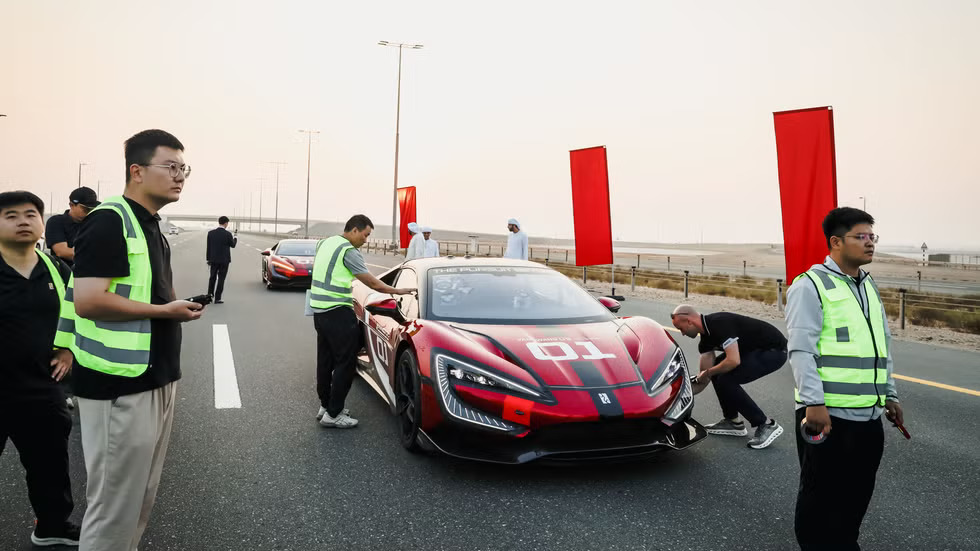
Abu Dhabi, UAE – Chinese electric vehicle manufacturer BYD has set a new production car speed record after its luxury performance brand, Yangwang, pushed the U9 Xtreme hypercar to 503.2 kilometres per hour (312.7 miles per hour) on a closed public road in Abu Dhabi.
The record-breaking run, completed on 1 November 2026, makes the U9 Xtreme the first production vehicle to exceed the 500 km/h mark. It also establishes new Guinness World Records for the highest speed achieved by a production car and a production electric car in a single-direction run.
German racing driver Marc Besseng, who was also behind the wheel during the vehicle’s previous record attempts, drove the electric hypercar along a specially prepared section of Sheikh Khalifa Bin Zayed International Road.
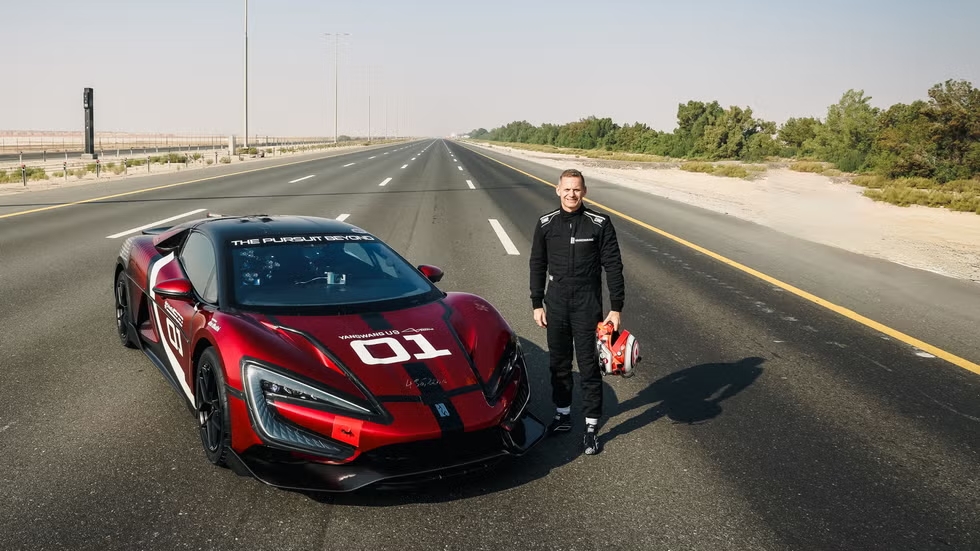
The latest achievement surpasses the car’s previous record of 496.22 km/h (308.3 mph), recorded at Germany’s ATP Papenburg test track in 2025.
Unlike the earlier attempt, Yangwang selected a public road in the United Arab Emirates for the latest challenge. Authorities closed approximately 10 kilometres of the E11 highway, including a straight stretch measuring about seven kilometres, to provide the conditions required for the high-speed run.
Preparing the road presented its own challenges. Given the route’s proximity to the desert and its regular use by motorists, the surface required extensive cleaning and inspection to remove potentially dangerous debris.
Yangwang said its team examined the entire route, including looking for tiny pieces of wire that could have been left behind by mechanical road sweepers. Such material could damage tyres or compromise the vehicle’s stability when travelling at speeds exceeding 500 km/h.
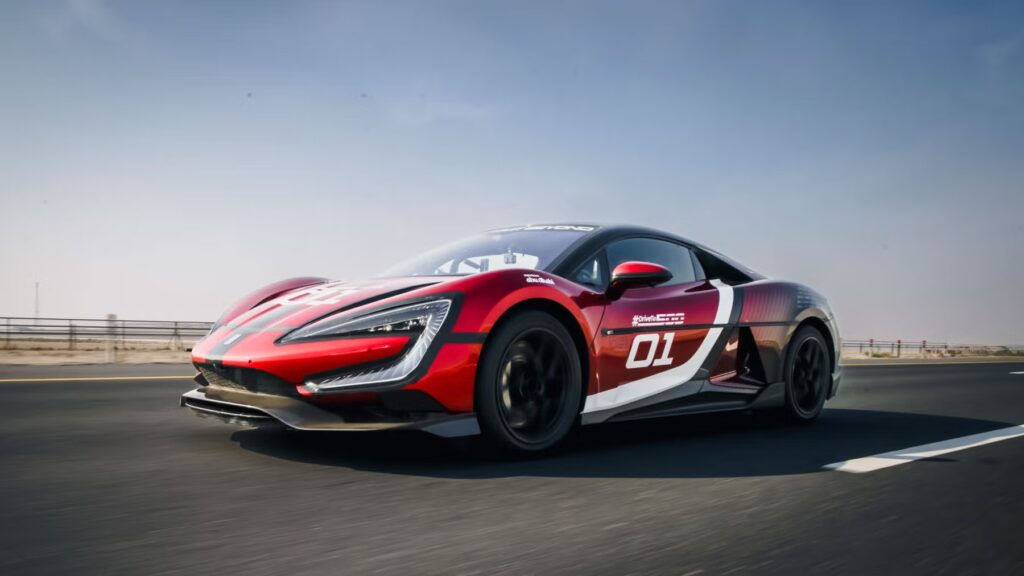
The record attempt extended over two days. Initial runs on 31 October reached a maximum speed of approximately 490 km/h (304.5 mph), prompting engineers to make further adjustments before the final attempt.
Besseng described the achievement as particularly significant because of the different conditions presented by a public road compared with a dedicated racing circuit.
“Unlike a dedicated test track, a public road presents a different set of challenges, making precision, stability and confidence in the vehicle more important than ever,” Besseng said.
“Breaking a world record once is extraordinary but doing it again in such a different environment is truly special.”
Engineering changes push the limits
The U9 Xtreme, also known as the U9X, received several technical adjustments to help it cross the 500 km/h threshold.
Yangwang modified the angle of the rear wing to generate additional downforce, improving the vehicle’s stability at extreme speeds. Engineers also adjusted the suspension software to increase rebound damping, allowing the car to respond more effectively to slight unevenness along the road.
Tyre pressure was also modified to improve stability during the high-speed attempt.
The hypercar is powered by four electric motors, with one installed at each wheel, producing a combined output of more than 3,000 horsepower. Some technical specifications put its power output at approximately 2,958 horsepower.
Its 1,200-volt electrical architecture represents a major departure from the standard Yangwang U9, which uses an 800-volt system.
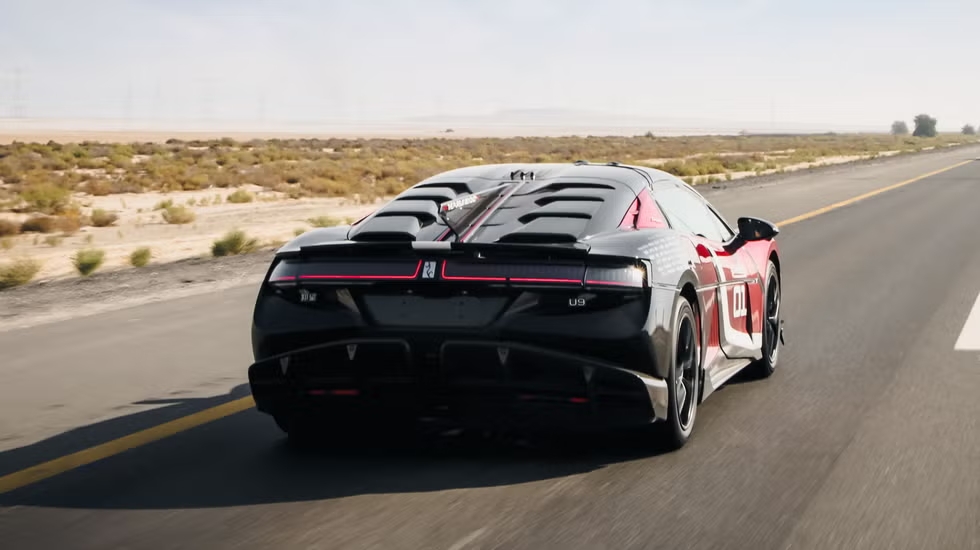
The upgraded battery technology allows the vehicle to deliver substantial power while managing heat more efficiently. Even at 20 per cent battery charge, the system can reportedly produce up to 1,800 kilowatts, equivalent to approximately 2,414 horsepower.
The four-motor configuration also provides sophisticated torque-vectoring capabilities, allowing power to be distributed independently across the wheels to maintain traction and reduce wheelspin.
Additional features include electronically controlled suspension dampers designed to manage the vehicle’s movement during acceleration and braking, alongside active aerodynamic components that help maintain stability.
The tyres were specially developed by Indonesia-based Giti Tire to withstand the extraordinary forces and temperatures associated with travelling at such speeds.
Limited production of 30 vehicles
Yangwang, BYD’s luxury performance division, plans to manufacture only 30 examples of the U9 Xtreme worldwide, making it an exclusive addition to the growing market for high-performance electric vehicles.
The model’s development has progressed rapidly since the introduction of the standard U9.
The original vehicle recorded a top speed of 309 km/h (192 mph) in January 2024 before reaching 391.94 km/h (243.5 mph) later that year.
The more powerful Xtreme version subsequently reached 472.41 km/h (293.54 mph) in August 2025, followed by 496.22 km/h the following month. Its latest run in Abu Dhabi finally took it beyond the 500 km/h barrier.
The achievement places the Chinese hypercar ahead of the Bugatti Chiron Super Sport, which reached 304.8 mph (490.5 km/h) in 2019.
However, the latest record comes with an important distinction. The 503.2 km/h figure was achieved during a single-direction run rather than a two-way average, a method commonly used to account for variations in wind and road conditions.
The FIA and Guinness World Records have recognised the achievement under the single-direction production vehicle speed category.













Leave a comment