


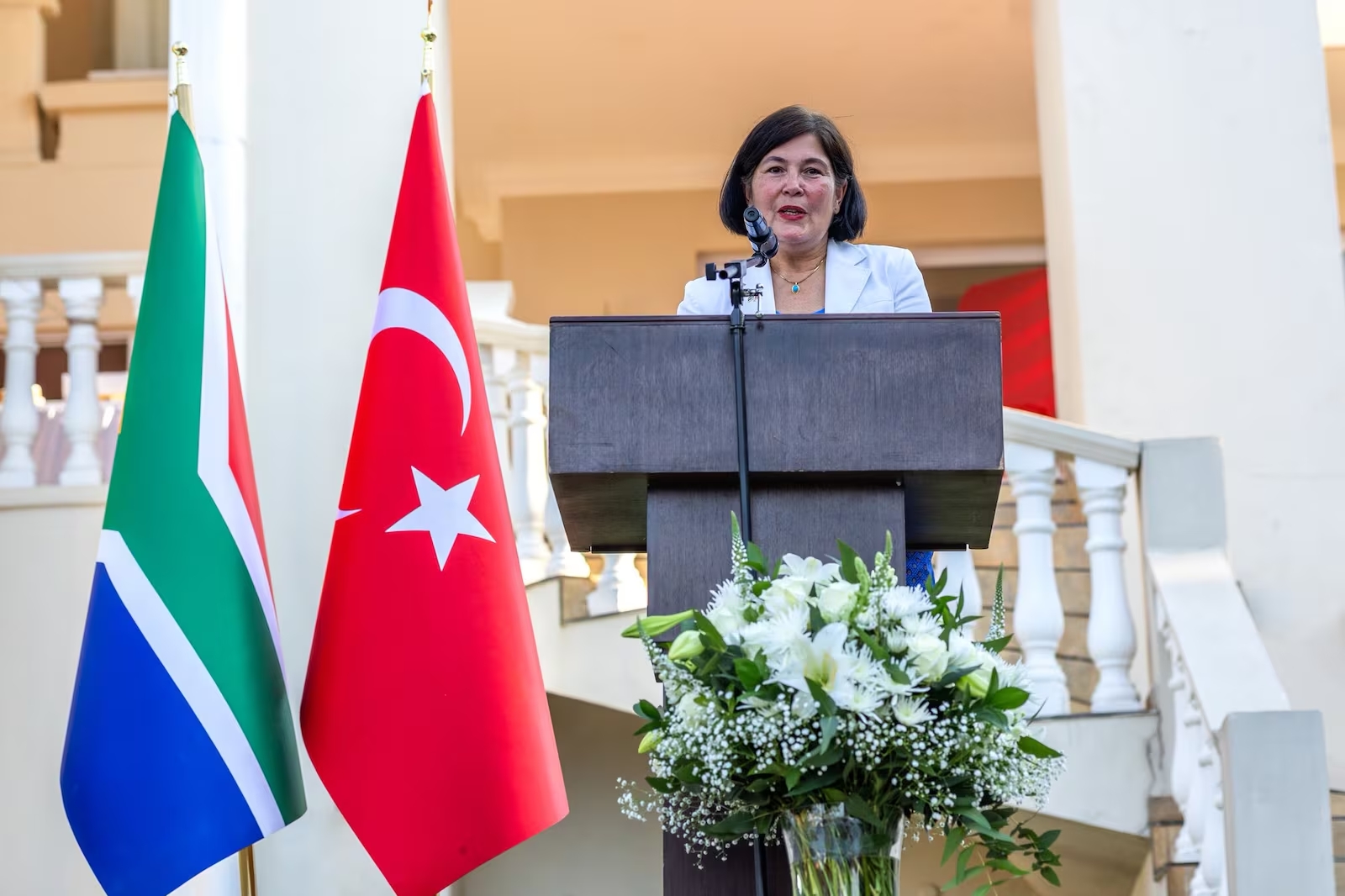
Pretoria, South Africa – Türkiye is seeking to increase bilateral trade with South Africa from approximately US$2 billion to US$5 billion, as Ankara looks to deepen economic cooperation with Africa’s most industrialised economy ahead of hosting the United Nations Climate Change Conference, COP31, in Antalya.
Turkish Ambassador to South Africa Kezban Nilvana Darama-Yıldırımgeç said the two countries were exploring additional trade and investment opportunities, with discussions underway to expand commercial relations across several sectors.
South Africa is currently Türkiye’s largest trading partner in sub-Saharan Africa, with bilateral trade reaching approximately US$2 billion in 2024, according to Turkish government figures.
Speaking to Business Day, Darama-Yıldırımgeç described the existing trade relationship as a strong starting point but said there was considerable room for expansion.
“South Africa is Türkiye’s largest trading partner in Sub-Saharan Africa. Our bilateral trade stands at around $2bn. This is a solid foundation, but it remains below our true potential. Our aim is to reach a trade volume of $5bn in the near future,” she said.
Türkiye’s ambitions come at a time when South Africa is navigating changes in its international trade relationships, particularly following the United States’ decision to remove the country from the African Growth and Opportunity Act (AGOA) trade programme.
The Turkish ambassador believes the economic structures of the two countries offer opportunities for partnerships that extend beyond the exchange of finished products and commodities.
“Together, we have the opportunity not only to trade but to build shared value chains, transforming raw materials into high-value products, combining technology with resources, and reaching broader regional and global markets,” she said.
She added that joint commercial ventures could generate employment, expand technical expertise and create opportunities for research and innovation, particularly among young people.
“These collaborative ventures will also create local employment opportunities and open new avenues for skills development, research and innovation, particularly for young people.”
Türkiye also sees South Africa as an important gateway into the wider African market, while Ankara’s economy offers South African businesses access to a substantial consumer base and markets beyond the continent.
“For Turkish companies, South Africa serves as an ideal platform for the wider African continent. Conversely, for South African companies, Türkiye is not only a vibrant market of 85-million people but also a strategic bridge to lucrative markets in Europe, the Middle East and beyond. Türkiye remains firmly committed to deepening its economic partnership with South Africa.”
Military cooperation gains momentum
The growing economic engagement is accompanied by efforts to strengthen diplomatic and defence relations.
During Türkiye’s National Day celebrations in South Africa last week, attended by several senior South African political figures, including former Minister of International Relations and Cooperation Naledi Pandor, officials discussed developments in bilateral cooperation.
Zoleka Lamati, Chief Director of Human Resource Management in the Department of Sport, Arts and Culture, disclosed that South Africa and Türkiye held their first military dialogue in October.
The discussions included negotiations aimed at accelerating the conclusion of two outstanding military cooperation agreements.
Lamati also acknowledged Türkiye’s support for South Africa’s presidency of the G20 in 2025, particularly President Recep Tayyip Erdoğan’s commitment to participating in the summit held in November that year.
“We recognise and appreciate Türkiye’s support for South Africa’s G20 presidency in 2025, where … President Recep Tayyip Erdoğan, ahead of his participation in the summit in November 2025, affirmed his government’s full participation. The commitment received from a leader such as the Turkish president remains invaluable to South Africa,” Lamati said.
Defence cooperation between the two countries has been under consideration for several years. In 2022, South African National Defence Force Chief General Rudzani Maphwanya and other senior military officials attended a reception hosted by the Turkish Embassy in Waterkloof, Pretoria.
The latest military dialogue signals renewed engagement on agreements intended to provide a framework for closer cooperation between the two countries’ defence establishments.
COP31 puts climate implementation on the agenda
Beyond trade and security, Türkiye is preparing to use its hosting of COP31 in Antalya to advance international cooperation on climate change, with implementation expected to be a central focus of the negotiations.
The conference, scheduled to run from 9 to 20 November 2026, will bring together government leaders, climate negotiators, international organisations and other stakeholders to discuss global responses to the climate crisis.
South Africa is expected to participate through its government representatives and climate experts, who will join multinational negotiations on climate commitments, financing and implementation.
Darama-Yıldırımgeç said Türkiye wanted the conference to move beyond setting targets towards delivering practical outcomes under the Paris Agreement.
“As we enter the second decade of the Paris Agreement, [the] priority must be to translate these commitments into practical action and tangible results. This is at the heart of Türkiye’s vision for COP31 as an ‘Implementation COP’,” she said.
She noted that the international community had spent the past three decades developing climate frameworks, particularly through the United Nations Framework Convention on Climate Change and the Paris Agreement.
The challenge, she said, was now to turn those commitments into measurable programmes capable of attracting investment and delivering tangible benefits.
“Over the past three decades, the international community has established a comprehensive climate framework, with the [UN Framework Convention on Climate Change] and Paris Agreement at its centre, and agreed on increasingly ambitious targets. The aim is to help turn climate goals into measurable, investable action and mobilise partnerships, finance and investment.”
The ambassador also pointed to the particular difficulties facing African countries, where climate action is closely connected to economic development, energy security and access to financing.
“Geopolitical tensions, energy security concerns, development needs and financing constraints affect the pace and conditions of the transition in many countries, especially African countries. International co-operation therefore remains essential,” she said.
Her comments come amid growing concerns over the effects of extreme weather events, including flooding, droughts and heatwaves, which have affected communities and infrastructure in different parts of the world.
Recent severe flooding in Istanbul and Nepal has provided further evidence of the scale of climate-related risks facing countries across different regions.
Darama-Yıldırımgeç said Türkiye and South Africa had both experienced natural disasters, including floods and prolonged dry seasons, making climate cooperation an important area of shared interest.
“No country is immune from the negative changes of climate change. Türkiye and South Africa have their own experience of nature disasters, floods and dry weather seasons.
“For the COP31, the ambition is from now, having commitments moving towards action.
“Extreme rainfall, floods, droughts, wildfires and heatwaves are increasingly affecting our cities, economies and societies. Türkiye is also experiencing these challenges directly. We therefore approach COP31 as a country that understands the importance of the urgency of translating our collective climate commitments into concrete action.”




Leave a comment