



CAPE TOWN, South Africa | Businesses risk undermining their technology investments over the next decade if leaders fail to address cognitive debt, the mental strain and accumulated decision making pressures that can weaken organisational performance, according to Standard Bank executive Avin Ruthipaul.
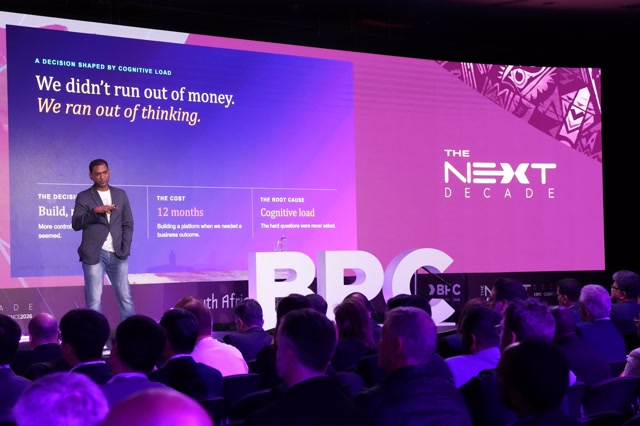
Ruthipaul, Chief Information Officer for Lending Products at Standard Bank, delivered the presentation titled “Cognitive Debt: The hidden constraint on the next decade of innovation” at the BPC Client Conference at The Westin hotel in Cape Town.
Speaking to business and technology leaders, he argued that the greatest obstacle to innovation may not be a shortage of advanced technology, computing power or technical expertise, but the ability of decision makers to think clearly while managing competing demands.
He pointed to differing predictions among technology experts about the future of artificial intelligence (AI), with some anticipating that machines could surpass human intelligence in the near future, while others question whether current approaches will ever achieve human level AI.
For Ruthipaul, these conflicting forecasts illustrate why business leaders should be cautious about making sweeping predictions and focus instead on the decisions that determine how technology is adopted and used.
“The real question is whether leaders, like us in the room, can we keep a clear head while we do this?” he asked.
He said businesses were operating in an environment where leaders faced numerous competing priorities, from modernisation programmes and growth strategies to budgets, operational demands and shareholder expectations.
Although organisations frequently develop ambitious strategies, he observed that many struggle to make deliberate choices about what to pursue and how to execute those plans.

Ruthipaul said the pressure to deliver results often leaves leaders with insufficient time to examine the long term consequences of their decisions, even when those decisions could shape their organisations for years.
He referred to a Microsoft study that found people were interrupted approximately 275 times a day by meetings, emails and messaging platforms, including WhatsApp and WeChat.
Such interruptions, he said, leave leaders making decisions in short intervals, sometimes within two minutes, rather than setting aside sufficient time to assess the available options.
These rushed decisions can have consequences far beyond the immediate problem being addressed, particularly when they concern major technology investments, organisational structures and business priorities.
Ruthipaul also drew attention to research indicating that employees often feel they lack the time and energy needed to perform their jobs effectively. He said the problem was particularly concerning when experienced by leaders responsible for making decisions that affect entire organisations.
He cautioned that burnout should not be viewed solely as an employee welfare issue, arguing that the mental exhaustion experienced by decision makers can influence the quality of strategic choices.
“Leaders don’t make decisions because they are incapable. They make decisions, right? They are comfortable because they are lost. Right? And the simple answer feels like relief,” he said.
To illustrate the consequences, Ruthipaul recounted an experience involving a project to modernise a system, where the organisation had to choose between developing its own solution and purchasing an existing product.
The team initially favoured building its own system, believing it had the necessary skills and personnel to complete the work.
However, competing priorities, budget pressures and the need to keep existing systems operational prevented the team from giving the decision the attention it required.
“We’ve got the people. We’ve got the skill.”
That confidence, combined with pressure to move forward, contributed to a decision that ultimately proved unsuccessful.
Ruthipaul said the team underestimated the engineering work involved and the complexity of integrating different systems. A more thorough assessment of available market solutions and the resources required could have produced a different outcome.
He explained that the failure was not caused by a lack of funding, but by the number of responsibilities competing for the same limited pool of time and attention.
The experience, he said, demonstrated how pressure can push leaders towards familiar or convenient choices instead of decisions that best serve their organisations.
When such choices accumulate, they create what he described as cognitive debt, a burden that can affect both individual performance and organisational effectiveness.
The concept draws a parallel with technical debt, which occurs when technology teams make short term compromises that create additional work, costs or operational difficulties later.
Ruthipaul noted that businesses had spent more than two decades learning to identify and manage technical debt, but were less equipped to recognise the human and organisational consequences of repeated decisions made under pressure.
Unlike an isolated instance of fatigue, cognitive debt can build over time as leaders continue approving projects, maintaining underperforming programmes and introducing new initiatives without sufficient capacity to evaluate their value.
He said some projects and pilot programmes continued for years not necessarily because they were delivering meaningful results, but because nobody had the time or mental energy to question whether they should continue.
Such initiatives consume financial resources while also diverting attention from other priorities, placing additional demands on already stretched teams.
Drawing on his experience in South Africa’s banking sector, Ruthipaul compared organisational management with the operation of large computer systems.
Technology infrastructure is not normally expected to operate at full capacity all the time because it needs sufficient room for monitoring, maintenance and unexpected demands.
He questioned why organisations did not apply the same principle to their employees and leadership teams.
“If you think about the mainframe, you never run it at 100%. You kind of never run any system at 100%. You need the headroom, you need the monitoring, we need the demand management, we need the workspace management. So, when we do this for our systems, why do we do this for our teams? Why do we run it at 100%? Why do we run our leaders at 100%?”
The comparison raised questions about whether companies were creating conditions that allowed their most experienced employees to think, learn and make sound decisions, particularly during periods of rapid technological change.
Ruthipaul cited figures suggesting that while 86% of executives recognised the need to modernise their organisations, only 18% felt adequately equipped to carry out the task.
He also referred to a 2026 projection that more than 70% of mainframe exit projects could fail, arguing that such outcomes should not automatically be interpreted as evidence of technological shortcomings.
Instead, he suggested that insufficient planning, limited organisational capacity and rushed decision making could be significant contributors to failure.
“I read this as decision failure. Not technology failure,” he said.
The challenge becomes more complicated as companies introduce AI and other digital tools to improve productivity.
Ruthipaul acknowledged that employees can experience tangible benefits from AI, but warned that productivity gains do not necessarily translate into lower workloads.
He referred to studies suggesting that AI adoption can increase the number of tasks assigned to employees, creating a situation in which people complete more work while facing a greater risk of exhaustion.
In his view, this means technology decisions cannot be treated exclusively as questions of architecture, procurement or operational efficiency. They must also account for the people expected to use the systems and absorb the changes they bring.
He described another organisational experience in which a business attempted to modernise its operations while pursuing growth with the same employees.
Although the initiative began with research and planning, leaders assumed their existing workforce could accommodate both objectives without additional capacity.
Over time, the organisation increasingly relied on its strongest performers because they could deliver work quickly and to the expected standard.
Ruthipaul said this approach created a risk of overloading the very people on whom the organisation depended most.
He argued that businesses often subject technology investments to rigorous assessment while failing to apply equivalent scrutiny to decisions about staffing, workloads and the allocation of talent.
“We need to use the same rigor for our people because they are absolutely the success for basically anything that we want to do,” he said.
His recommendation was for leaders to create room for proper thinking before introducing additional responsibilities or launching new initiatives.
“A technology decision can wait for a quarter, people’s decisions can’t. They not be there.”
Ruthipaul also proposed three questions leaders should ask before agreeing to new work: Does it reduce the workload or add to it? Does it help people think better or encourage them to think less? Does it allow people to continue learning?
He warned that automating work without considering its implications for skills development could create a longer term talent shortage.
As organisations adopt AI to handle tasks previously performed by experienced employees, opportunities for younger workers to learn through practical experience could diminish.
His concern was that businesses might improve immediate productivity while weakening the development of the expertise they would need in the future.
“In 2036, we’re not going to have a technology problem. We’re going to have a talent problem,” he said.
Ruthipaul said cognitive debt was not an unavoidable consequence of technological progress. Like technical debt, it could be addressed if organisations recognised the problem, developed ways to measure it and treated it as a strategic concern.
He challenged leaders to remove at least one responsibility from their workloads before accepting another and to protect time for uninterrupted thinking.
“Before you take out something new, protect one hour of real thinking. Okay? Just protect it.”
He also urged decision makers to question their motivations when choosing a course of action, asking whether they were selecting an option because it was right for the organisation or simply because it offered the quickest relief from immediate pressure.


















Leave a comment