


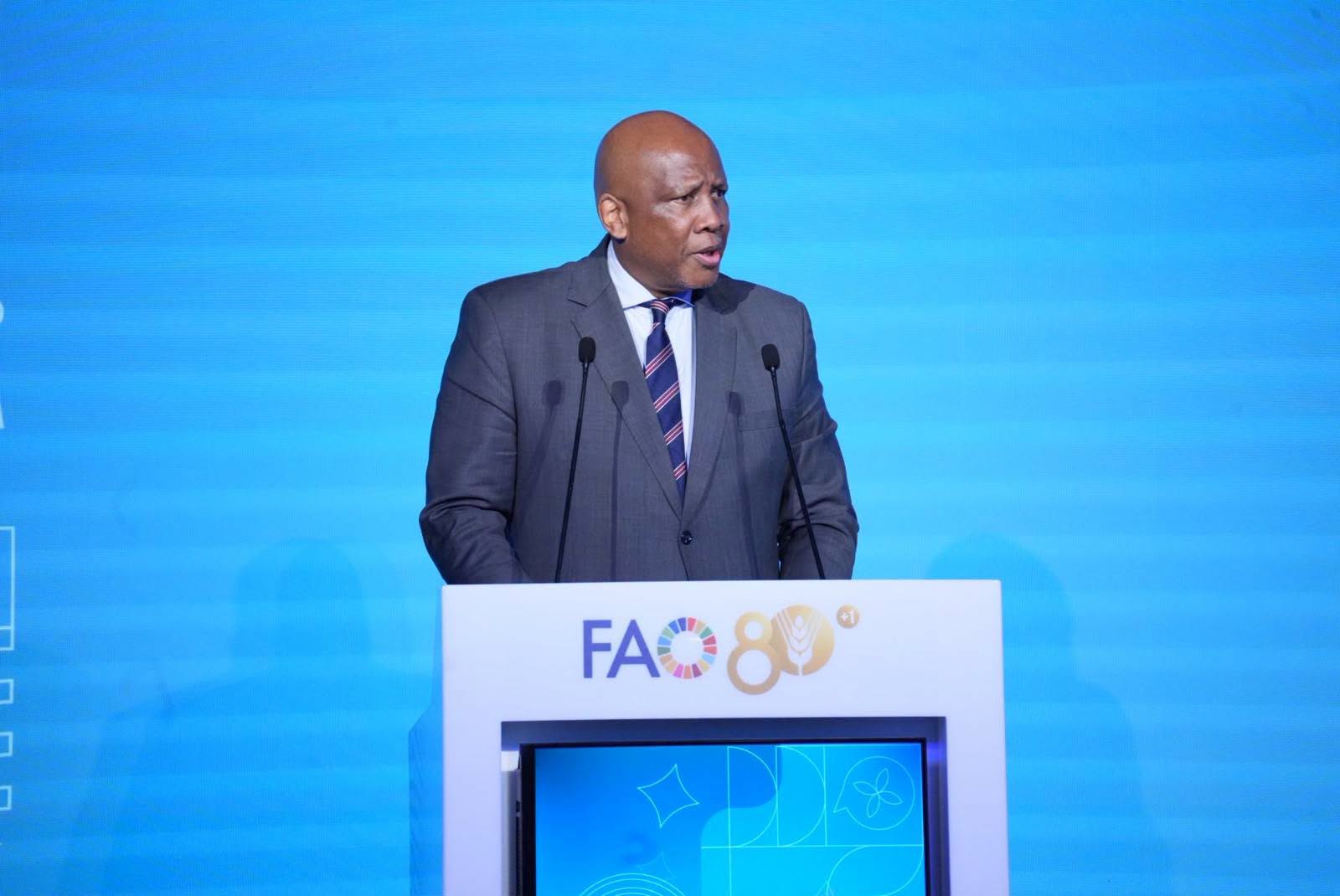
ROME, Italy: Lesotho’s King Letsie III has warned that Southern Africa faces renewed food security challenges as the region prepares for the effects of El Niño, calling for greater investment in agriculture, climate resilience and innovation to protect vulnerable communities.
The King delivered the warning on Tuesday, 13 October 2026, while addressing the opening of the sixth World Food Forum (WFF) at the Food and Agriculture Organization (FAO) headquarters in Rome, Italy.
Speaking in his capacity as FAO Special Ambassador for Nutrition, King Letsie III said decisions taken today would determine whether future generations inherit food systems capable of providing sufficient, safe, diverse and nutritious food while protecting the environment.
The forum, running from 13 to 17 October under the theme Fostering Innovation for Food Security and Nutrition, brings together stakeholders to examine ways of strengthening global food systems amid mounting climate, economic and geopolitical pressures.
King Letsie III said Lesotho was particularly vulnerable to climate shocks because much of its agriculture depends on rainfall, while the country also relies on imported agricultural inputs and services.
He warned that the anticipated El Niño conditions could weaken food security at both national and household levels, slow progress towards greater self-sufficiency and expose farmers to increasingly unpredictable weather.
“This is not only Lesotho. The whole of the Southern African region will experience El Niño,” the King said.
He recalled that previous El Niño episodes had exposed weaknesses across the region’s agricultural and food supply systems, bringing droughts, floods, extreme heat, water shortages, reduced electricity generation and disruptions to food markets.
The King said the combination of climate-related shocks, geopolitical tensions, trade disruptions, economic uncertainty and limited development resources had made the global food security situation increasingly complicated since the previous forum.
He called for a broader understanding of innovation, arguing that technological advances alone would not resolve the challenges confronting farmers and food producers.
“Innovation however, extends beyond technologies, it includes application of traditional knowledge, the adaptation of farming practices to local conditions, effective policies, accessible finance and stronger connection between farmers and market,” His Majesty said.
He cautioned that scientific and technological progress needed to be guided by shared responsibility, with new approaches designed to benefit communities rather than undermine established knowledge and practices.
The King said innovation in Africa should produce practical improvements in agricultural productivity and environmental sustainability. These include more efficient use of land and water, restoring degraded landscapes, improving soil health, reducing food losses and maintaining production despite increasingly unpredictable climatic conditions.
He also called for stronger support for young people seeking opportunities in agriculture and related industries, saying the sector could provide meaningful employment if governments and investors changed how it was perceived, financed and practised.
“Investing in young people must be central. Across Africa millions of young people seek meaningful and dignified economic opportunities and agrifood systems can provide them, but only if agriculture is perceived, financed and practiced differently,” he said.
King Letsie III said young people needed access to practical education and skills development, land, financing, digital connectivity and mentorship. He also called for their meaningful participation in decisions affecting agricultural development and food security.
He urged governments, development partners, research institutions, local authorities, civil society organisations and private sector players to coordinate their policies, programmes and resources around common priorities.
He said such cooperation should be supported by measurable targets and accountability, with the aim of increasing productivity, strengthening resilience, creating decent livelihoods and improving food and nutrition security.
The address also drew attention to Lesotho’s experience in agriculture, nutrition and efforts to combat hunger, placing the country’s challenges within the wider struggle to build resilient food systems across Africa.
FAO Director-General Dr Qu Dongyu, addressing the opening, said the organisation’s founding mission to free humanity from hunger remained urgent eight decades after its establishment.
“Eighty years later, that mission is more urgent than ever. Conflict, climate change, and economic shocks continue to drive food insecurity and malnutrition around the world,” Dr. Qu said.
He said global agrifood systems were facing several overlapping crises, including armed conflict, extreme weather, economic shocks and rising inequality, while millions of people continued to experience hunger and malnutrition.
Dr Qu said the 2026 World Food Forum was built around three central pillars: youth, science and innovation, and investment.
“The future of food is in the hands of youth. Last week’s exhibition showed thousands of young leaders breaking barriers – not as spectators, but as participants. You are drivers of change,” he said.
The FAO chief also drew attention to this year’s campaign, Zero Waste, Full Taste: Innovate Today, Nourish Tomorrow, which seeks to address the enormous quantities of food lost or wasted worldwide.
According to Dr Qu, approximately one-third of all food produced globally is lost or wasted, making it necessary to develop approaches that convert waste into value and ensure more food reaches consumers.
“We must transform this waste into value.”
The World Food Forum is being held alongside the second Global Exhibition, From Seeds to Foods, at Circo Massimo in Rome. The exhibition features 300 exhibitors from 140 countries, providing a platform for showcasing agricultural innovations, food products and approaches to improving food systems.














Leave a comment