


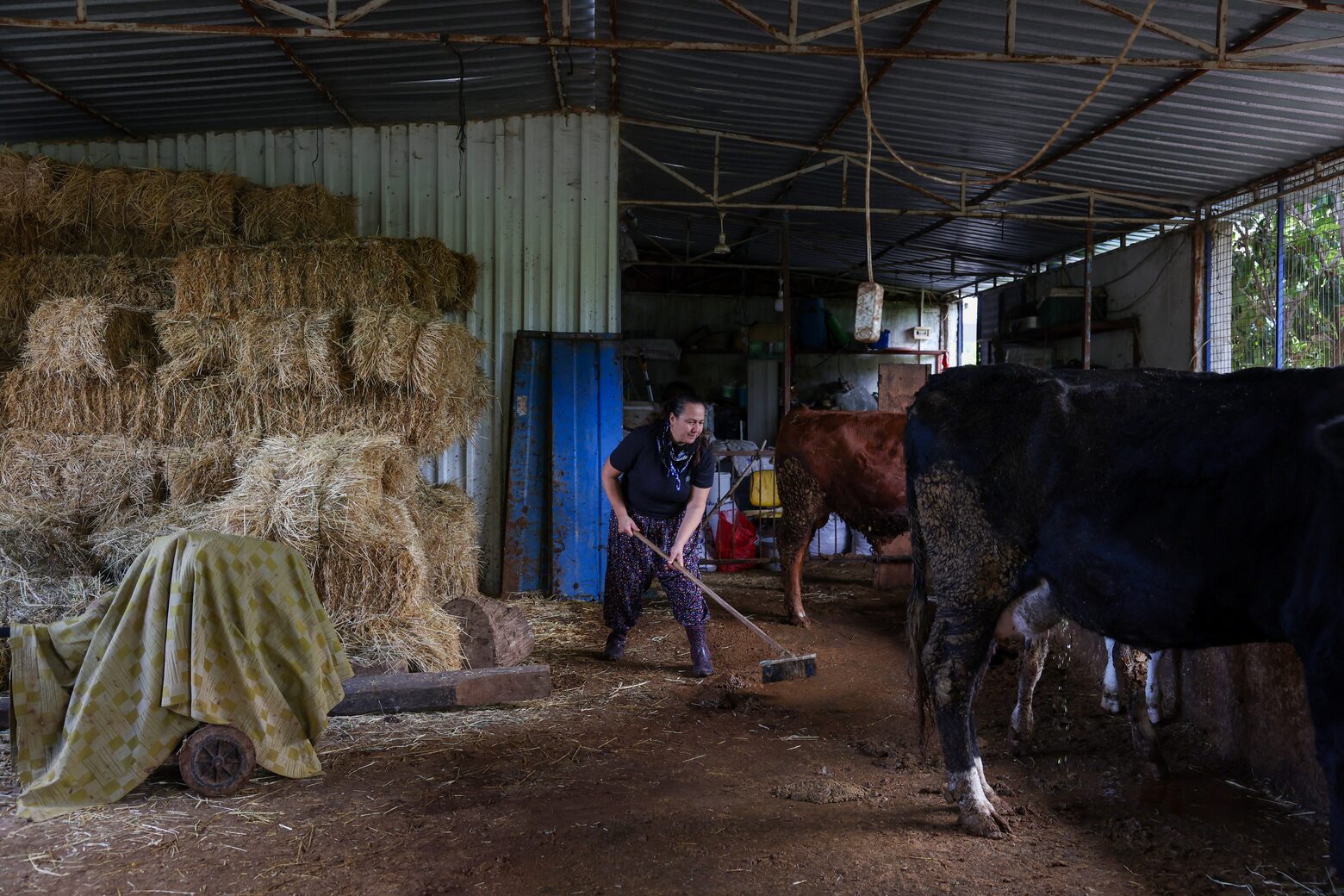
IKIZKOY, Turkey, November 8, 2026 – Residents of a village in southwestern Turkey living alongside an expanding coal mine are calling on world leaders attending the upcoming United Nations climate conference, COP31, to visit their community and witness the environmental destruction they say decades of coal extraction have caused.
Nejla Isik, an elected community representative in Ikizkoy, near the Akbelen forest in Mugla province, wants government leaders and United Nations officials to travel beyond the conference venue in Antalya and see the consequences of coal mining for themselves.
The COP31 climate conference, which begins on Monday and runs until November 20 in the Mediterranean coastal city of Antalya, will feature discussions on transitioning towards cleaner energy, among other major climate issues.
However, for residents of Ikizkoy, the debate over energy transition is not simply about international commitments. They say the effects of continued dependence on coal are already visible in their homes, forests, agricultural land and livelihoods.
“They should come here, those heads of state. They should come not to Antalya but to Akbelen, to Ikizkoy,” Isik said.
Her home stands only a few hundred metres from a lignite mine that has gradually moved closer to the village as mining operations have expanded over several decades.
Lignite is the lowest grade of coal and produces higher carbon dioxide emissions when burned compared with more energy-dense varieties of coal.
Coal dependence raises questions over energy transition
One of Turkey’s major objectives at COP31 is to secure a voluntary commitment to increase electrification, an initiative proposed by the host country.
However, environmental concerns remain over whether expanding electricity access will deliver meaningful climate benefits if the additional power continues to come from fossil fuels.
According to energy think tank Ember, coal accounted for 34 per cent of Turkey’s electricity generation last year, making the country Europe’s largest coal-fired electricity producer.
The mines around Akbelen supply coal to power stations responsible for slightly more than two per cent of Turkey’s electricity generation, according to information published on the operator’s website.
Environmental activists and residents opposing the expansion of lignite mining say the operations have already destroyed significant areas of forest while placing olive groves, agricultural land and surrounding communities at risk.
For years, villagers have organised demonstrations against mining activities, with several protesters facing arrests, detention and financial penalties.
The dispute has also affected members of Isik’s family. Her 26-year-old daughter, Esra Isik, spent 42 days in pretrial detention following protests against plans to expropriate land for mining activities.
A court sentenced Esra to two years in prison in July for resisting public officials. She remains free while awaiting the outcome of her appeal.
“This punishment was not just handed to me. It was an attempt to punish everyone in this country who stands up for their rights, their land and their village,” Esra Isik said.
Her mother has also spent years campaigning against the expansion of coal mining in the area.
“For 40 years we’ve been living with coal breathing down our necks. I try to live here with the breath of coal, with the dirt of coal,” Nejla Isik said.
The coal extracted from the area supplies the nearby Yenikoy and Kemerkoy power stations, which are operated by Yenikoy-Kemerkoy Energy, a joint venture involving Turkish companies Limak and IC Ictas.
Limak declined to comment on the matter, while IC Ictas did not respond to a request for comment.
Turkey considers nuclear power alternative
Turkey’s Energy Minister Alparslan Bayraktar addressed the country’s energy transition during a meeting with foreign media on Thursday, saying Ankara was working towards a just transition to cleaner energy.
However, he acknowledged that moving away from coal presented significant challenges because the mining industry provides employment for thousands of people.
Bayraktar identified nuclear energy as the most viable alternative and said Turkey was targeting 10 gigawatts of nuclear electricity generation capacity by 2040.
According to Reuters calculations, that capacity would be roughly equivalent to Turkey’s current coal-fired electricity production.
The country’s energy strategy therefore faces the challenge of balancing electricity demand, employment and economic considerations with international climate commitments.
For communities around Akbelen, however, the immediate concern remains the continued expansion of mining operations and the consequences for their land.
Rights groups question treatment of protesters
The conflict has also drawn attention to broader concerns about restrictions on demonstrations and the treatment of environmental activists in Turkey.
Human Rights Watch, in an October report, accused Turkish authorities of arbitrarily arresting and prosecuting environmental protesters in Akbelen and other parts of the country.
The organisation said security forces had forcibly dispersed peaceful demonstrations, while protesters, lawyers and journalists faced criminal charges, including illegal assembly, obstructing public officials, trespassing and spreading false information.
Deniz Bayram, assistant Europe and Central Asia researcher at Human Rights Watch, said the situation raised questions about the country’s treatment of environmental campaigners ahead of its role as host of the global climate conference.
“With Turkey about to host the annual UN climate change summit, its environmental crackdown is a salient reminder of its intolerance of dissent,” Bayram said.
The Turkish government maintains that police intervene when demonstrations are unlawful or pose a threat to public order.
The country’s interior and justice ministries did not respond to requests for comment.
Tensions around Akbelen intensified in 2023 when tree-felling activities resumed, triggering renewed protests by villagers determined to prevent further destruction of the forest.
Residents alleged that security forces deployed water cannon and pepper spray against demonstrators attempting to enter the forest, followed by arrests and other penalties.
“We were subjected to water cannon, pepper gas, detention, everything,” Nejla Isik said. “Afterwards, because we didn’t abandon this area, this village, there were fines, and a year later cases were opened against us.”
Another resident, Hasan Yorulmaz, described how demonstrators attempted to prevent pine trees from being cut down before soldiers blocked their route.
He said security personnel used pepper spray against protesters regardless of their age or gender.
“They used pepper spray on women and men, young and old,” he said. “Despite that, we continued the resistance. I was at the front and they took me away and detained me.”















Leave a comment