


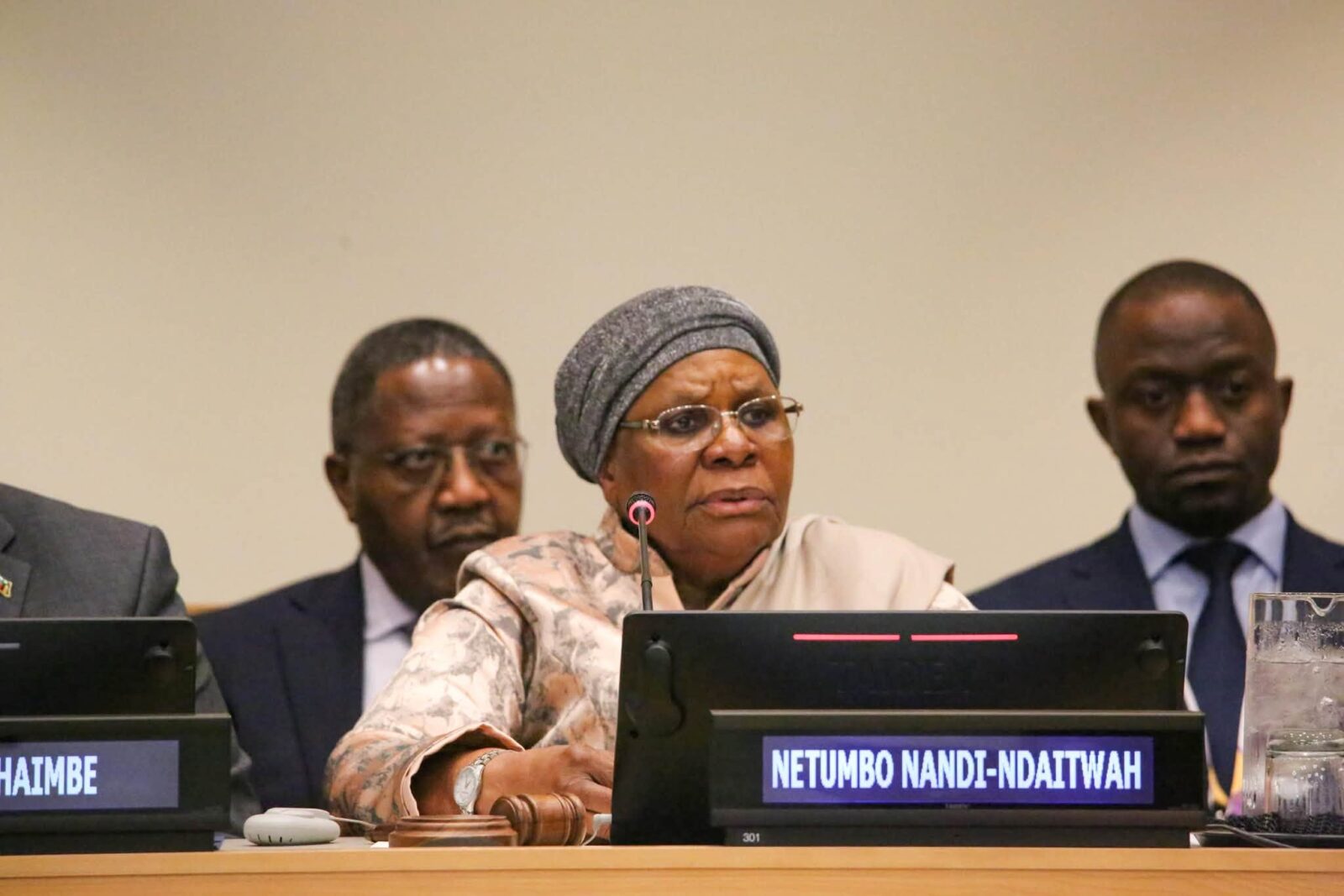
New York – Namibian President Netumbo Nandi Ndaitwah has called for faster implementation of the Pact for the Future as African leaders and international partners reviewed progress on the landmark agreement ahead of its 2028 review.
President Nandi Ndaitwah co facilitated a High Level Side Event at United Nations Headquarters in New York on Tuesday, held on the margins of the 81st Session of the United Nations General Assembly.
The dialogue was co hosted by Namibia and Zambia together with the United Nations and the African Union. It brought together African leaders, senior United Nations officials, ministers, youth representatives and members of civil society to assess Africa’s progress since the Pact was adopted in 2024.
Namibia played a central role in the negotiations that produced the agreement, having co facilitated the intergovernmental process that led United Nations Member States to adopt the Pact for the Future.
The agreement contains 56 actions covering areas including international cooperation, sustainable development, peace and security, digital transformation, development financing, as well as the interests of young people and future generations.
During the New York meeting, the African Union outlined progress recorded across the continent during the past two years.
Among the gains cited was the provision of electricity access to an additional 50 million Africans. Progress was also reported on climate commitments, monitoring mechanisms linked to the Global Digital Compact and efforts towards establishing a United Nations Framework Convention on International Tax Cooperation.
Despite these developments, African countries continue to face major challenges linked to development financing, high borrowing costs and debt servicing.
Poverty, hunger, inequality and limited access to basic services were also identified as continuing obstacles to achieving the development goals contained in the Pact.
President Nandi Ndaitwah said the Pact provides an agreed framework for strengthening multilateral cooperation and working towards a global system that is fairer, more representative and more effective.
She said Africa should play a greater role in shaping international decisions rather than simply participating in processes determined elsewhere.
The President also called for stronger African representation at the United Nations Security Council as part of efforts to reform global governance structures.
She called for changes to the international financial architecture, increased development financing, technology transfer and stronger international tax cooperation.
The Namibian leader also backed collective measures to tackle illicit financial flows, which continue to affect the resources available to African countries for development.
At home, President Nandi Ndaitwah pointed to Namibia’s National Digital Strategy 2025 to 2028, free tertiary education and the National Youth Fund as initiatives designed to give young Namibians greater access to skills, opportunities and resources.
She said young people should be treated as partners in determining the future rather than simply as beneficiaries of development programmes.
The President urged United Nations Member States to “bring the Pact home”, saying its success would ultimately be measured by whether international commitments produce tangible improvements within individual countries.
She also linked implementation of the Pact to efforts to accelerate progress towards the Sustainable Development Goals ahead of the 2027 SDG Summit.
Looking towards the 2028 review, Nandi Ndaitwah called for renewed efforts to implement the Sustainable Development Goals and strengthen North South, South South and Triangular Cooperation.
She said stronger international partnerships would be important as countries begin discussions on the development agenda beyond 2030.
“The Pact for the Future gives us additional tools with which we can further achieve our noble aspirations.”
The New York dialogue placed greater focus on translating international commitments into national programmes, stronger partnerships and measurable development outcomes, while giving African countries a greater role in determining how the multilateral system responds to the priorities of their populations.






Leave a comment