


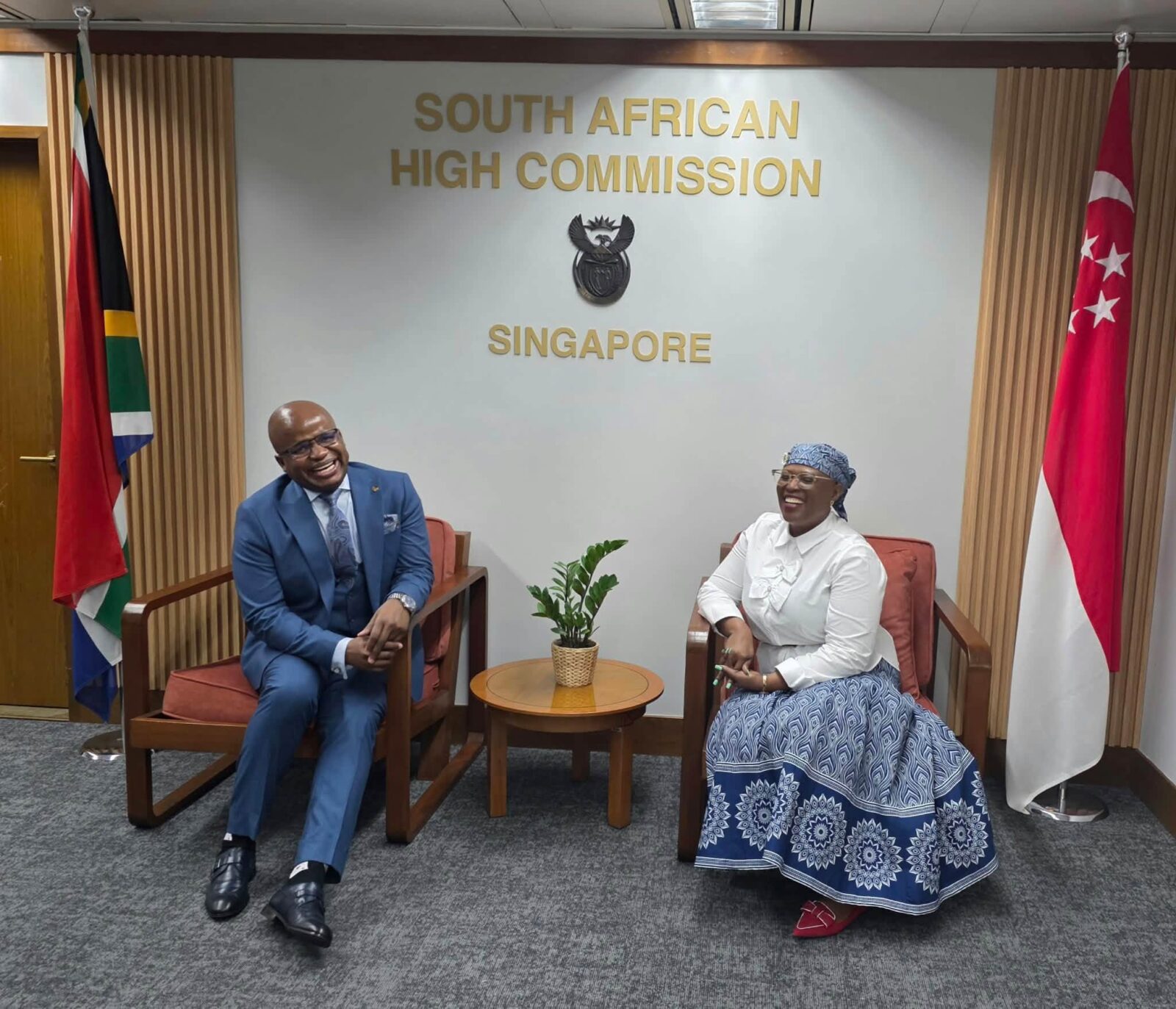
South Africa is seeking to expand its commercial footprint in Southeast Asia, with Singapore emerging as a potential base for businesses looking to access new markets, diversify operations and strengthen international partnerships.
The South African High Commission in Singapore recently hosted Mabu Mamadi, Chairman of Mamadi International, for a courtesy visit followed by a business engagement with the South African Chamber of Commerce Singapore.
The discussions focused on opportunities for Mamadi International to expand into Singapore, with the company considering the city state as a possible headquarters for its Asian operations.
The engagement explored Singapore’s business environment, its position as a major international commercial hub and its potential to support South African companies seeking to expand beyond traditional markets.
Economic diplomacy featured prominently in the discussions, particularly its role in connecting businesses across borders, facilitating private sector cooperation and translating commercial interest into tangible trade and investment opportunities.
The engagement comes amid growing uncertainty in global trade, with businesses navigating shifting supply chains, geopolitical tensions and changing conditions for accessing international markets. Diversifying into new territories has consequently become an important consideration for companies seeking to remain competitive and build resilience against economic disruptions.
Singapore offers several advantages for South African businesses, including a business friendly regulatory environment, efficient customs procedures, advanced logistics infrastructure and extensive maritime and air connections. Its established financial and professional services sectors also provide access to international investors, commercial networks and global markets.
Beyond its domestic economy, Singapore serves as a regional centre for businesses seeking opportunities across the Association of Southeast Asian Nations (ASEAN). The bloc includes Indonesia, Malaysia, Viet Nam, Thailand and the Philippines, among other markets.
The region’s changing economic priorities are creating opportunities in infrastructure development, manufacturing, energy, technology and sustainable development, sectors that could offer new avenues for South African companies seeking to expand their operations internationally.
During the engagement, Mamadi outlined his company’s business model, technical expertise and areas of operation, which cover engineering and infrastructure development, water and sanitation, energy and power, transportation, environmental sustainability, technology and innovation, as well as project management and consulting.
Discussions also considered possible partnerships with Singapore based businesses, regional partners and project developers, with the objective of identifying commercial opportunities that could benefit the participating parties.
For South African companies, the strategy involves more than finding new destinations for exports. Establishing a presence in international markets requires careful positioning, the development of competitive advantages and partnerships capable of supporting long term commercial growth.
Singapore is therefore being considered not only as a destination for South African goods and services, but also as a strategic base from which businesses can explore opportunities throughout Southeast Asia and other international markets.
The South African High Commission in Singapore said it remained committed to advancing the country’s economic diplomacy agenda by facilitating business to business connections, supporting companies exploring new markets and strengthening trade and investment relations between South Africa, Singapore and the wider ASEAN region.
The mission outlined several priorities for South African businesses seeking international expansion, including repositioning their operations to take advantage of emerging markets, broadening their commercial reach beyond established trading partners and developing strategic relationships with Singapore based companies.
Businesses were also encouraged to use Singapore’s international connectivity and regional networks to explore opportunities across ASEAN and beyond.













Leave a comment