


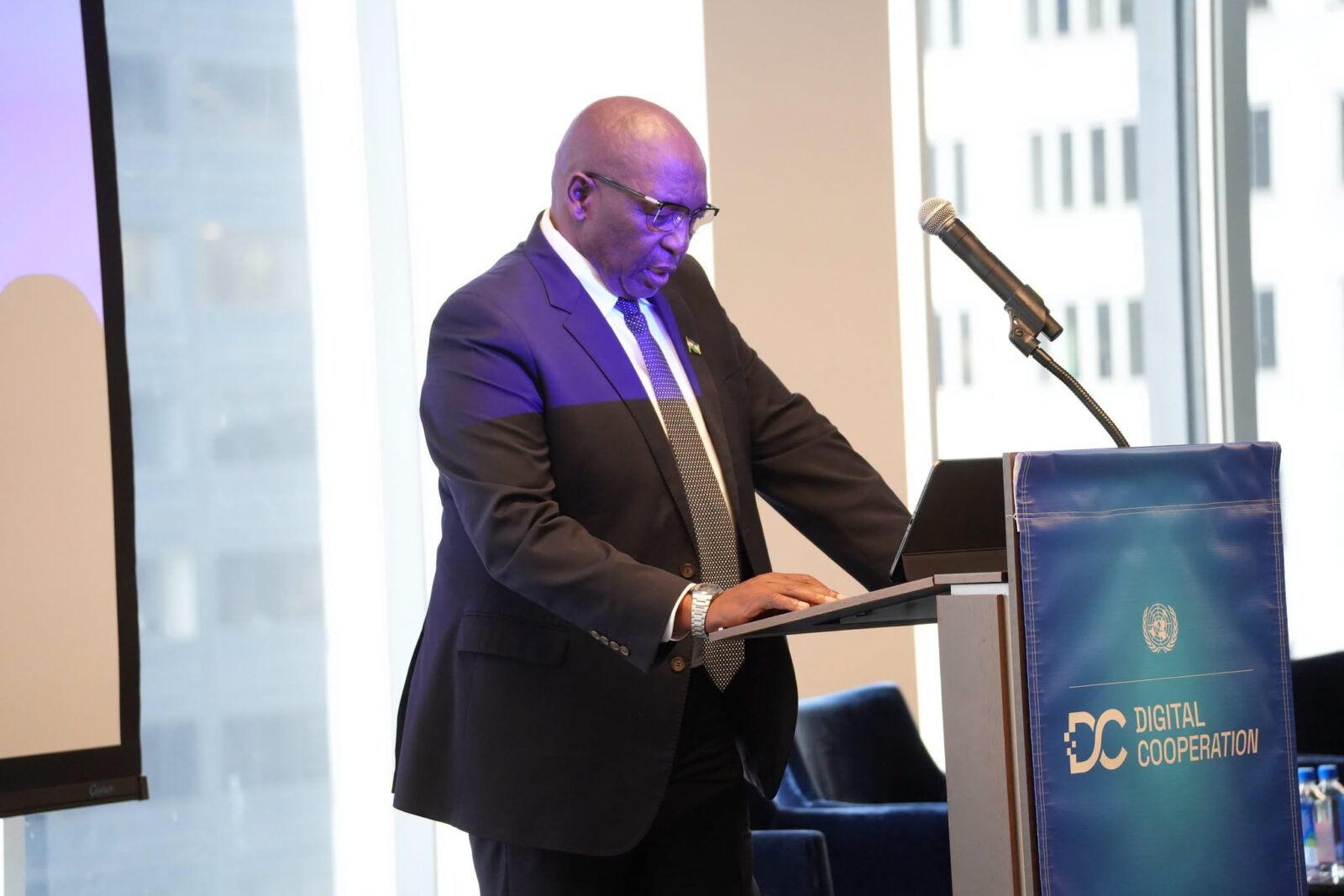
NEW YORK, United States: Lesotho has moved from planning to implementation of its national artificial intelligence agenda, with Prime Minister Samuel Ntsokoane Matekane announcing that the country is advancing the first phase of its National Compute Roadmap for 2026 to 2029.
Matekane made the announcement while opening the substantive session of the second United Nations Digital Cooperation Day in New York, where he presented Lesotho’s experience as the first country to apply the United Nations Blueprint for National AI Strategies.
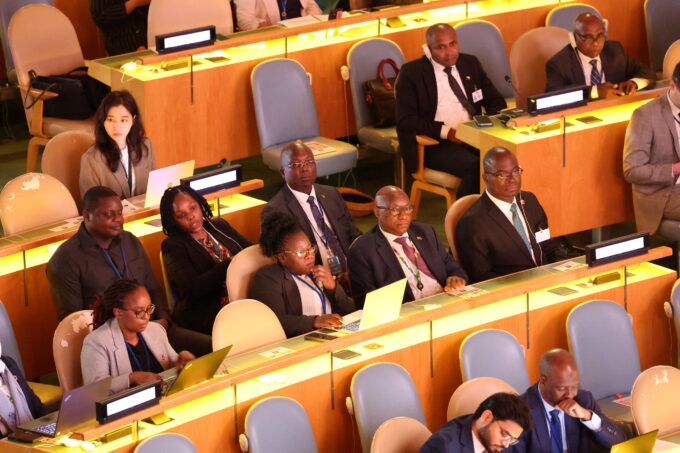
The session, titled “Introducing the AI Strategy Blueprint: Turning National Ambition into Action,” examined how countries can translate national AI ambitions into practical programmes and investments.
Matekane said Lesotho welcomed the rapid development of artificial intelligence and was seeking to use the technology to support sustainable development rather than approach it with fear.
He said AI alone would not guarantee development, arguing that infrastructure, institutions, skills, governance and investment would determine whether the technology expands opportunities or worsens existing inequalities.
“Yet technology alone does not create development. Infrastructure, institutions, skills, governance and investment determine whether AI expands opportunity or deepens existing inequalities,” Matekane said.
He outlined three key lessons from Lesotho’s experience with the UN blueprint.
The first was the importance of conducting an honest assessment of the country’s readiness to govern and benefit from AI.
The second was the practical value of the blueprint, which Matekane said validated decisions Lesotho had already begun making while providing a framework for organising further action.
The third was the country’s transition from strategy development to implementation.
Working with the United Nations Office for Digital and Emerging Technologies, the Office of the UN Resident Coordinator and other UN agencies, Lesotho is now advancing the first phase of its National Compute Roadmap.
Matekane said the government, led by the Ministry of Information, Communications, Science, Technology and Innovation, had spent the past year assessing the country’s preparedness for artificial intelligence.
The assessment identified several areas requiring greater national capacity, including digital infrastructure, computing capacity, data governance, institutional arrangements, skills development and sustainable financing.
The findings were reinforced by Lesotho’s participation in the first United Nations Global Dialogue on AI Governance in Geneva.
According to Matekane, discussions during the dialogue showed that the global AI divide is increasingly determined not only by access to technology, but also by whether countries have the computing resources, data, skills and institutions required to govern and benefit from artificial intelligence.
Lesotho has responded by using its readiness assessment, the AI Strategy Blueprint and the Data Centre Blueprint to translate international discussions into national programmes.
Matekane said the objective was to position Lesotho as an active participant in determining how AI affects development rather than simply becoming a consumer of technologies developed elsewhere.
He said the country had not started from scratch.
Lesotho already had three validated digital policies, an operational government data centre and a designated Chief Digital Office. The government had also identified investment requirements in infrastructure, computing capacity, data governance, skills, institutional capability and financing.
“Like many countries, we have a data centre. But possessing a data centre is not the same as being prepared for AI,” Matekane said.
He said the blueprint helped the government address how Lesotho could build the infrastructure needed to support its AI ambitions while dealing with constraints involving energy, water, financing, human resources and geography.
Its purpose, he said, was not to replace existing plans but to strengthen and organise them.
The government began by reviewing policies already in place before identifying public services that would have the greatest impact on citizens. Infrastructure requirements could then be determined according to those priorities.
Matekane said digital investment would have to produce practical improvements in sectors such as agriculture, healthcare, education, water management and public administration.
“Every investment in digital infrastructure must be justified by tangible improvements in people’s lives, whether in agriculture, health, education, water management or public administration,” he said.
He said Lesotho was not seeking to reproduce the digital infrastructure models of larger economies, but wanted to develop systems suited to its own resources, priorities and development requirements.
“For Lesotho, digital infrastructure must never become a monument to technological ambition. It must become a foundation for national capability,” Matekane said.
From strategy to implementation
Matekane said the effectiveness of Lesotho’s AI strategy would ultimately depend on implementation.
With support from the UN Resident Coordinator’s Office, the United Nations Office for Digital and Emerging Technologies, the Global AI Capacity Development Network, UNDP, UNICEF, UNESCO and the International Telecommunication Union, Lesotho recently completed a five day working session in Maseru.
The prime minister said the exercise was designed to produce practical outcomes rather than serve as a conventional conference.
The process resulted in a roadmap containing five concrete actions, with responsible institutions and timelines assigned to each.
The Minister responsible for digital affairs was expected to provide further details during a panel discussion at the UN event.
Matekane said the country’s ambitions extended beyond physical infrastructure.
Lesotho is seeking to develop the wider national capabilities needed to govern data responsibly, deploy AI safely, improve public services and create opportunities for innovation and economic growth.
He also pointed to international cooperation as an important resource for developing countries seeking to build digital capacity.
According to Matekane, development assistance can sometimes be fragmented because international partners operate through separate programmes with different priorities and timelines.
He said the Lesotho initiative differed because several parts of the UN system worked together around priorities identified by the Lesotho government.
Through coordination by the UN Resident Coordinator, expertise from different UN agencies was brought together around the country’s identified needs.
Matekane said the blueprint therefore served not only as a technology planning tool, but also as a mechanism for coordinating governments and development partners around common priorities.
“This may be one of the most valuable lessons from our experience. The Blueprint is not only a tool for technology planning. It is also a tool for coordination, enabling governments and partners to work from the same picture and move toward the same objectives. It truly puts Government in the driving seat,” he said.
The prime minister thanked the United Nations Office for Digital and Emerging Technologies for selecting Lesotho as the first country to apply the blueprint and for supporting the process.
He also acknowledged the Executive Office of the UN Secretary General, the Office of the UN Resident Coordinator in Lesotho, ITU, UNESCO, UNICEF, UNDP, the Global AI Capacity Development Network, as well as the governments of Ethiopia and Senegal for sharing expertise and practical experiences.
Matekane said the partnerships demonstrated the role international cooperation can play in helping developing countries build the capabilities needed for the AI era.
Lesotho now intends to build on its position as the first country to apply the Blueprint for National AI Strategies by implementing its National Compute Roadmap.
“The design phase is behind us,” Matekane said.
“We are now implementing Phase One of our National Compute Roadmap for 2026-2029 with clear objectives, accountable institutions and a commitment to building lasting national capability.”
He said international partnerships would remain important but would not replace national ownership of Lesotho’s digital development.
“Partnership is not a substitute for national ownership. For countries like Lesotho, it is one of the ways national ownership is strengthened,” he said.
Matekane invited additional partners to work with Lesotho as the country moves from strategy development into implementation and seeks to build what he described as an inclusive, responsible and development focused digital future.











Leave a comment