


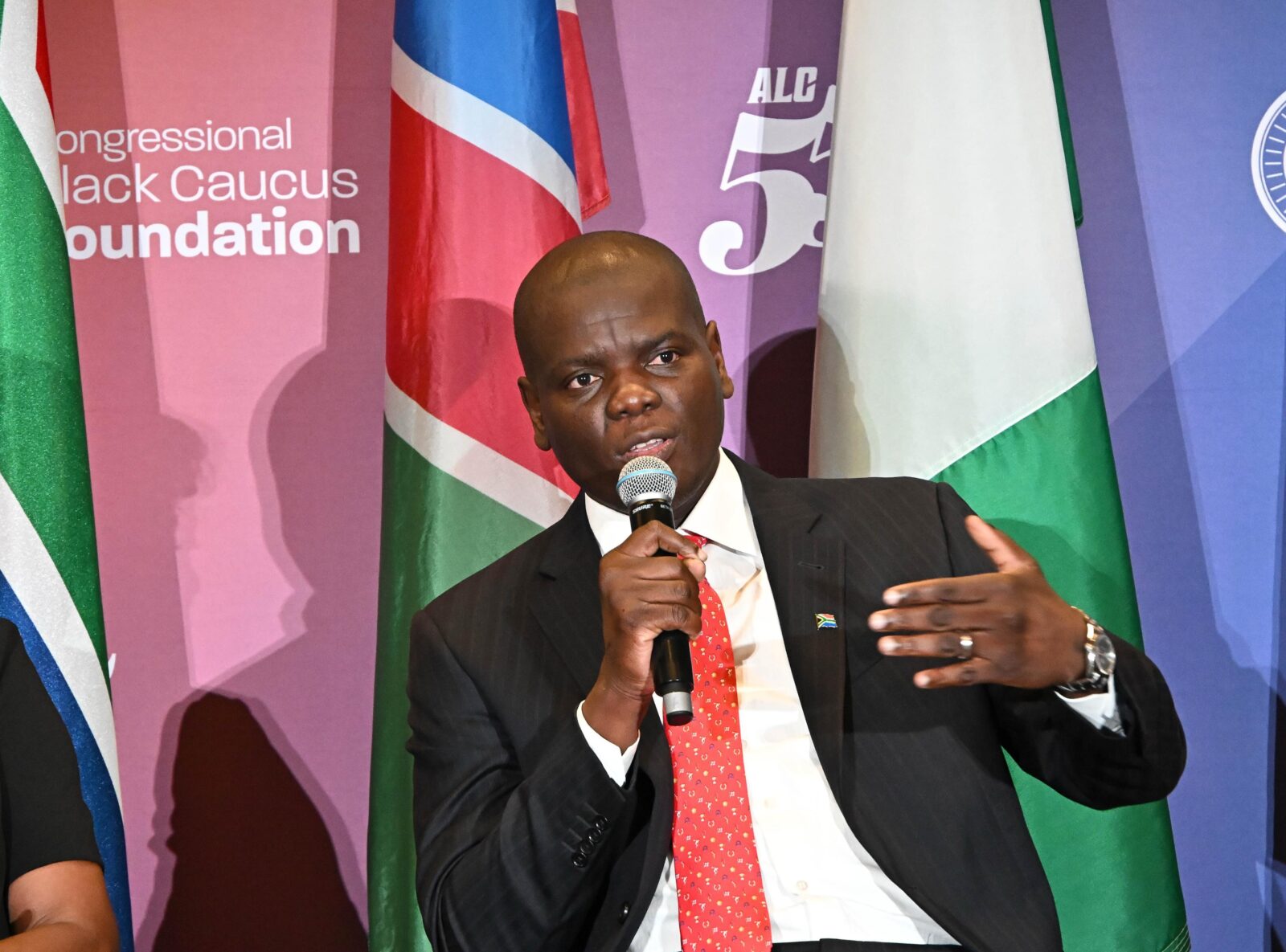
WASHINGTON, United States — South Africa’s Minister of International Relations and Cooperation Ronald Lamola has called for stronger cooperation between African governments and the diaspora, saying Africa must use its resources, skills and human capital to drive industrialisation and economic development.
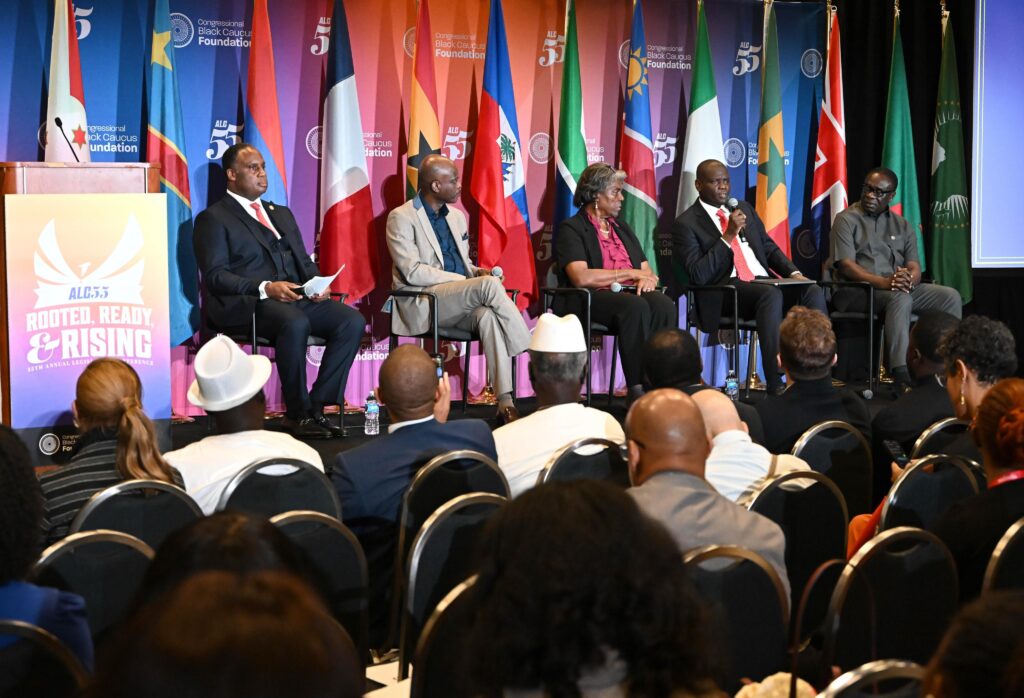
Lamola was speaking during a panel discussion at the African Diaspora Forum hosted by the Congressional Black Caucus Foundation in the United States on Friday, September 18, 2026.
The discussion brought together African government officials, diplomats, members of the African diaspora and US lawmakers to discuss Africa’s position in the global system, reparations, economic diplomacy, migration, trade, critical minerals and relations between Africa and the United States.
Lamola said South Africa supported efforts led by the African Union and Ghana on reparations and backed initiatives aimed at changing perceptions of Africa and strengthening the continent’s position in global affairs.
He also called on Africans in the diaspora to contribute their skills, technology and financial resources to Africa’s development.
“This is a space now for the diaspora, the African diaspora as our part of our own a platform to bring your skills, to bring your financial capabilities, to bring your new technologies to help us industrialize,” Lamola said.
He said Africa needed to create jobs and build industries on the continent instead of continuing to export raw materials for processing elsewhere.
According to Lamola, about 60 per cent of the critical minerals required for the global transition to new technologies and a green economy are found in Africa.
“But what is currently happening in the past all the minerals are extracted and industrialized outside the African continent,” he said.
“We have said through the G20 declaration and again adopted by the African Union that there must be beneficiation at source.”
Lamola said the African diaspora could play a significant role in ensuring that more value was retained within African economies.
He also called for greater African participation in artificial intelligence, saying the continent and the wider Global South should not remain spectators as new technologies are developed.
“The African continent and the global south should not be spectators on issues related to artificial intelligence. We should be on the table on research and development,” he said.
The minister linked Africa’s technological development to the continent’s young population, arguing that the skills and potential of young Africans needed to be matched with employment opportunities.
He said African governments needed to work together to address unemployment, economic growth and the factors contributing to irregular migration.
South Africa defends its democracy
Lamola also addressed criticism of South Africa over claims of attacks against white people and the country’s land reform programme.
He rejected claims that South Africa was experiencing genocide against white people and defended the country’s constitutional democracy.
“The South African government has got a constitutional democracy that allows everyone in whatever diversity to live together free of any retractions of any nature,” Lamola said.
He said South Africa had maintained a system in which black, white and Indian South Africans could live together under a constitutional framework.
Lamola also rejected suggestions that South Africa’s land reform policies amounted to arbitrary action, saying the country had constitutional and judicial processes through which such matters were being handled.
“Our courts are in the government. They allow them to function,” he said.
He said South Africa remained open to American businesses and pointed to companies including Coca Cola, Microsoft, Apple and Amazon as examples of US businesses operating in the country.
Lamola said South Africa wanted to maintain its long-standing relationship with the United States while protecting its constitutional framework and national interests.
“We see value in working with the United States of America because there has been a Nigerian partnership between the South African government and the government of the United States of America for many years. And we want that to continue,” he said.
Migration and attacks on African migrants
The minister was also questioned about reports of violence and intimidation involving African migrants in South Africa.
The question was raised by a participant from Senegal who said Africans from other countries had faced threats and attacks in South Africa.
Lamola said the South African government had condemned vigilantism and was taking legal action against those involved in anti migrant violence.
“To date 354 people have been arrested for activities related to anti-migrant violence. They are going through our court processes,” he said.
He added that 103 cases involving anti migrant violence, intimidation and looting were before the courts, while 43 cases remained under investigation.
Lamola said irregular migration was a challenge for South Africa but argued that enforcement of immigration laws should remain the responsibility of government rather than individuals.
“This is not a state-sponsored activity. It’s individuals who are mobilizing themselves to enforce the South African law,” he said.
He also linked migration pressures to Africa’s employment deficit.
Lamola said about 12 million Africans enter the labour market each year, while African economies create only about three million jobs.
“Where what happens to the other 9 million? Whose responsibility is it? Is it only the South African government? No. It’s for all African governments,” he said.
He called for greater continental cooperation to address unemployment, economic development and the root causes of irregular migration.
Togo pushes for a different view of Africa
The forum also heard from Togo’s Foreign Minister, Professor Robert Dussey, who spoke about an initiative concerning the representation of Africa on world maps.
Dussey said the issue went beyond geography and concerned how Africans viewed themselves and how the continent was perceived internationally.
“We need to change our to put Africa in in the real size, the true size is also to respect African people, to respect people, to respect East for humanity, to respect everyone,” he said.
He said correcting the representation of Africa should also lead to a change in perceptions of the continent.
“It is not only to correct the map, is also to correct to correct our vision, to correct our approach where we are coming from,” Dussey said.
The discussion also focused on Africa’s relations with major global powers.
Dussey said African countries were not seeking to choose between East and West but wanted partnerships that served African interests.
“We’re not facing east. We are We are not facing west. We are facing forward,” he said.
He also said Togo was seeking to use dialogue to strengthen relations between West African countries, including those facing political transitions.
Togo, he said, wanted to serve as a bridge between ECOWAS and countries including Mali, Burkina Faso and Niger.
Ghana pushes reparations agenda
Ghanaian representatives at the forum discussed the country’s campaign for reparatory justice and its role in efforts to secure wider international recognition of the historical consequences of the transatlantic slave trade.
A Ghanaian representative said the United Nations General Assembly adopted a resolution on March 25, 2026, concerning the trafficking of enslaved Africans and racialised chattel enslavement.
The representative said the resolution received 123 votes in favour, three against and 52 abstentions.
Ghana subsequently hosted a high level consultative conference in Accra on June 17 and 19, 2026, bringing together representatives from more than 80 states, intergovernmental organisations, scholars and representatives from Africa, the Caribbean, the Americas and Europe.
The meeting resulted in the Accra Next Steps Commitment to Reparatory Justice, according to the representative.
Ghana also presented the reparations campaign as a broader effort involving Africans and people of African descent around the world.
The representative said Ghana intended to continue working through the African Union and international partnerships to advance the agenda.
Diaspora seeks easier access to Africa
Participants also raised concerns about the difficulties faced by members of the African diaspora seeking to return to the continent for business, investment and skills transfer.
One participant said visa restrictions, uncertainty over investments and difficulties moving between African countries continued to discourage diaspora engagement.
A Ghanaian representative said Ghana was working towards expanded visa free access for African citizens and argued that greater freedom of movement was necessary to achieve the objectives of the African Continental Free Trade Area.
“You see, we cannot bring United Africa with all these barriers. How do you continue with African continental free trade if you cannot move even freely between one country of Africa to the next?” the representative said.
The discussion also examined the limited number of direct air connections between Africa and the United States.
Participants called for stronger air links, greater investment and improved movement between Africa and its diaspora communities.
The forum ended with calls for Africans on the continent and in the diaspora to build stronger partnerships around investment, technology, education, science, healthcare and economic development.
Lamola said South Africa remained open to cooperation with the African diaspora and urged participants to help challenge misconceptions about the continent while contributing directly to its development.




Leave a comment