


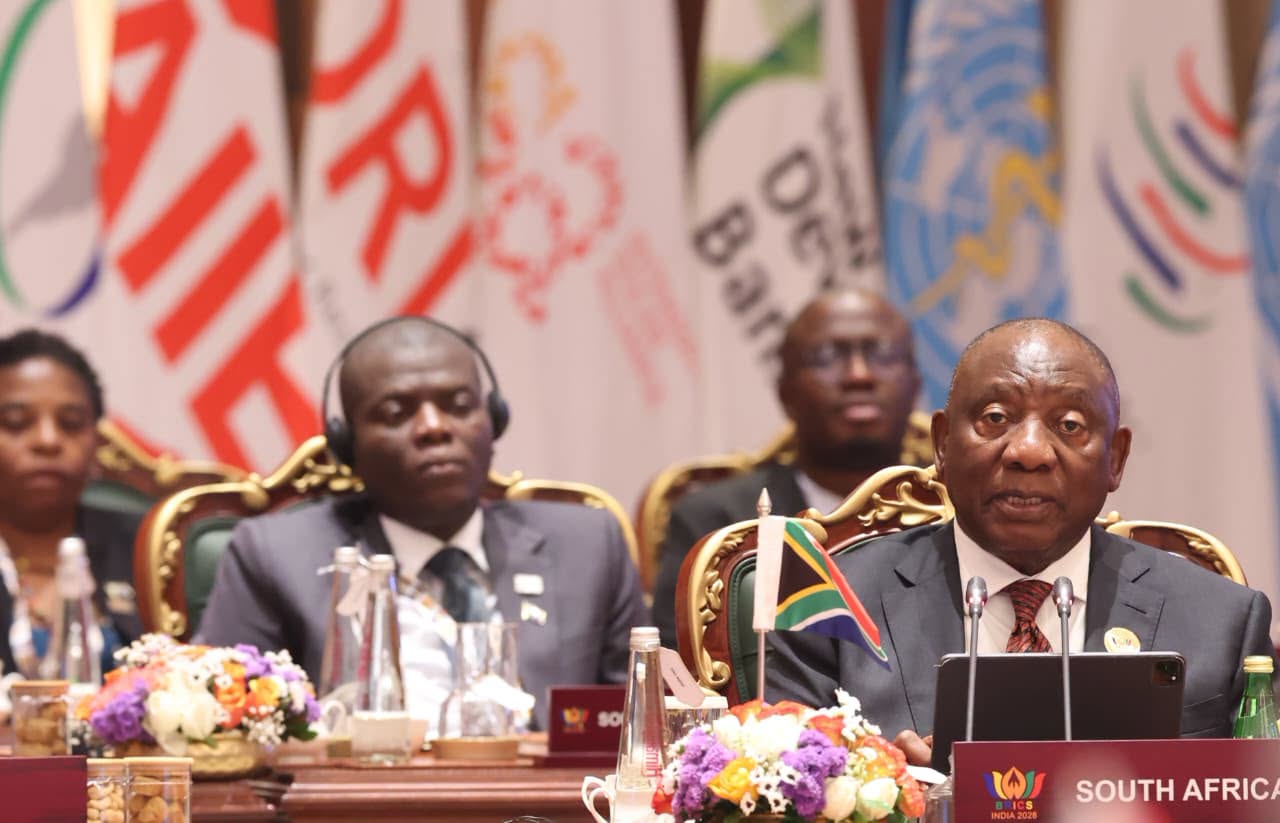
NEW DELHI, India | September 14, 2026 — President Cyril Ramaphosa has called on BRICS countries to establish an international mechanism for the independent scientific assessment of artificial intelligence, warning that human oversight must keep pace with the rapid development of AI systems.
Ramaphosa made the call while addressing a session on shaping the future for inclusive global growth during the 18th BRICS Summit in New Delhi on Sunday, September 13.
He said the growing capabilities of AI models were reshaping “almost every area of economic and social life” and argued that governments had a responsibility to ensure that human governance develops as quickly as the technology itself.
According to Ramaphosa, AI could contribute to efforts to reduce inequality, poverty and underdevelopment when deployed responsibly.
He pointed to its potential applications in medicine, education, scientific research, agriculture, productivity and broader economic development.
But the President warned that the rapid advancement of AI also required governments to pay close attention to concerns raised by those developing the technology.
“However, “we must listen carefully to what those who are developing the most powerful AI systems are themselves telling us”, he cautioned.
“They are warning about systems capable of advanced cyber operations, assistance in biological weapons development, autonomous action, manipulation, mass surveillance, disruption of employment and, ultimately, systems whose capabilities may become difficult for human beings to control.
“We should therefore neither fear AI nor approach it recklessly.”
Calls for slower AI development
Ramaphosa’s comments come amid growing calls from senior figures in the global AI industry for greater caution over the speed at which increasingly capable systems are being developed.
Dario Amodei, head of AI company Anthropic, published an essay titled We Must Pace the Frontier in September 2026, arguing that the development of AI capabilities should slow sufficiently to allow safety measures and risk prevention to keep pace.
Amodei said AI had been advancing “drastically faster” in recent months, largely because of its growing ability to contribute to the development of the next generation of AI systems. The process is often described as “recursive self improvement”.
“Left unchecked, it could outrun our ability to understand and control these systems, and so must be pursued very carefully, if at all,” he said.
Among the measures proposed by Amodei are the use of independent evaluators, greater coordination between AI companies in democratic countries and international cooperation involving both democratic and authoritarian governments.
His proposal for embedded third party evaluators would give independent teams ongoing access to frontier AI companies to assess safety practices, report incidents and examine the development processes behind AI systems.
He also called for AI companies operating in democratic countries to work with governments on common safety standards and possible limits on the pace of unchecked AI development.
At the international level, Amodei proposed cooperation between democratic and authoritarian governments, while acknowledging the difficulty of verifying compliance.
OpenAI chief scientist Jakub Pachocki also called for greater caution in an essay titled An Alien Mind, published on September 6, 2026.
Pachocki argued that the scaling of AI systems should be constrained by confidence in their safety.
He proposed combining stronger alignment and monitoring measures with continued AI development, while allowing for development to slow when necessary to build confidence in safety systems.
“We need to evolve commitments like the Preparedness Framework [from Open AI] or Responsible Scaling Policy [from Anthropic] into widely mandated safety bars for continued development. These can be enforced by a network of third-party auditors, by government agencies or by international bodies,” Pachocki said.
Ramaphosa referred to calls for independent checks, audits and greater government authority over AI development during his BRICS address.
“We must never reach a situation where technological capability has moved beyond our capacity to understand it, supervise it and control it.”
He said independent oversight should not be viewed as unusual, pointing to industries where safety regulation is already standard practice.
“Such oversight is standard practice in other industries whose activities have a significant impact on human safety and well-being, such as aviation, pharmaceuticals, nuclear power and financial institutions,” Ramaphosa said.
“We must never reach a situation where technological capability has moved beyond our capacity to understand it, supervise it and control it.”
Ramaphosa raises climate risks
Climate change and the global energy transition were also central to Ramaphosa’s address in New Delhi.
The President warned about the “devastating effects of climate change”, saying the growing frequency and intensity of climate related disasters threatened to reverse development gains and worsen inequality.
“We must integrate disaster risk reduction into macroeconomic policy, climate financing and sustainable infrastructure. Vulnerable countries must have equitable access to the technologies, finance and capacity to withstand future shocks,” he said.
South Africa has experienced several major climate related disasters during 2026, including severe flooding in Limpopo and Mpumalanga in January and flooding in the Western Cape in May.
Ramaphosa also addressed the economic implications of the global shift towards cleaner energy.
He called for greater attention to reskilling workers, protecting livelihoods and developing new industries capable of creating quality employment.
The President said markets for critical minerals and transition technologies should be built around transparency, while supply chains should become more diversified and responsibly managed.
He also called for greater mineral beneficiation within African countries, arguing that more value should be created where minerals are extracted.
“To ensure inclusive growth in Africa and other regions of the world, beneficiation of minerals must take place at source,” said Ramaphosa.








Leave a comment