


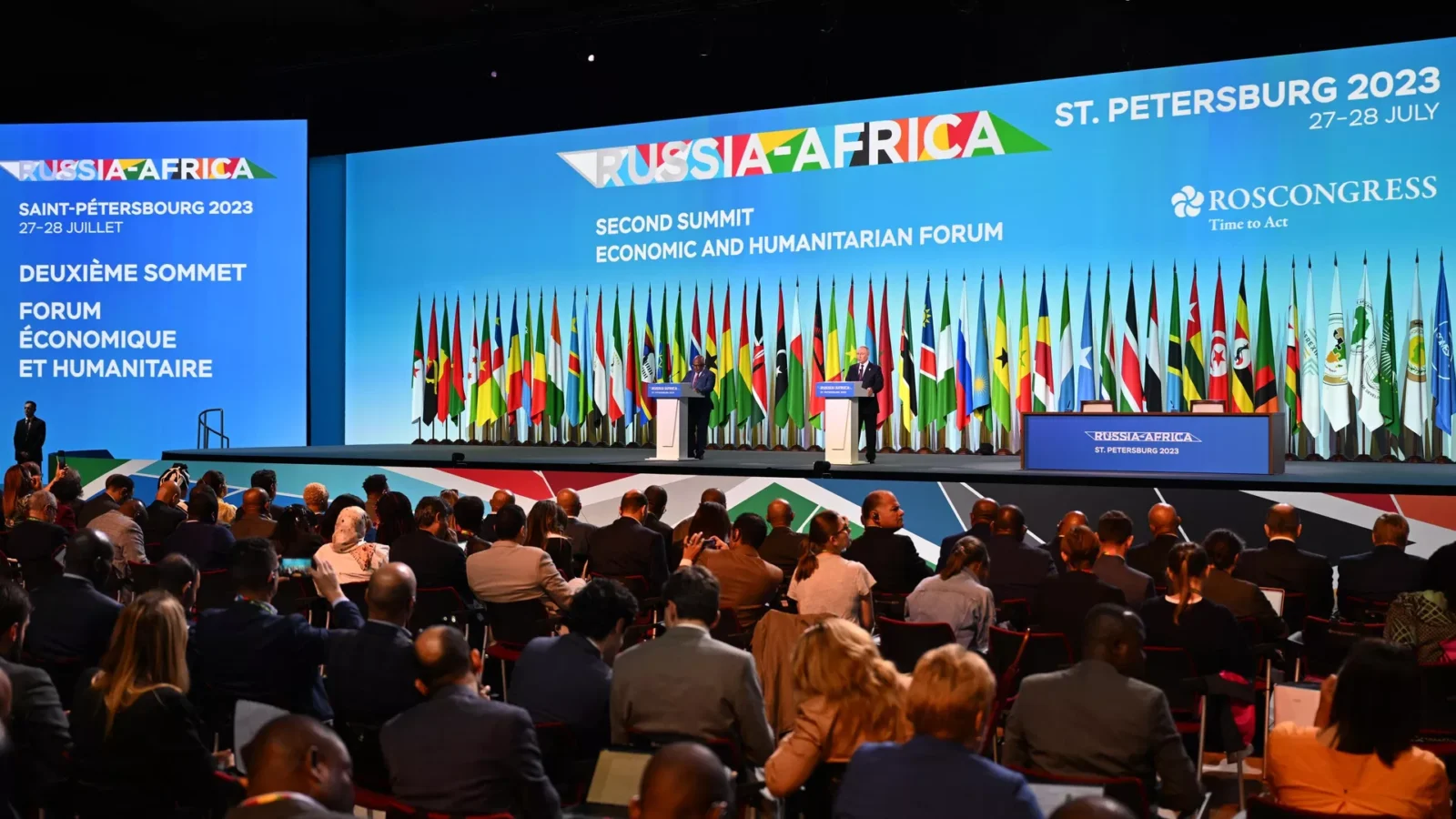
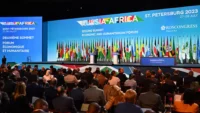
Moscow – Russia and African countries are preparing to discuss trade, energy, agriculture, education, healthcare, artificial intelligence, media cooperation and technological development during the Third Russia Africa Summit and related events scheduled for October 28 and 29, 2026, in Moscow.
The business programme, to be hosted at Gostiny Dvor, will bring together a broad range of subjects linked to economic growth, national sovereignty and international cooperation, with African countries seeking greater opportunities to expand industrial production, develop infrastructure and strengthen their position in the global economy.
The discussions are expected to examine how Russia and African partners can translate their political relations into practical projects, including investment, technology transfers, agricultural development, transport networks and alternative financial arrangements.
Trade, BRICS and economic integration
Economic cooperation will feature prominently on October 28, with sessions examining Russia’s commercial relations with Africa and the role of multilateral platforms in expanding trade and investment.
A session titled Economic Cooperation between Russia and Africa: The Path to Equal Partnership will examine infrastructure and energy projects, alternative international payment mechanisms and the creation of new logistics corridors.
Discussions will also consider the prospects for a free trade arrangement between the Eurasian Economic Union (EAEU) and the African Union, alongside the potential for BRICS to support industrialisation, resource management and the development of African value chains.
Participants will explore whether the expansion of BRICS, which includes Egypt and Ethiopia alongside South Africa, could create additional opportunities for African economies to engage with Russia and other members of the grouping.
The programme will also examine the challenges facing Russian suppliers competing with international businesses offering lower prices and more accessible financing. The availability of credit, the growing use of national currencies in Russia Africa transactions and the possibility of African investment in Russia will form part of the discussion.
A separate session on October 28 will focus on the EAEU and Africa, looking at ways to reduce regulatory and infrastructure barriers, improve transport and logistics connections, and strengthen industrial and agricultural partnerships.
Another discussion will examine BRICS as a platform for business cooperation, including opportunities to establish more reliable payment systems, expand insurance arrangements, transfer technology and implement major infrastructure projects.
The sessions will seek to identify practical mechanisms for increasing direct contact between businesses and turning economic agreements into projects across the continent.
Agriculture and food security
Agriculture will be another major area of discussion, particularly as Africa faces growing pressure to feed an expanding population while improving productivity and reducing dependence on imported agricultural inputs.
According to projections cited in the summit programme, Africa’s population is expected to increase by almost one billion people by 2050.
The session The Russia Africa Agro Industrial Alliance: Meeting the Challenges Together, scheduled for October 28 in partnership with the Russian Association of Fertilizer Producers, will examine cooperation in fertiliser supplies, agricultural machinery, infrastructure and modern farming technologies.
Russia’s role in supporting African food security will be considered alongside opportunities for joint investment and the transfer of agricultural expertise.
Participants will discuss financial and logistical arrangements that could protect trade from restrictions, as well as the possibility of assembling Russian agricultural machinery locally and establishing transport and logistics hubs across Africa.
The role of scientific research and genetic technologies in improving agricultural output and strengthening long term food security will also be examined.
On October 29, another session, From Food Products to Agricultural Technologies, will consider how technological cooperation could help African agricultural businesses become more productive.
The programme states that agriculture supports the livelihoods of more than 60% of the population in sub Saharan Africa, while 20% of the region’s population experienced hunger in 2024.
Low soil fertility is identified as one of the major constraints on agricultural production. Discussions will therefore focus on technologies that could improve soil productivity, increase output and help address wider socioeconomic challenges.
Land degradation, desertification and drought will also feature in a separate session examining cooperation on land restoration and sustainable agriculture.
Energy and nuclear technology
Energy cooperation will be central to discussions on October 28, with Russia and African countries expected to consider how technology and investment could help meet the continent’s growing electricity needs.
The session The Russia Africa Energy Dialogue: Russian Technological Solutions for the Continent will examine opportunities ranging from oil and gas exploration to electricity transmission equipment, hydroelectric facilities, thermal power stations, nuclear energy and hybrid renewable energy systems.
The programme estimates that Africa has approximately 253 gigawatts of installed electricity generation capacity, representing about 2.6% of the global total of roughly 9,600 gigawatts.
With Africa’s population projected to rise from 1.5 billion to 2.5 billion by 2050, electricity demand is expected to increase significantly as cities expand and industrial activity grows. Experts cited in the programme estimate that demand could double over the same period.
The discussions will examine how African countries can secure reliable and affordable electricity while developing their own energy capabilities.
Russia’s approach to what the programme describes as energy justice will be considered, including access to technology regardless of a country’s current level of economic development.
Nuclear energy will receive dedicated attention in a session organised in partnership with the State Atomic Energy Corporation Rosatom.
The discussion will examine the potential of nuclear power to supply stable electricity while supporting related industries, including nuclear medicine, agriculture and scientific research.
Participants will consider the resources, skills and institutional capabilities African countries need to establish national nuclear industries, as well as the challenges already encountered by countries implementing nuclear projects.
Mining and industrial development
Africa’s mineral wealth and its potential to support broader economic development will feature in discussions on October 28 and 29.
A session titled From Extraction to Prosperity: Subsoil Resources as the Bedrock of National Well Being will examine investment in geological exploration, mineral deposits and processing technologies.
The programme calls for approaches that ensure Africa’s natural resources contribute to the economic prosperity of its countries and people.
Government geological surveys, private sector exploration and cooperation between public institutions and businesses will be discussed as important elements in identifying mineral deposits and attracting investment.
Participants will also consider how countries can exchange expertise on mining regulations, education and modern extraction and processing technologies.
Questions surrounding state support for exploration companies, financing for smaller geological businesses and the responsible management of mineral resources will form part of the agenda.
On October 29, the Russia Africa Industrial Dialogue will examine opportunities for African countries to increase the local processing of raw materials, establish manufacturing operations and develop domestic technical expertise.
The discussion will consider how joint industrial projects can incorporate local production, technology transfer, domestic supply chains and long term partnerships.
Education and scientific cooperation
Education and human capital development will form another substantial part of the programme, reflecting decades of academic engagement between Russia and African countries.
A session on October 28 will examine ways to expand educational partnerships through university cooperation, international academic events and increased opportunities for African students to study in Russia.
The Russian African Network University Consortium and the Subsoil of Africa International Consortium of Technical Universities will feature in discussions about training specialists and sharing knowledge, particularly in the mining sector.
Participants will consider the role of the African Union in developing training opportunities and how Russia and its African partners can improve the regulatory frameworks governing educational cooperation.
On October 29, a separate session will focus on transferring educational practices in general education, secondary vocational training and supplementary education.
Discussions will examine how Russian teaching methods and elements of the Soviet and Russian educational legacy could be adapted to the needs of African countries, particularly those seeking skilled workers for expanding industries.
The programme also includes a session on scientific partnerships, covering joint research, academic mobility, grants for young scientists and the establishment of laboratories and research centres.
Potential areas of collaboration include climate research, energy, biotechnology, oceanography, archaeology and agriculture.
Another session will explore the historical relationship between Russia and Africa, examining the legacy of Soviet support for universities, engineering education, medical assistance, industrial projects and specialist training during the continent’s struggle for independence.
Artificial intelligence and technological sovereignty
Artificial intelligence and digital development will feature across several sessions, as Russia and African countries consider how to participate more actively in emerging technologies.
A session on October 28 will examine AI as a factor in development, focusing on scientific research, specialist training and cooperation between universities and research institutions.
The discussions will follow the provisions of the Declaration of the Third Russia Africa Summit on cooperation in the civilian application of artificial intelligence.
Participants will consider how Russian experience in applying AI across different industries could be adapted to African needs and how joint research and education programmes could strengthen technological capacity.
Another session will examine broader technological cooperation, including industrial automation, agricultural technology, unmanned systems, space monitoring, cybersecurity and digital public administration.
For African countries, technological independence has become an increasingly important consideration amid reliance on foreign suppliers for equipment, software and digital infrastructure.
The programme presents Russia’s experience in import substitution and domestic technology development as a potential resource for countries seeking to strengthen their own capabilities.
On October 29, a dedicated session titled The Dimensions of AI: Opportunities and Challenges for Africa and Russia will consider the continent’s place in the global artificial intelligence economy.
Rising demand for computing power, electricity, critical minerals and skilled workers could create new opportunities for African economies. However, the programme warns that insufficient infrastructure, institutional capacity and regulatory frameworks could leave countries dependent on supplying raw materials and low cost computing resources to external markets.
The discussion will examine how partnerships in infrastructure, skills development and regulation could help African countries become more active participants in the AI industry.
Space technology will also be discussed, with potential applications in agriculture, telecommunications, disaster management, natural resource monitoring, healthcare and transport.
Participants will examine ways to expand space education, strengthen national and regional space programmes and develop cooperation between Russia and African countries.
Healthcare and epidemic preparedness
Public health will be addressed through discussions on healthcare systems, epidemic prevention and the treatment of thrombosis.
On October 28, the session Clogged Arteries: The Challenges of Our Time. A Russia Africa Dialogue will examine the prevention, diagnosis and treatment of thrombosis.
The programme cites the International Society on Thrombosis and Haemostasis as reporting that one in four deaths worldwide is caused by thrombosis related disease.
The condition affects patients across medical disciplines, including cardiology, neurology, surgery and oncology. The session will examine differences in the epidemiology of thrombosis in Russia and Africa, the introduction of routine risk assessments, diagnostic challenges in resource constrained settings and access to newer medicines.
On October 29, a separate discussion will focus on cooperation in preventing and managing epidemics.
According to the programme, Russia has supported African partners through the deployment of 20 operational mobile laboratories across 11 countries. These facilities are intended to help local specialists detect and contain disease outbreaks more rapidly.
Participants will examine the continent’s most urgent epidemic management priorities, examples of cooperation in responding to infectious diseases and the feasibility of establishing an integrated continental system for responding to biological threats.
Another session will consider healthcare as a foundation for sustainable development, including the strengthening of primary care, preventive medicine, medical training, research and reliable medicine supplies.
The discussions will explore how countries with different healthcare systems can exchange practical experience while retaining the freedom to develop policies suited to their populations and available resources.
Transport and smart cities
Transport infrastructure will be examined as a key factor in connecting African markets, increasing trade and supporting industrial development.
The Russia Africa Transport Partnership session on October 29 will focus on infrastructure planning, transport equipment, engineering, digital systems, maintenance and workforce training.
The programme notes that the African Union has established long term infrastructure priorities while regional economic communities are developing cross border transport corridors.
Participants will consider which routes and projects should take priority through 2030, how Russian suppliers can compete in African markets and what steps could lead to the launch of joint projects as early as 2027.
Urban development will also feature in a session on smart cities, organised in partnership with Sberbank.
Rapid urbanisation is creating pressure on African cities to improve transport connections, public services, infrastructure and the business environment.
The discussion will examine how digital technology can improve urban management, attract investment and support industrial development, while addressing constraints that prevent cities from making full use of smart city solutions.
Media cooperation and African narratives
The Russia Africa Media Forum will provide a platform for discussions on journalism, information exchange, disinformation and the international representation of African countries.
A session on October 28, titled Changing the Perspective: How the Media of the Global Majority Are Shaping the World, will examine how Russian and African media can expand cooperation and reach wider audiences with their reporting.
The programme identifies the development of independent information channels and the promotion of perspectives from countries of the Global Majority as key issues for discussion.
Participants will consider how media organisations can cooperate in producing content, share resources and respond to attempts to influence domestic political debate through information campaigns.
Questions will also be raised about the kinds of stories audiences in Africa and Russia want to see, and how media organisations can develop partnerships that reflect the interests of their respective societies.
On October 29, a session titled Understanding the New Challenges Standing before the Media will examine the impact of misinformation, the growth of infotainment and the changing ways audiences consume news.
The discussion will address how journalists can maintain professional standards in an environment increasingly shaped by artificial intelligence summaries, social media and rapidly changing broadcasting platforms.
Participants will consider practical methods for detecting fabricated content, responding to disinformation and strengthening regional media organisations’ reliance on their own sources and expertise.
The programme also includes a session on the legacy of Africa’s founding leaders and their contribution to national liberation, sovereignty and media development.
Discussions will examine the role of alternative and national media in shaping African narratives, drawing comparisons with broadcasting during the struggles against colonialism and apartheid.
Another session will explore cooperation in sharing media resources, producing joint content, exchanging journalists and training editors to identify false information.
The wider objective of these discussions is to consider how African newsrooms can expand their international reach and shape coverage of the continent rather than simply responding to narratives produced elsewhere.
Water security and environmental sustainability
Access to clean water will be addressed on October 29, with a session examining the social, economic and technological dimensions of water supply across Africa.
The programme notes that the African Union has designated 2026 as the Year of “Assuring Sustainable Water Availability and Safe Sanitation Systems”.
The discussion will consider the barriers preventing communities from accessing clean water, the affordability of treatment and purification technologies, and opportunities for cooperation between Russia and African countries.
Infrastructure investment, water resource management and partnerships involving governments, businesses, scientists and development institutions will form part of the agenda.
The session will examine practical ways to expand access to safe water while supporting public health, food production, urban development and economic activity.
Environmental concerns will also feature in discussions on restoring degraded land, protecting soil fertility and improving resilience to drought.
Participants will explore how sustainable land management could reduce environmental risks while opening opportunities for agricultural production, employment and investment.
Women’s leadership and civil society
The summit programme also includes discussions on women’s participation in international cooperation and the role of civil society organisations in development.
A session titled The Mission of Women in Russia and Africa in Building Trust and Global Cooperation will bring together women leaders to consider partnerships in trade, science, technology, education and humanitarian work.
The meeting will explore how business networks, joint educational initiatives, cultural programmes and social projects could strengthen relations between women-led organisations and professional communities in Russia and Africa.
The programme places the discussion ahead of the fifth anniversary Eurasian Women’s Forum.
Separate sessions will examine cooperation between non-profit organisations, development assistance and citizen diplomacy, including joint initiatives addressing humanitarian, technological and legal challenges.
Other discussions will focus on municipal diplomacy, with Russian and African cities considering opportunities for sister-city partnerships, cultural exchanges, youth programmes, education and sport.
The programme also includes a session on the International Russophile Movement and non-governmental organisations, examining the role of cultural associations, alumni networks and educational institutions in building long term relations.
Sovereignty, security and historical justice
The October 29 programme will include several sessions devoted to national sovereignty, security and the changing international order.
A session organised in partnership with Rosoboronexport will examine what the programme describes as indivisible sovereignty, bringing together physical security, digital protection and the ability of governments to maintain essential services.
Topics will include satellite monitoring, unmanned aerial systems, the protection of critical infrastructure, counterterrorism and efforts to combat the illegal trafficking of natural resources, drugs and weapons.
Participants will also discuss cybersecurity, information management and the use of technology to strengthen national security.
Another session will consider digital sovereignty, including secure software, the protection of critical information infrastructure and cooperation to address cross border cyber threats.
The programme frames these issues against the backdrop of Africa’s expanding digital economy and the risks associated with rapid technological adoption without adequate safeguards.
Historical memory and the legacy of colonialism will be addressed in a separate session examining reparations, the return of cultural heritage, historical research and efforts to challenge distortions of the continent’s past.
The discussion will consider the role of BRICS in supporting cooperation among developing countries in education, science and culture, as well as the contribution of African universities, archives, museums and research institutions to international debates about colonial history.
Further sessions will examine political party cooperation amid geopolitical instability and the role of traditional values, religious engagement and education in Russia Africa relations.
Culture and humanitarian partnerships
Cultural cooperation will form part of the wider programme, with a dedicated session examining the presentation of African art and cultures in Russian museums.
The discussion will consider how museums can move beyond portraying African cultures as merely traditional or exotic and provide a more comprehensive account of their historical, contemporary and international significance.
Proposed areas of cooperation include exchanging collections and exhibitions, conducting joint research in African countries, organising conferences and developing educational programmes.
The programme also proposes professional exchanges and internships involving African museum staff and students, alongside opportunities for Russian researchers to gain practical experience in African institutions.
A separate session on spiritual sovereignty and traditional values will examine humanitarian and educational engagement, including the role of religious institutions in developing links between communities.
Participants will discuss the protection of Christians in Africa, approaches to countering religious extremism and the development of lasting cooperation through cultural, educational and interfaith initiatives.
The two day programme will conclude its scheduled discussions on October 29 with sessions covering historical justice, political cooperation, digital development, culture, artificial intelligence and space technology.



Leave a comment