


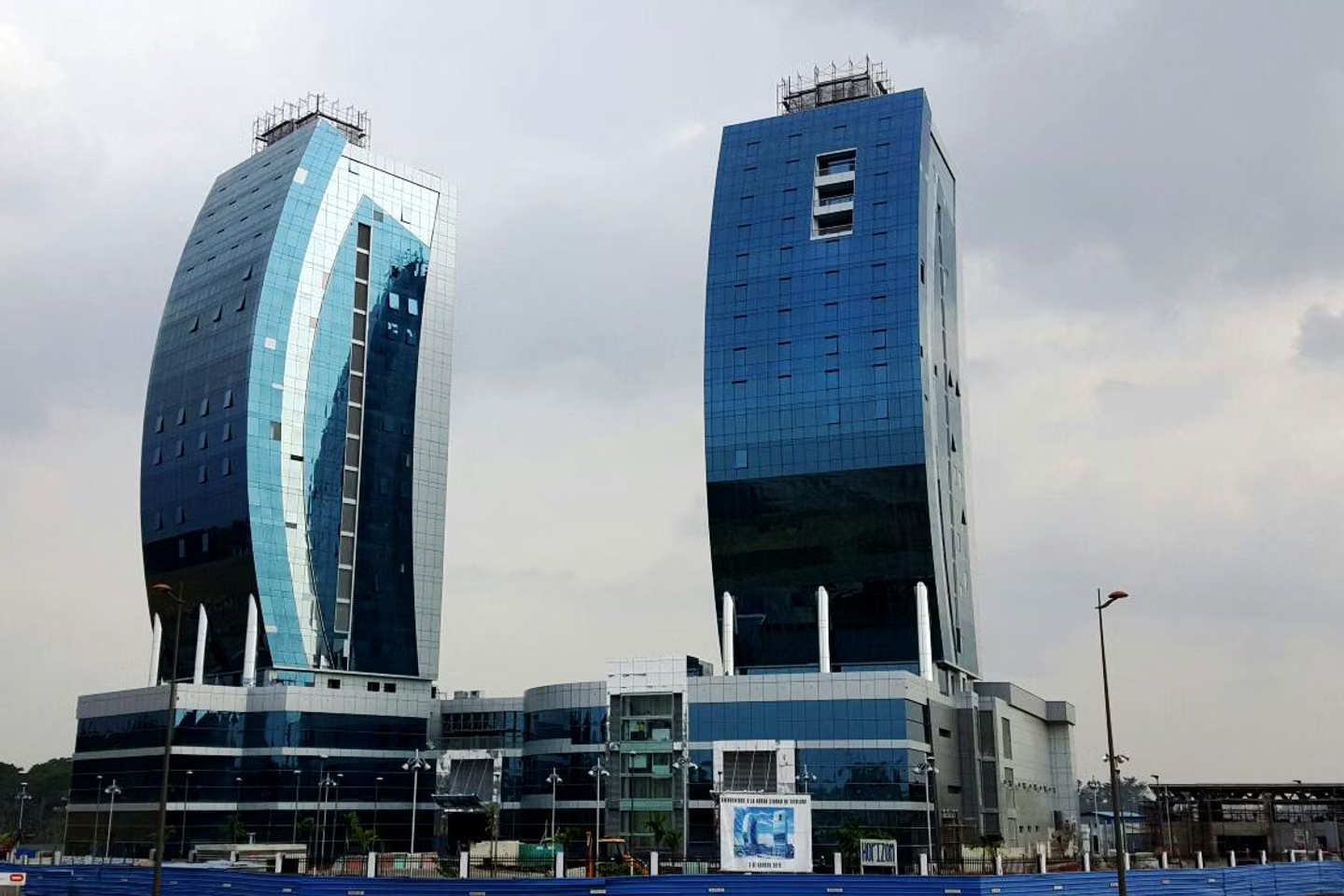
Malabo, Equatorial Guinea: Nearly eight months after Ciudad de la Paz was officially designated as the new political capital of Equatorial Guinea, the city remains largely empty, with little evidence of the population and public services expected in a national capital.
Located deep in the country’s mainland rainforest, Ciudad de la Paz is surrounded by dense vegetation and connected by broad, largely deserted roads. The city has newly built hotels, a major hospital, a university and government facilities, but there are still few residents, shops or schools.
“We still don’t see anything here that could make us think we’re in a capital,” university lecturer Cipriano Ela told AFP.
A presidential decree issued in January formally changed the capital from Malabo to Ciudad de la Paz, formerly known as Oyala. Government institutions have been given one year to relocate from Malabo, which has served as the capital since Equatorial Guinea gained independence from Spain in 1968.
The move transfers the political centre of the oil rich Central African country from Bioko Island in the Gulf of Guinea to the mainland, close to the borders with Cameroon and Gabon.
A project dating back to 2008
President Teodoro Obiang Nguema Mbasogo launched the Ciudad de la Paz project in 2008. He has ruled Equatorial Guinea for 47 years.
The development has been built with infrastructure from Chinese, South Korean and Italian companies and is being financed by the state, which has benefited from major oil discoveries made in the early 1990s.
The government says the location provides a central position on the mainland and enough surrounding land for future expansion.
The city is planned to cover about 32,000 hectares and eventually accommodate approximately 65,000 people.
Vice President Teodoro Nguema Obiang Mangue, the president’s son, described the relocation as an important national project.
Writing on X in January, he said the move “represents a firm determination to consolidate our sovereignty and identity” and would “drive the creation of thousands of jobs”.
He also said the project was “breaking with the structures inherited from the colonial period, after 57 years of independence”.
The relocation follows similar decisions elsewhere in Africa. Ivory Coast moved its political capital from Abidjan to Yamoussoukro in 1983, while Nigeria transferred its capital from Lagos to Abuja in 1991.
Despite those changes, the former capitals have remained larger and more economically active than the new administrative centres.
Services remain limited
The lack of housing, public services and commercial activity is proving to be one of the biggest obstacles to the relocation.
A resident of Oyala Poblado, a settlement bordering the new capital, said little had changed apart from the identification centre, which provides identity cards and passports.
“Apart from the identification centre, which issues ID cards and passports more quickly than others, nothing has changed,” the resident said.
Parliament formally opened a session in July at its new building in Ciudad de la Paz, although lawmakers later returned to Bata, the country’s economic capital on the Gulf of Guinea, about 170 kilometres away.
Bata has grown rapidly and is home to nearly 500,000 people, while Malabo has also expanded significantly in recent years.
The government’s January decree cited the concentration of infrastructure, jobs, government offices and public services in Malabo and Bata as a factor behind the decision to establish a new capital. The concentration has attracted people from rural communities and smaller towns, contributing to the growth of the two cities.
However, Ciudad de la Paz currently lacks many of the facilities needed to support a permanent population.
Several employees of the ruling Democratic Party of Equatorial Guinea, known as PDGE, told AFP they had already left Malabo but were now based in Bata while waiting for conditions in the new capital to improve.
“No hospitals, no schools, no supermarkets. We just go down to Ciudad de la Paz to carry out a few small jobs, then we go back up to Bata,” one PDGE employee said on condition of anonymity.
Housing plans underway
The government is seeking to encourage civil servants to relocate by developing social housing for employees who will eventually work in the new capital.
Authorities are also working to expand essential infrastructure.
Last month, the government signed an agreement with the Arab Bank for Economic Development in Africa, BADEA, to support electrification and housing projects in Ciudad de la Paz.














Leave a comment