


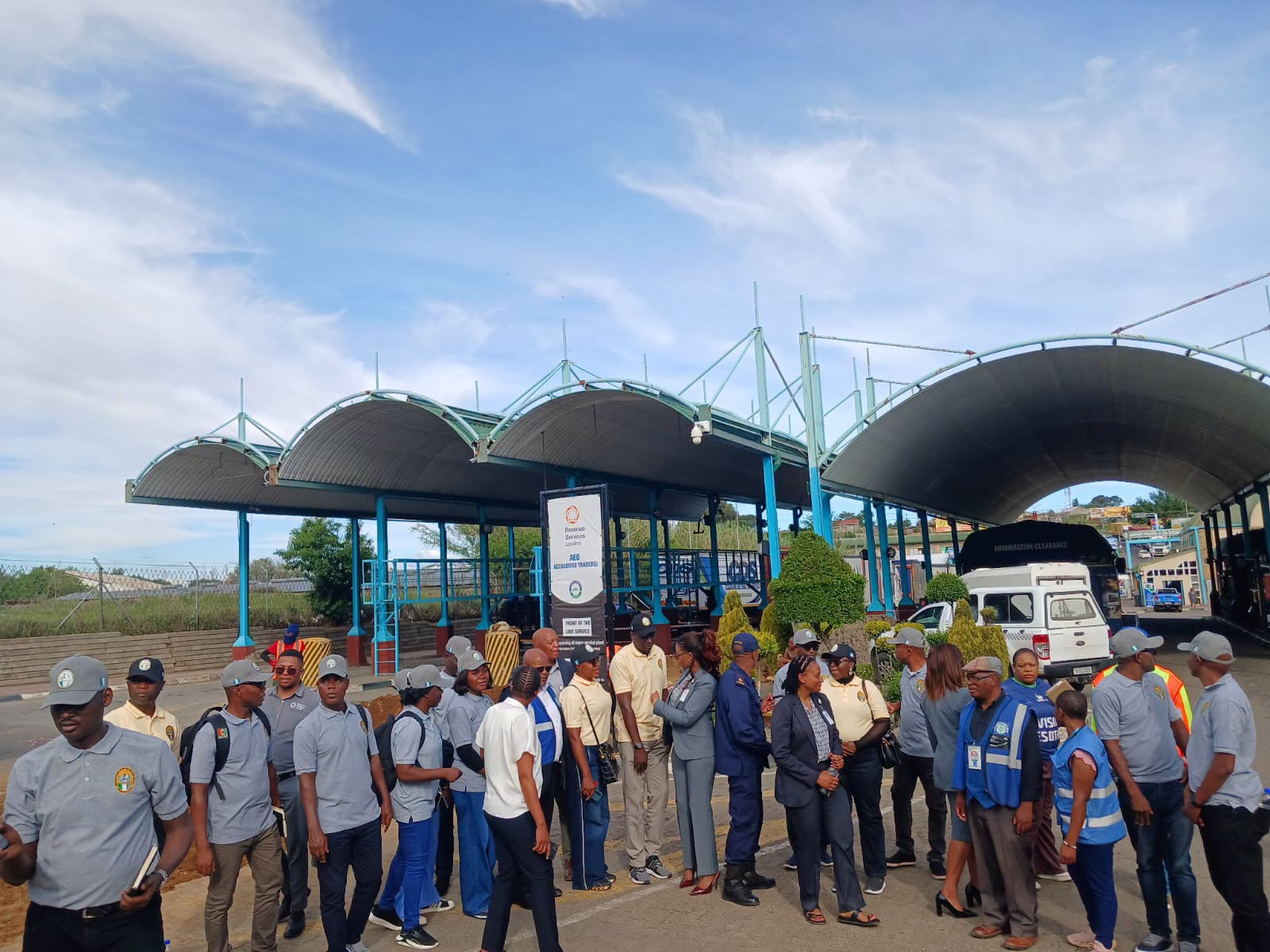
MASERU, Lesotho: A delegation from Nigeria’s Customs Command and Staff College has completed a five day study tour of Lesotho’s busiest border crossing, Maseru Bridge, examining how government agencies coordinate their operations to facilitate trade, manage the movement of people and strengthen border security.
The visit, hosted by Revenue Services Lesotho (RSL), provided the Nigerian officers with practical exposure to Lesotho’s coordinated border management system, which brings together several government departments under a common operational framework.
Maseru Bridge serves as Lesotho’s principal gateway to South Africa and handles the country’s largest volume of cross border trade and passenger traffic. Its strategic importance is particularly significant for Lesotho, a landlocked country entirely surrounded by South Africa.
During the visit, RSL Maseru Bridge Manager ’Mats’epang Tsietsi explained how the Lesotho Border Management Service (LBMS) coordinates the activities of government institutions responsible for managing the country’s borders.
She said the system brings together Immigration, the Lesotho Mounted Police Service, the National Security Service, the Lesotho Tourism Development Corporation, Port Health, the Transport Department, the Agriculture Department and the Road Fund, alongside revenue authorities.
According to Tsietsi, cooperation between these institutions is necessary to ensure that traders and travellers receive efficient services while border controls remain effective.
She explained that the agencies work collectively to facilitate the movement of people and goods, protect border users and ensure that consignments entering or leaving Lesotho comply with the country’s regulatory requirements.
The coordinated arrangement is intended to reduce the administrative burden on travellers and businesses by allowing government departments to work together rather than operating through separate and disconnected procedures.
Lesotho introduced the Lesotho Border Management Service at Maseru Bridge on November 1, 2019, establishing a shared operational point where government institutions could coordinate their border activities.
When the initiative was introduced, Mosuoe Mapetla, who was then head of client services at the Lesotho Revenue Authority, said: “We commit to provide better service to all our clients and border users,” according to the Government of Lesotho.
The Lesotho Revenue Authority has since transitioned into Revenue Services Lesotho.
Lesotho expands border reforms
The Nigerian delegation’s visit comes as Lesotho continues efforts to modernise border administration and improve cooperation between government agencies.
The Maseru Bridge arrangement was initially introduced as a pilot project, with a wider national programme envisaged to extend coordinated border management beyond the country’s busiest crossing.
In February 2024, Lesotho validated a draft Coordinated Border Management National Strategy aimed at reducing unnecessary administrative procedures, duplication and delays while maintaining effective border controls, safety and security.
The Southern African Development Community (SADC) reported on the development as part of the region’s broader efforts to improve trade facilitation and border efficiency.
Further technical cooperation has focused on information sharing and the standardisation of procedures among government departments.
The World Customs Organization (WCO) conducted a two week workshop in Maseru between February 23 and March 7, 2025, focusing on coordinated border management and harmonising data systems across government institutions.
The work recognises that effective border coordination requires more than having different agencies operating from the same premises. Departments must also share information, align their procedures and avoid repeatedly requesting identical documentation from traders and transport operators.
Lesotho and South Africa have also signed a joint action plan to develop smart one stop border posts at Maseru and Ficksburg, according to The Reporter.
In November 2025, the South African Revenue Service (SARS) and Revenue Services Lesotho launched a joint Time Release Study to establish how long goods take to clear through the two border crossings.
The exercise is designed to identify administrative bottlenecks, measure clearance times and determine where improvements could reduce delays for businesses and other border users.
Nigeria seeks practical lessons
Speaking on behalf of the visiting delegation, Chukwuka Mowete James described the study tour as educational and informative, saying participants had gained useful knowledge through the various activities organised during their stay.
He said the officers intended to apply the experience gained to their professional responsibilities and expressed hope that further opportunities for engagement with Lesotho would be made available in the future.
Revenue Services Lesotho Deputy Commissioner of Frontier Services Central, Dr Tseko Nyesemane, spoke about the importance of coordinated border management and encouraged the Nigerian officers to examine how the lessons from Maseru could strengthen their own operations.
He acknowledged Nigeria’s considerable experience in customs administration, urging the delegation to identify operational weaknesses and consider improvements that could enhance border management practices.
The Nigeria Customs Command and Staff College, located in Gwagwalada near Abuja, was established in 2011. It is the Nigeria Customs Service’s highest training institution and also serves as a World Customs Organization training centre for West and Central Africa.
The institution provides professional training and capacity development for customs personnel, supporting efforts to improve revenue collection, trade facilitation, enforcement and border administration.
Part of a wider African study programme
The Lesotho engagement formed part of the college’s broader Africa Study Tour, which also included visits to Tunisia, Niger and Cameroon.
In Cameroon, 13 trainees and four administrators undertook a separate programme between October 26 and 30, examining customs operations and institutional practices.
According to Cameroon Tribune, their activities covered cargo inspection, financial intelligence, revenue collection and coordinated border management.
Cameroonian customs official Ekolle Felix described the exchange as “a major academic and operational bridge”.
The programme reflects the value of practical exchanges between African customs administrations, allowing officers to learn from different institutional arrangements and approaches to managing international trade and cross border movements.
For Lesotho, the visit provided an opportunity to share the experience of its border reforms with officials from Nigeria, one of Africa’s largest economies, while strengthening professional engagement between the two countries’ customs institutions.
The engagement also provided Nigerian officers with an opportunity to examine how Lesotho’s multi-agency system operates at a strategically important crossing connecting the Southern African country to South Africa.











Leave a comment