


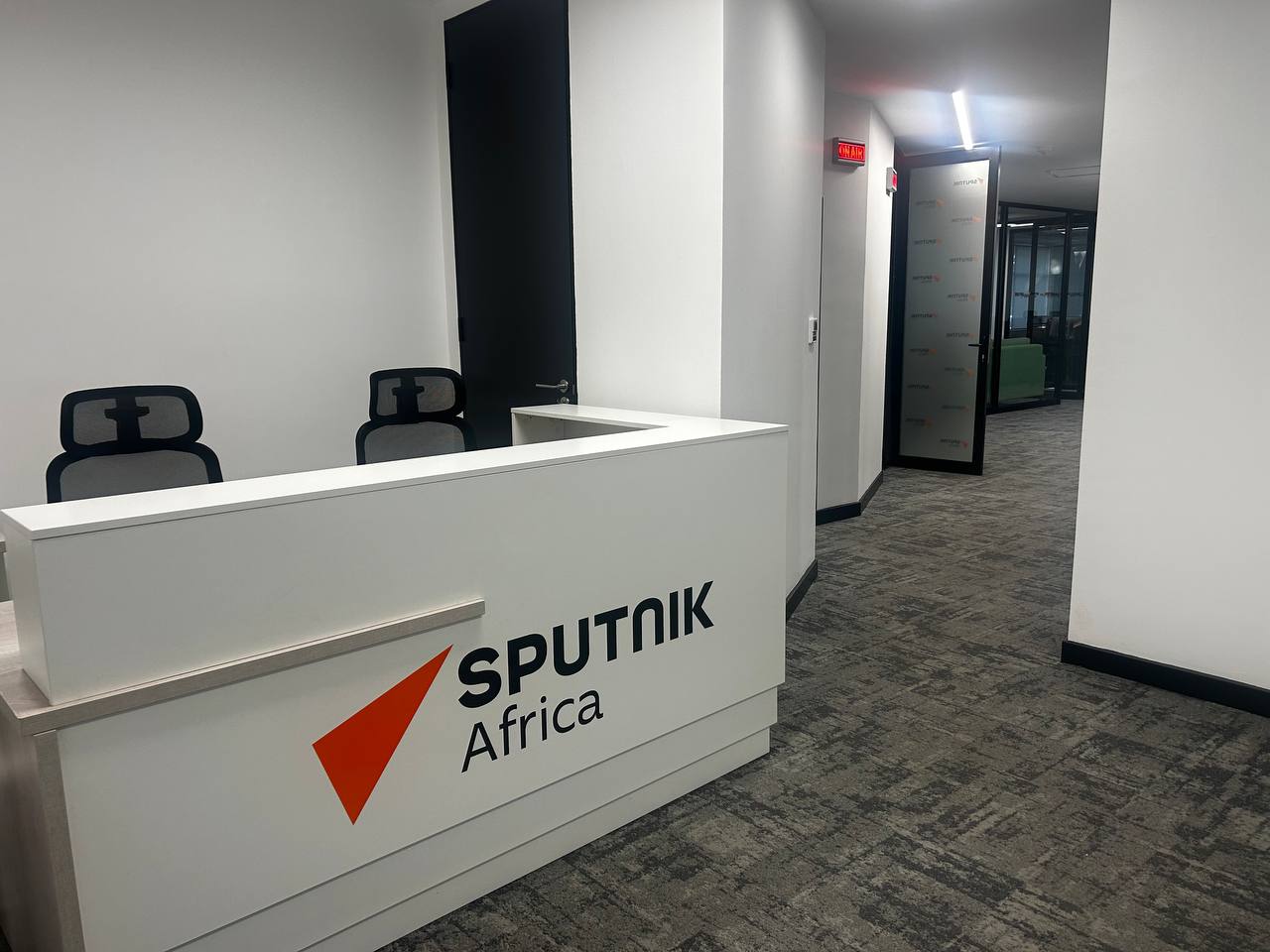
Johannesburg – Russian state news agency Sputnik has set up two new editorial centres on the continent, one in Johannesburg and another in Dar es Salaam, Tanzania’s commercial capital, in a push to grow its audience in Southern and East Africa.
Both offices opened simultaneously on Tuesday, less than two weeks before Moscow hosts the third Russia-Africa Summit on October 28 and 29.
The newsrooms will be staffed by dozens of local journalists and will produce material in English and Swahili. Part of that output will be podcasts carried by partner radio stations around the continent, which Sputnik says reach more than 100 million listeners combined.
Sputnik Africa started operating in 2022 and currently publishes in five languages, among them Swahili, Amharic and Oromo. Globally, the agency broadcasts in more than 30 languages and runs 26 multifunctional centres. It belongs to the Rossiya Segodnya media group.
Lavrov takes aim at the West
Russian Foreign Minister Sergey Lavrov addressed the launch ceremony in Tanzania by video. He said the offices would give African readers and listeners better access to reliable information.
“The opening of regional offices in Dar es Salaam and Johannesburg will help provide African audiences with greater access to objective, verified information,” Lavrov said, adding that this information would be “free from distortion or ideological filters.”
He thanked the South African and Tanzanian governments for backing the project, saying their support was key to allowing journalists to work effectively and safely.
Lavrov also accused Western countries of silencing alternative views. “Today, as the collective West persistently suppresses any dissenting voices within the global information space,” he said, the West was “resorting to methods such as censorship and the application of double standards,” adding that “the value of such work can hardly be overstated.”
Mashatile welcomes the move
South Africa’s Deputy President Paul Mashatile said the Johannesburg office was a significant step for the country’s media scene and for Africa as a whole.
“The opening of Sputnik’s regional office in Johannesburg represents an important development for the media landscape of South Africa and the African continent,” Mashatile said.
He said the launch was a sign of deepening ties between Pretoria and Moscow and would add to the variety of viewpoints in public discussion.
“We welcome Sputnik’s commitment to amplifying African voices and telling African stories,” he said, adding that he hoped the office would serve as a space for constructive dialogue, quality reporting and closer relations between South Africa, Russia and the rest of the continent.
Russia’s ambassador to South Africa, Roman Ambarov, said trustworthy reporting mattered more than ever.
“We live in a time when information is increasingly politicised, and it is not always easy to distinguish facts from disinformation,” Ambarov said.
“That is why professional journalism, access to diverse sources and the opportunity to hear different perspectives are more important than ever.”
He noted that Rossiya Segodnya, Sputnik’s parent group, had already built a sizeable footprint across Africa.
Tanzania looks for wider coverage
In Dar es Salaam, Said Shaib Moussa, deputy permanent secretary in Tanzania’s Ministry of Foreign Affairs, said the new office was expected to report on Tanzania, East Africa, the continent and global affairs, including geopolitics and development.
“We believe that the Sputnik agency will provide us with news of the country, the region, the continent, and the entire world in all spheres without exception, including the sphere of geopolitics and development,” Moussa said.
Kelvin Kanje, acting director of Tanzania’s Department of Information Services, said the launch would bring the two countries closer, open new avenues for professional collaboration and give Tanzania a bigger platform to be heard internationally.
Dmitry Kiselev, director general of Rossiya Segodnya, said opening newsrooms in African countries reflected trust between governments, citizens, journalists and audiences, which he said would reinforce information sovereignty in both Africa and Russia.
Margarita Simonyan, the group’s editor in chief, said Sputnik intended to tell Russians about Africa and Africans about Russia, describing the new centres as a chance to build on long standing relations between the two sides.
Growing footprint despite Western bans
Russian media outlets have steadily widened their partnerships with African broadcasters in recent years. In July, RT became the first international partner of Tafouk TV, the joint channel of the Alliance of Sahel States (AES), which brings together Mali, Niger and Burkina Faso. That deal covers content sharing, exchanges of expertise and joint reporting on events in Russia and the three Sahel nations.
The African expansion is taking place even as Russian media face tight restrictions in the West. Since the Ukraine conflict escalated in 2022, the European Union and the United Kingdom have banned a number of Russian news outlets, RT and Sputnik among them. Moscow has condemned the EU wide ban as an effort to shut out reporting on the conflict that runs counter to what it calls Brussels’ maximalist political position.






Leave a comment