


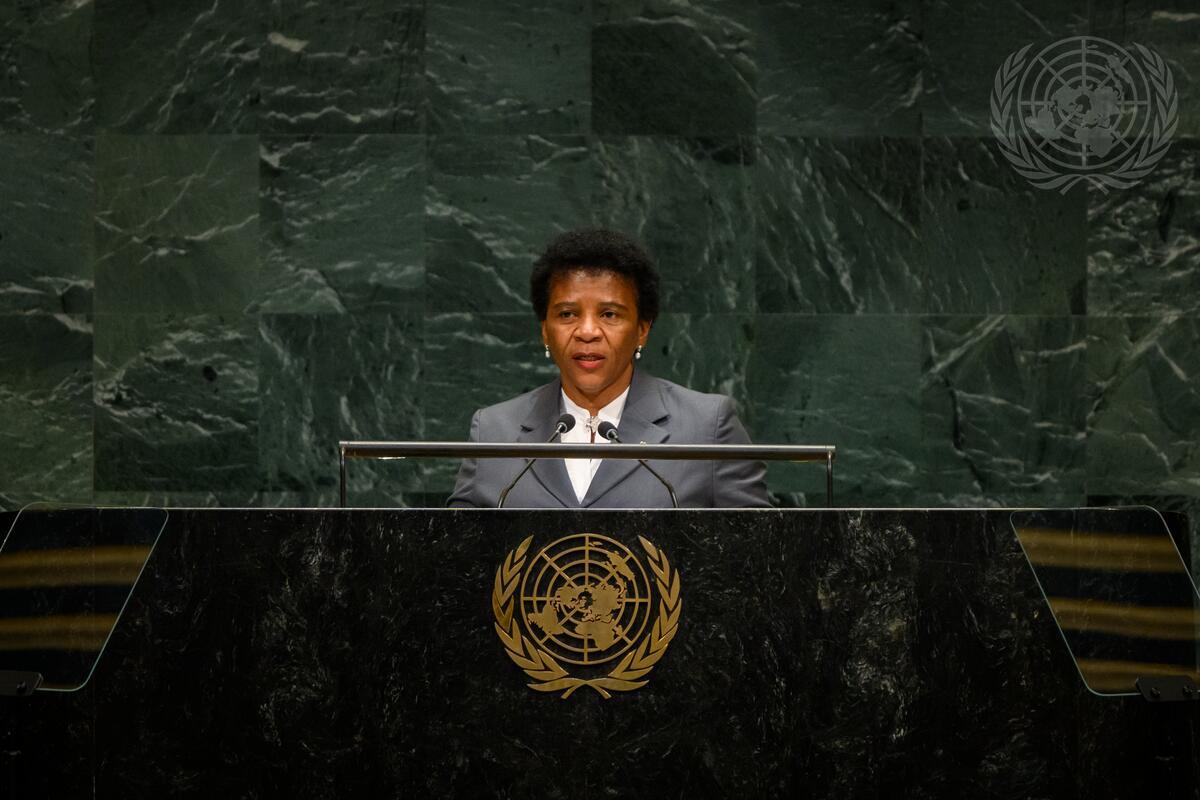
NEW YORK, 26 September 2026 — São Tomé and Príncipe has called for greater access to climate finance, saying small island developing states should receive support that reflects their specific vulnerabilities rather than relying primarily on income classifications.
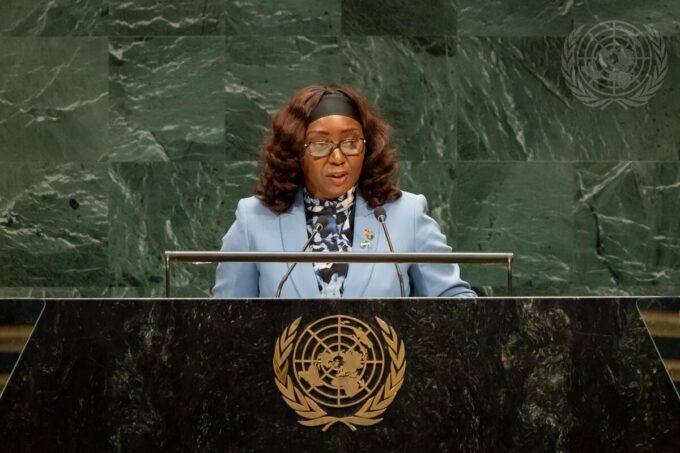
The country’s Minister of State and for Foreign Affairs, Cooperation and Communities, Ilza Maria dos Santos Amado Vaz, made the appeal while addressing the 81st session of the United Nations General Assembly.
Vaz said climate change was already affecting São Tomé and Príncipe’s coastal areas, infrastructure, marine resources and livelihoods despite the country’s negligible contribution to global greenhouse gas emissions.
“This reality reflects a profound climate injustice,” she said.
She said implementing the Paris Agreement, São Tomé and Príncipe’s nationally determined contribution and its National Adaptation Plan would require adequate, predictable and accessible resources.
The minister also called for the vulnerability of small island states to be assessed beyond per capita income, taking into account their particular characteristics and structural constraints.
São Tomé and Príncipe wants the Multidimensional Vulnerability Index to be translated into concrete eligibility criteria for concessional financing. It also called for the full operationalisation of the loss and damage fund and simpler, more effective access to the Green Climate Fund.
“The limited institutional capacity of vulnerable countries must not become an obstacle to accessing the very instruments created to support them,” Vaz said.
The appeal comes after São Tomé and Príncipe’s graduation to middle income country status, which Vaz described as an important milestone reflecting progress in human development. She said the transition also required measures capable of protecting those gains from external shocks.
Energy transition
Vaz said energy transition was an economic, financial, social and environmental necessity for the island nation.
São Tomé and Príncipe remains dependent on imported fuel, making the cost and reliability of electricity important to virtually every part of the economy.
The country’s Energy Transition Programme and National Energy Compact are intended to support a cleaner, more affordable, secure and stable energy system, but the minister said achieving this would require investment and international partnerships.
Food security and stronger productive capacity were also identified as priorities.
The government wants to reduce dependence on imports, increase domestic production and improve market access for farmers, particularly so that more of the value generated by products such as cocoa and coffee remains in the country.
Blue economy and biodiversity
Vaz said São Tomé and Príncipe’s marine resources and biodiversity represented major opportunities for sustainable development.
The country’s recognition by UNESCO as a World Biosphere Reserve, she said, reflected the value of its natural heritage while placing greater responsibility on the country to protect and sustainably use those resources.
“The recognition of our territory by Unesco as a World Biosphere Reserve confirms the exceptional value of our natural heritage and reinforces our responsibility to protect it and make the most of it,” she said.
The government intends to develop fisheries, the blue economy, research and nature based tourism as avenues for creating employment and income for local communities.
The country will also continue working with regional states and international partners to address illegal fishing and transnational crime while strengthening maritime security.
Focus on young people and diaspora
The minister said the country’s long term development would depend on creating opportunities for young people to study, work, establish businesses and innovate at home.
She described the São Toméan diaspora as an important source of human capital and a strategic partner, with the government seeking to strengthen its links to the country and increase its contribution through investment, entrepreneurship, knowledge transfer and participation in national life.
Vaz also linked sustainable development to strong institutions, human rights and the participation of both women and men in political, economic and social affairs.
São Tomé elections
She said 2026 was a significant year for São Tomé and Príncipe’s democracy.
According to her address, presidential elections were held on 19 July and resulted in the re-election of Carlos Vilanova as president.
The country was also due to hold legislative, local and regional elections on 27 September, with the minister pointing to automatic voter registration and the first application of the country’s parity law as notable developments.
Women accounted for 41.4 per cent of confirmed candidacies, above the legal threshold of 40 per cent, according to Vaz.
She said São Tomé and Príncipe remained committed to constitutional order, political pluralism, fundamental freedoms and respect for the sovereign will of its citizens.
“Inclusion and equality must also guide our response” to the major transformations of the current era, she said.
Responsible use of artificial intelligence
The country also called for greater international cooperation to ensure developing states can access the technology, knowledge, infrastructure and financing required to participate in the digital transition.
Vaz said artificial intelligence and digital transformation should be governed in a way that protects human dignity, transparency and fundamental rights.
“We advocate responsible technology governance centered on human dignity, transparency, and fundamental rights, so that innovation translates into better opportunities and services for all,” she said.
Call for stronger African representation
São Tomé and Príncipe also backed reform of the UN Security Council, arguing that Africa’s growing demographic, economic and political importance is not adequately reflected in institutions responsible for major international decisions.
Vaz described Security Council reform as an issue of legitimacy, justice and effectiveness rather than a concession to Africa.
She said an institution responsible for international peace and security could not indefinitely operate according to a distribution of power inherited from another era.
São Tomé and Príncipe welcomed recent decisions recognising the historical gravity of the transatlantic trafficking of enslaved Africans and efforts to correct distortions in the cartographic representation of Africa.
“These acts of recognition must translate into an international order in which Africa participates fully in shaping the future, rather than remaining merely in the position of responding to the decisions taken elsewhere,” Vaz said.
Conflicts and international diplomacy
On global conflicts, São Tomé and Príncipe expressed concern over the situations in Ukraine, Sudan, the Sahel, the Great Lakes region, the Horn of Africa and the Middle East.
The government called for stronger diplomacy, protection of civilians, respect for international humanitarian law, full humanitarian access and the release of hostages.
On the Israeli Palestinian conflict, Vaz reaffirmed support for a two state solution allowing Israel and Palestine to live side by side in peace and security, based on international law and relevant UN resolutions.
São Tomé and Príncipe also called for the lifting of economic, commercial and financial restrictions affecting Cuba, expressing solidarity with the Cuban people.
The minister said her country would remain committed to the UN Charter, international law, peace, human rights and multilateralism, while seeking to contribute to stability in the Gulf of Guinea.
She said reforms in infrastructure, energy transition, digitalisation and investment attraction were intended to mobilise resources for pressing needs including healthcare, water, sanitation, justice, security and environmental protection.
São Tomé and Príncipe’s development strategy also includes sustainable tourism through 2040, with the government thanking bilateral and multilateral partners supporting the country’s development efforts.
Vaz said the country’s vulnerabilities as a small island developing state should not determine its future, calling instead for strategic partnerships based on shared responsibility and mutual benefit.



Leave a comment