


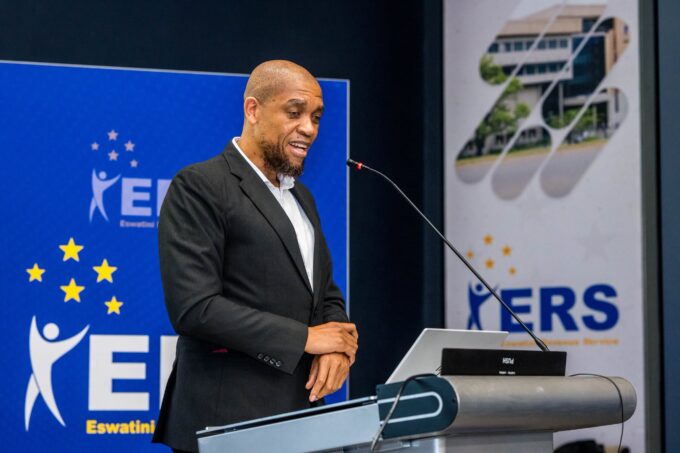
Ezulwini – The Eswatini Revenue Service (ERS) Commissioner General used the 4th Annual ERS Client Appreciation Day, held on Friday evening at the Happy Valley Hotel in Ezulwini, to reflect on 15 years of the institution’s operations and outline plans to move the country toward compliance by default.
Minister of Finance Neal Rijkenberg, chairpersons of the Finance Portfolio Committees of the Senate and House of Assembly, Members of Parliament, South African Revenue Service Commissioner Dr Ngobani Johnstone Makhubu, principal secretaries, ERS Governing Board Chairperson David Dlamini and board members, senior government officials, business leaders, representatives of Business Eswatini, SMEs, development partners, government communications officers, media and ERS management and staff attended the event, held under the theme “Stars of Compliance, Honouring Clients Who Build Eswatini.”

The Commissioner General said the evening was set aside to recognise taxpayers and traders who consistently choose to do the right thing. “The businesses and individuals we recognise tonight may operate in different sectors and at different scales, but they share one important characteristic, they understand that compliance is more than a legal requirement. It is an act of responsible citizenship and a direct investment in the future of Eswatini,” the Commissioner General said.
“Tonight, we therefore say to you, your contribution is seen, it is valued, and it is deeply appreciated,” the Commissioner General added.

The Commissioner General said ERS has now completed 15 years of operations, having commenced work in January 2011, and that domestic revenue has become increasingly important as a source of national financing as receipts from the Southern African Customs Union remain subject to fluctuations. This growth, the Commissioner General said, has enabled Eswatini to reduce its vulnerability to external revenue movements and strengthen its capacity to finance national priorities from resources mobilised within its own economy.
Quoting Jean Baptiste Colbert’s observation that the art of taxation is to collect the greatest possible amount with the least possible resistance, the Commissioner General said modern revenue administration means designing systems that make it easier for taxpayers to comply and progressively more difficult to remain outside the system, combining legislation, data, technology and risk management with taxpayer education, empathy, partnership and service.
The Commissioner General said ERS has moved away from viewing taxpayers merely as people from whom revenue must be collected, regarding them instead as clients and partners in the country’s development. Taxpayer education remains central to this approach, delivered through outreach programmes, stakeholder engagements, digital platforms and initiatives such as Bafundzise.
The Commissioner General said the ERS Net Promoter Score has risen from below 10 percent to approximately 83 percent over the past six years, reflecting growing confidence among clients in the service they receive. “We do not take this trust for granted. We know that every unanswered telephone call, every delayed refund, every inconsistent decision and every difficult interaction can weaken it. We therefore remain committed to listening, learning and continuously improving,” the Commissioner General said.
The Commissioner General described ERS’s recent attainment of ISO 9001:2015 certification as confirmation of its commitment to building consistent, accountable and client centred processes, calling it a discipline that must now become visible in every interaction with clients.
On efficiency, the Commissioner General said the ERS cost to revenue ratio has declined from above 5 percent to approximately 4 percent over the past decade, while the domestic tax to GDP ratio has increased from about 13.4 percent to approximately 16.5 percent. “However, efficiency cannot be measured only by how much revenue we collect. It must also be assessed by how fairly, transparently and professionally that revenue is collected,” the Commissioner General said, adding that honest businesses should not be placed at a competitive disadvantage by those who under declare, conceal transactions or remain outside the tax system.
The Commissioner General said ERS is working with the Ministry of Finance and Government Communications Officers through the Taxes at Work and the Minister’s Finance in Focus initiative to communicate how public revenue supports schools, hospitals, roads, water infrastructure, security and other government services, saying voluntary compliance grows when taxpayers see the results of their contribution.
The voluntary compliance rate has increased from approximately 62 percent in 2019/20 to more than 72 percent in 2025/26, the Commissioner General said, describing the progress as encouraging but noting significant work remains. “Our vision remains ambitious and clear, 100 percent voluntary compliance for a better Kingdom of Eswatini,” the Commissioner General said, adding that achieving it requires the participation of government, Parliament, businesses, professional bodies, financial institutions, the media, development partners and every individual taxpayer.
On trade, the Commissioner General said the Authorised Economic Operator programme reflects a relationship with traders that is evolving from one based on control to one built on trust and partnership, with the number of accredited operators growing from two several years ago to more than 30 currently participating and accredited. The Commissioner General congratulated the 15 companies receiving AEO accreditation on the night, saying their achievement recognises commitment to customs compliance, supply chain security and high operating standards, and that ERS intends to deepen the trusted trader approach as it progresses toward smarter and ultimately no stop border processes.
The Commissioner General welcomed the presence of Dr Ngobani Johnstone Makhubu, saying it reflects the strong institutional relationship between SARS and ERS. “Eswatini and South Africa share extensive economic, trade and social ties. Our borders facilitate significant daily movements of goods, people and capital. These movements create opportunity, but they also expose both countries to risks such as smuggling, under valuation, illicit financial flows and cross border tax avoidance,” the Commissioner General said, adding that no revenue administration can address these risks in isolation and that ERS looks forward to strengthening cooperation with SARS through improved data sharing, coordinated risk management, joint interventions and greater use of technology at the border.
Looking ahead, the Commissioner General said the next phase of ERS transformation is focused on moving from compliance by effort to compliance by default, prioritising four areas over the coming 12 months. The first is the introduction of electronic invoicing, which will enable invoices to be transmitted to ERS in real time, improve the integrity of VAT information and reduce the administrative burden of submitting transaction schedules, with the rollout prioritising the wholesale and retail sector before covering all VAT registered taxpayers.
The second is strengthening payment integration to make the payment of domestic taxes and customs obligations simple, immediate and fully connected to taxpayer and trader accounts. The third is strengthening audit effectiveness through data analytics, machine learning and artificial intelligence, with ERS set to pilot models that flag high risk returns and explore the responsible use of AI agents to review larger populations of submitted returns. “These technologies will support, not replace, professional judgement and appropriate human oversight,” the Commissioner General said. The fourth is advancing the no stop border pilot, working with SARS and other border agencies to reduce unnecessary delays for trusted and compliant traders.
The Commissioner General said technology will make these reforms possible, but people will make them happen, and that ERS will continue investing in the capabilities of its staff and supporting clients as they adapt to new systems.
Addressing taxpayers facing financial difficulties, the Commissioner General pointed to the Sondzela Sikhulume programme. “Come closer, let us talk,” the Commissioner General said, encouraging taxpayers with outstanding obligations to engage ERS early rather than waiting until debts become unmanageable, describing the programme as an opportunity to confront responsibility honestly and begin the journey back to good standing. The Commissioner General said ERS will continue to be firm where deliberate non compliance occurs but will remain open to constructive engagement with taxpayers who genuinely want to regularise their affairs.
The Commissioner General thanked the Minister for his policy leadership, the ERS Governing Board for its guidance and oversight, partners across government, Parliament, the private sector, professional bodies, financial institutions, the media and the development community, and ERS management and staff for their commitment over the past 15 years.
“Most importantly, to our award recipients, congratulations. You are tonight’s Stars of Compliance. You demonstrate that business success and responsible citizenship can go hand in hand,” the Commissioner General said, adding, “Compliance builds Eswatini.”











Leave a comment