


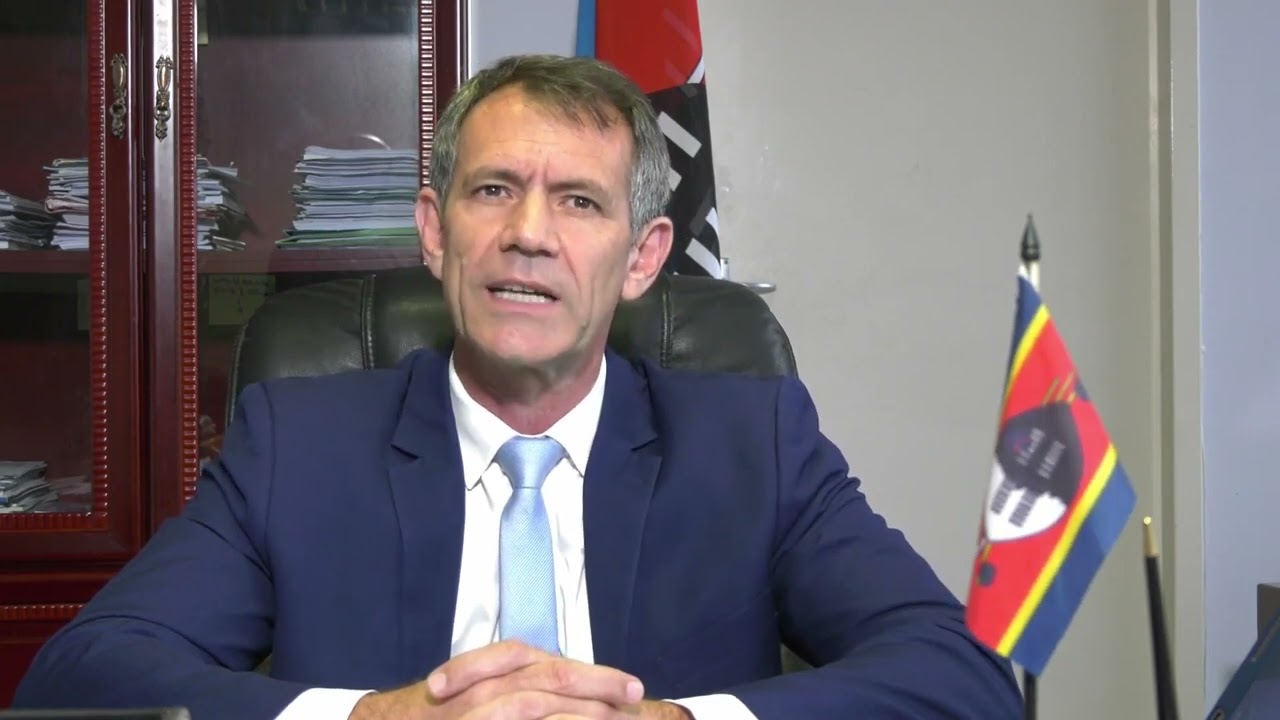
Mbabane – Minister of Finance Neal Rijkenberg has unpacked Eswatini’s macro fiscal outlook, providing insights into the country’s economic performance, fiscal position, and the measures being implemented to promote sustainable growth and strengthen public finances.
The Minister was speaking during this week’s edition of Finance in Focus, a Ministry of Finance programme.
“Good day Eswatini Lemahle. Once again, we’re doing our finance in focus and today I thought it might be a good idea to really unpack how macro fiscal things work in the country. As sometimes they look complicated, but they actually are not,” Rijkenberg said.
He explained that for about 20 years before the COVID era, Eswatini recorded average growth of around 2 percent, which he described as “really too low growth to create enough jobs and to get us out of poverty.”
The main reason, he said, lay in three reports written about the country which determine whether the world of finance is open or closed to Eswatini. “These reports are, the one is the IMF Article 4 report, the other one is the World Bank report and the other one is our Moody’s report. Obviously, we only use one rating agency that quite expensive, but we use Moody’s,” he said.
The Minister said the reports were unfortunately quite negative about Eswatini. They would say the wage bill was absolutely unsustainable and way too high, the fiscal deficit was too high, the country was on an unsustainable path, it had volatile SACU receipts, and it spent outside the budget. He added that they would often carry “a very strange narrative” on the country’s political system.
Rijkenberg said that from around 2018, 2019 and 2020, the country worked very hard to fix these narratives. A hiring freeze on government brought the wage bill down from 42 percent of expenditure to 32 percent. “In fact, now with the salary review, it’s taken us up to a 33% of expenditure, but again, we’re not going back to those old times,” he said, adding that government hopes to bring it below 32 percent over the next few years.
On the fiscal deficit, which he described as the gap between the money spent and the money available, government brought it down from 7.5 percent of GDP to about 2 percent in that period. Debt stabilised at around 40 percent of GDP, which meant the country was on a sustainable path.
The SACU Stabilization Fund was also introduced to deal with volatility in SACU receipts. “So now all of a sudden we have a fund, the fund is currently holding around 1.5 billion and that fund is now the cushion towards SACU receipts, meaning it’s no longer volatile,” he said.
Government also spent below budget for many years, while open discussions were held around the country’s political system. “Some people say Eswatini is undemocratic and it’s absolutely not the truth. Eswatini is very democratic and I say to everybody, come spend a day with me in parliament and tell me again we’re undemocratic,” Rijkenberg said.
He said after unpacking all of that, each of the entities removed negative commentary about the political system, and the three reports changed the narrative from Eswatini being virtually uninvestable to being investable.
This, he explained, meant two things. The world of finance opened up to the private sector in Eswatini, with local firms now able to borrow money from about ten times more sources than before, while world finance institutions also became open to lending to government.
“That is probably the main driver why we then went from a 2% average to around a 5% average because for those who don’t know what’s going on in the country, virtually every large company in Eswatini is going through growth and they can go through that growth because they have finance available to them to grow with,” he said.
The Minister however cautioned that the improved access to funding comes with risk, as government now faces the temptation to take on more debt. He revealed that debt has unfortunately risen from 40 percent last year to 45 percent, and might reach 50 percent of GDP this year.
He said there were very good reasons for this. The salary review added almost E2 billion to the wage bill. “It was necessary. That wage freeze did really bring civil servant salaries below what it should be,” he said.
Government also borrowed around E3 billion to settle arrears once and for all. In addition, with world oil prices volatile, a strategic fuel reserve is being built through a supplementary budget, while government also decided to finish the International Convention Centre.
Rijkenberg said these factors will be red lights to the entities watching the country closely, and Eswatini now needs to stabilise and bring debt back to around 45 percent of GDP.
He said the strategic approach going forward is to ensure debt is raised more through PPP structures, build arrangement structures and parastatals, directing funding to private sector kind of enterprises rather than directly to government. Government can still take on E7 to E8 billion a year in capital projects as debt, but must be careful not to exceed that.
“If we take more than that, we do risk turning again this green light we have on the world’s funding back to being red lights and go back to square one where our growth goes down again,” he warned.
The Minister said the underlying message is that now is a good time for those planning projects in the country, with funding generally more open to business than before. “I’m not going to say it’s easy, I’m not going to say the banks are relaxing the rules, but there is definitely more available to us as a country,” he said.
He added that the more GDP grows, the more the debt to GDP ratio allows government to take on more debt and do more projects, but government must be careful not to do projects ahead of growth and prevent the growth in the first place.
“So Eswatini, I know some of these things might be complicated a little bit, but in general, it is what we’re trying to do and as government, we’re trying to make sure that we remain in the right path and keep us sustainable as an economy. Thank you Eswatini Lemahle,” he said.






Leave a comment