


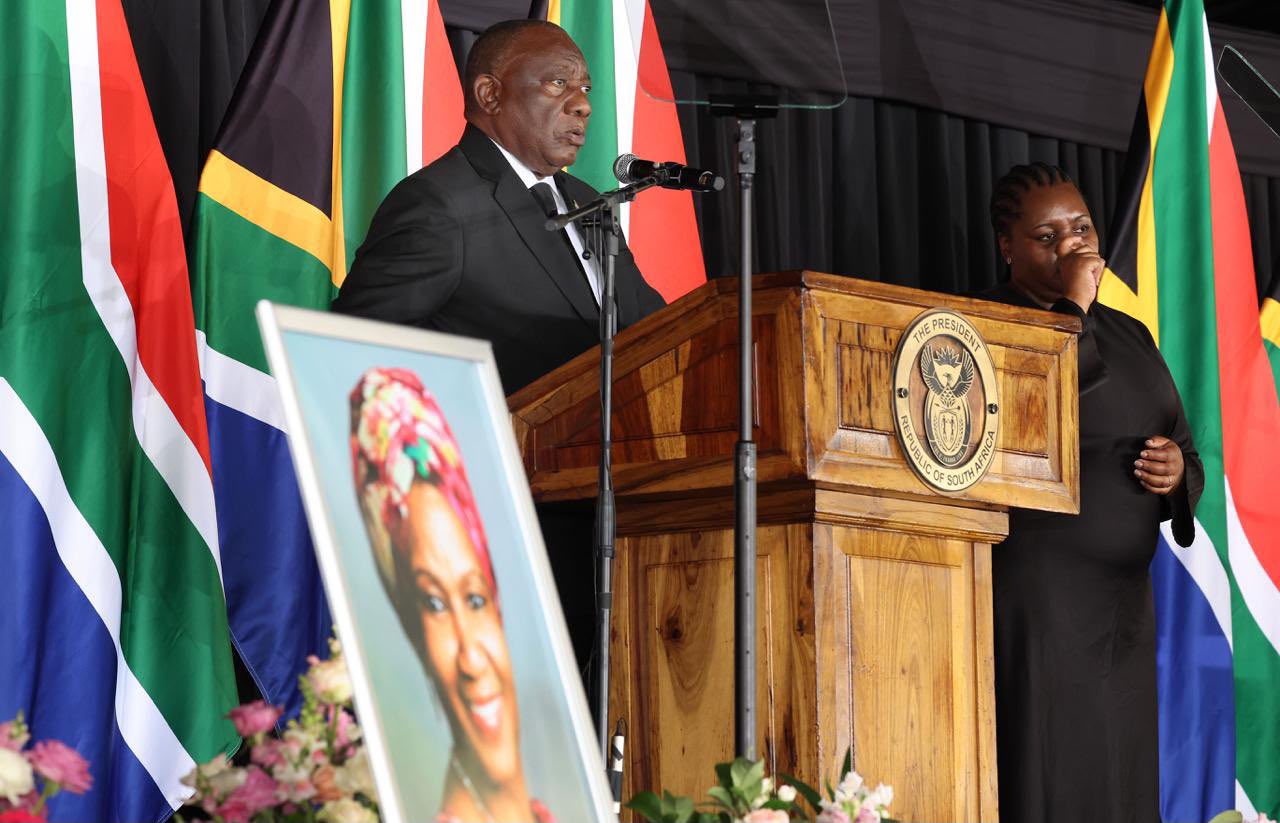
Middledrift – President Cyril Ramaphosa has paid tribute to former South African Deputy President Dr Phumzile Mlambo-Ngcuka, describing her as a dedicated servant leader whose lifelong commitment to women’s emancipation, gender equality and peacebuilding left a lasting mark on South Africa and the international community.
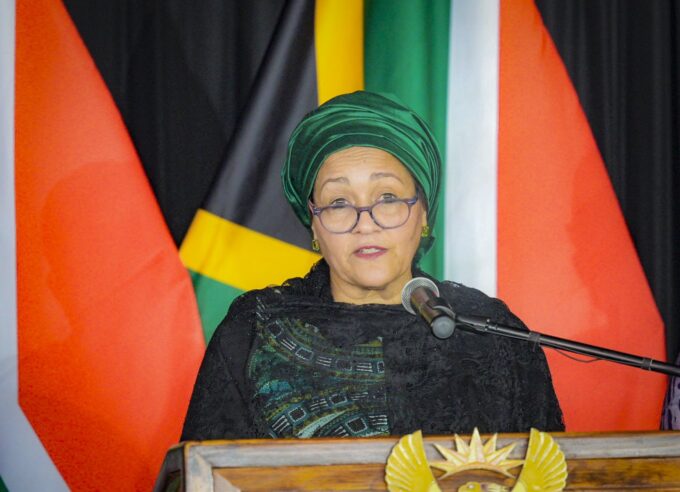
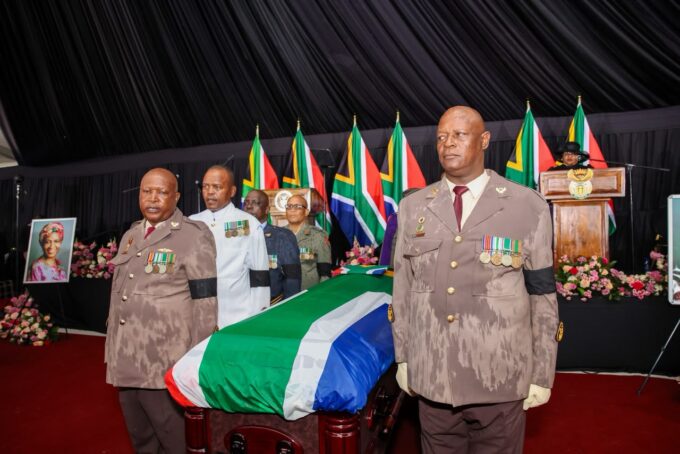
Ramaphosa delivered the eulogy at Mlambo-Ngcuka’s State Funeral in eXesi Village in the Eastern Cape, where family members, government leaders and mourners gathered to bid farewell to the former deputy president, who died aged 71.
The President remembered her as a woman of exceptional strength, humility and quiet determination, whose leadership was defined by her commitment to people and causes beyond herself.
He said her ability to command respect did not depend on authority or a forceful public presence, but on the dignity with which she approached leadership and public service.
“She was gentle without ever being timid. She was humble without ever diminishing the importance of the causes for which she stood. She did not need to raise her voice to make herself heard, nor did she need to assert her authority to command respect.
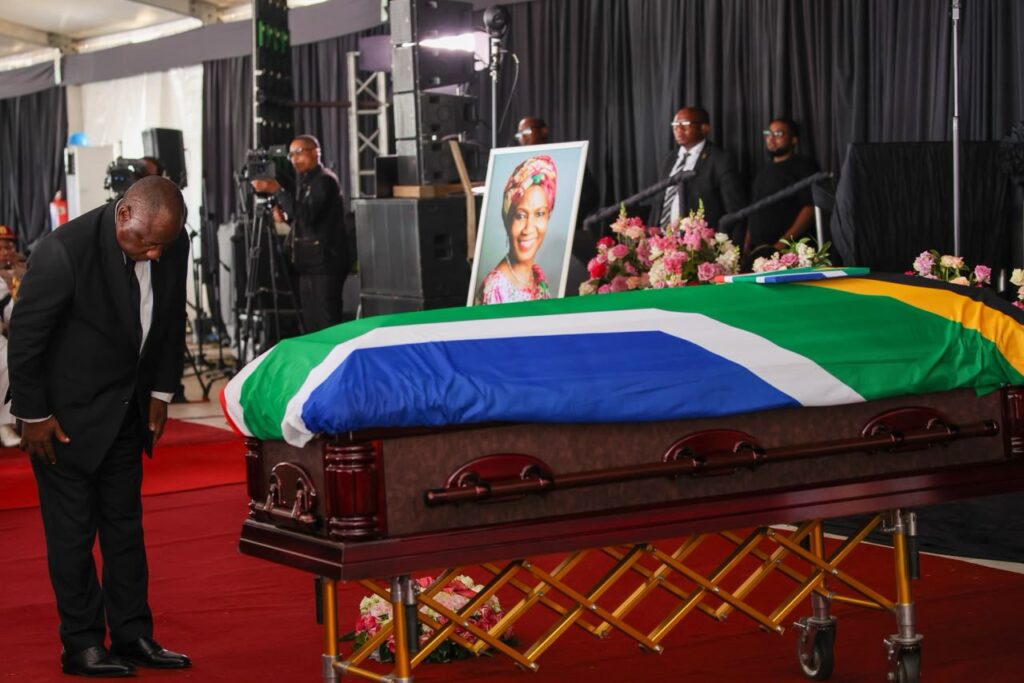
“There was a quiet dignity about her, a firmness of purpose and a generosity of spirit that endeared her to so many of us. No one would ever doubt the extraordinary impact that she had on the people of this country and around the world,” the President said.
Ramaphosa reflected on her journey as an activist, tracing her involvement in the Natal Organisation of Women and the World Young Women’s Christian Association in Geneva before she assumed prominent leadership responsibilities on the international stage.
Her appointment as Executive Director of UN Women placed her at the centre of global efforts to advance women’s rights and expand opportunities for women across different societies.
The President described the emancipation of women and the pursuit of gender equality as the defining causes of her public life.
“She knew that no country could be free until its women were free. And she knew that women could not be free until they had an equal stake in the economic life of the nation. And she was determined that women should be an integral and equal part of the global community.
“As the Executive Director of UN Women, she forged a new path for women across the world. Through the HeForShe campaign, she challenged men and boys to recognise that the emancipation of women was their responsibility too. She helped secure the recognition of gender equality as a goal in its own right among the UN Sustainable Development Goals.
“Through Generation Equality, she united governments and social formations across the world behind a shared determination that no woman should be denied the rights, opportunities and resources required for a secure, just and prosperous life. She understood the injustice of a world in which women bear so much of the suffering of war, yet are so often absent from the negotiating tables where peace is made,” Ramaphosa said.
Under her leadership at UN Women, the HeForShe campaign sought to bring men and boys into the struggle for gender equality, while the Generation Equality initiative mobilised governments and civil society organisations around commitments to improving women’s rights and access to opportunities.
Her international work also included advocating for women’s participation in peace negotiations, particularly in regions affected by armed conflict.
Ramaphosa drew attention to the timing of her burial during South Africa’s annual 16 Days of Activism for No Violence Against Women and Children campaign.
He said the coincidence carried particular significance given her longstanding commitment to protecting women and children from violence and abuse.
The President called on South Africans to carry forward her conviction that freedom must include protection from fear, violence and abuse, particularly violence perpetrated by men against women.
Beyond her work on gender equality, Ramaphosa recognised Mlambo-Ngcuka’s contribution to African diplomacy and conflict resolution, particularly her involvement in efforts to end the conflict in Ethiopia’s Tigray region.
She worked alongside former Nigerian President Olusegun Obasanjo and former Kenyan President Uhuru Kenyatta in the mediation process that led to the Pretoria Peace Agreement in November 2022.
The agreement brought an end to two years of large-scale hostilities and created an opening for humanitarian assistance to reach communities affected by the conflict.
“The Pretoria Peace Agreement of November 2022 brought an end to two years of large-scale hostilities and opened the way for humanitarian assistance to reach communities that had endured unimaginable suffering.
“Through her contribution to this process, she demonstrated that Africa possesses the wisdom, the experience and the capacity to resolve its own conflicts,” the President noted.
Ramaphosa’s tribute placed her diplomatic contribution within the broader question of Africa’s ability to address its political and security challenges through homegrown solutions.
Addressing the bereaved Mlambo and Ngcuka families, the President acknowledged the personal sacrifices associated with having a family member devote much of her life to public service, national leadership and international responsibilities.
He conveyed the nation’s condolences and thanked the families for allowing her to serve South Africa and the wider international community.
“To the Mlambo and Ngcuka families, please know that the whole nation shares your loss. We thank you for sharing her so generously with our country and with the world. We recognise the sacrifices that families make when those they love dedicate their lives to the service of others.
“May you find comfort in knowing that her life was a blessing to so many people, and that her legacy will endure far beyond our own generation. As you remember her, may her legacy assuage the anguish of your loss, and leave you only the wonderful memory of Sis’ Phumzile,” he said.
The President described her passing as a national loss, recalling her contribution to South Africa’s democratic journey and her influence on international efforts to advance equality and peace.
South Africa, he said, had lost a servant leader and a remarkable daughter of the soil.
“She was called to lead and she answered with humility and quiet courage. A great tree has fallen. But we can see where it lies. And from where it lies, we know her purpose. We know her character. And we know what we must now do to take forward her struggle.
“Our dear sister, mother, comrade and leader has been called to her eternal rest. Rest in peace, mbokodo,” President Ramaphosa concluded.




Leave a comment