


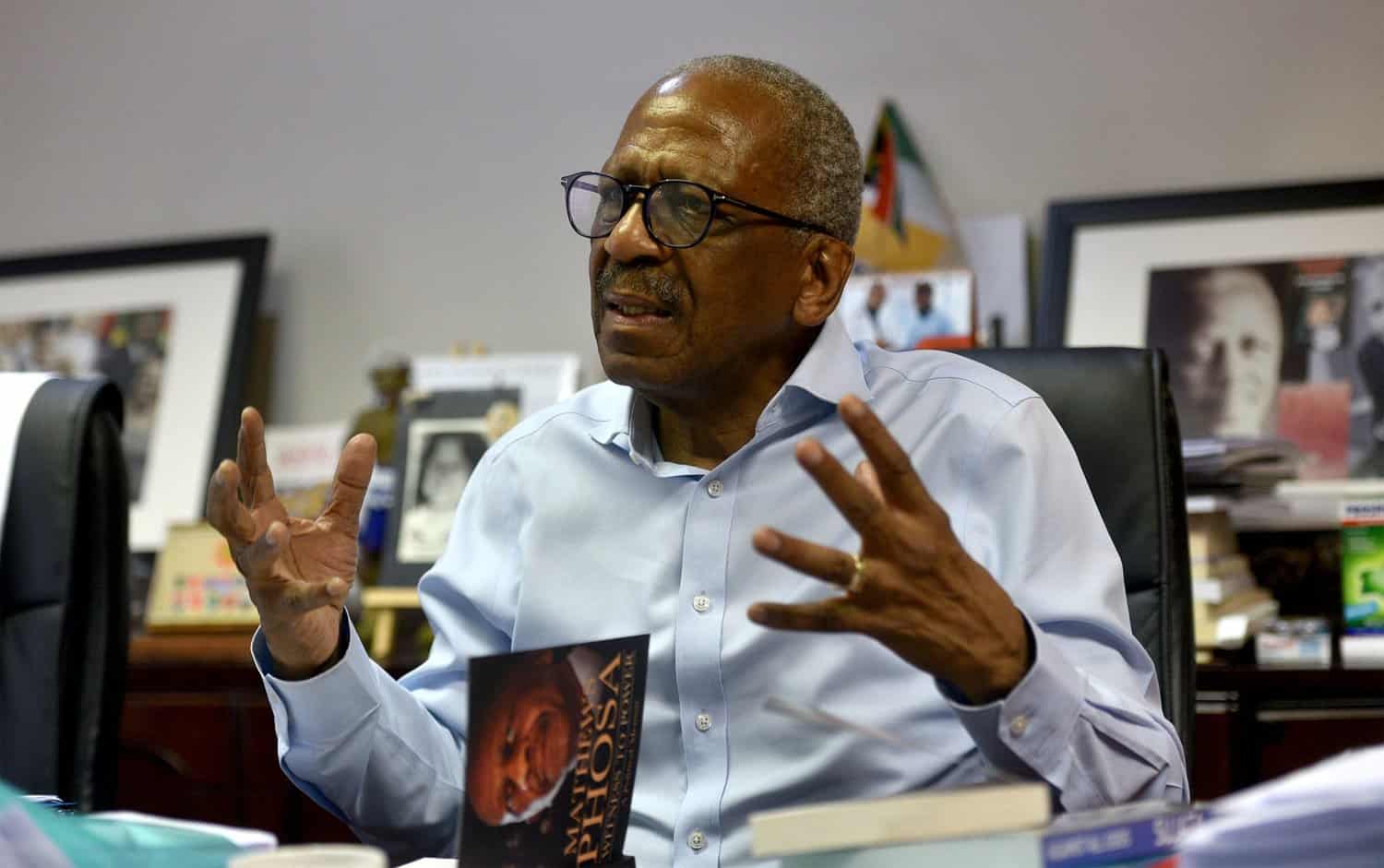
In the first episode of the podcast “Human at the Helm”, Dr Nakedi Matthews Phosa made a case that deserves the attention of every African university, government, boardroom and young innovator.
His message was simple and profound: Artificial Intelligence is here to stay. The question is no longer whether we should use it or not. The question is how we use it.
Dr Phosa sees AI as a driver of every aspect of life, including education, health, justice, innovation, corporate governance and economic growth. He is right. AI is already preparing board papers. It is already helping doctors diagnose. It is already helping students learn. It is already helping governments detect fraud.
But Dr Phosa went further. He proposed something urgent and necessary: Africa must develop what he calls Ubuntu AI, an indigenous approach to AI that reflects African excellence, African values, and African humanity.
The time to consume only a Westphalian or Eurocentric model of AI is over. Africa must not only consume the products of the Fourth Industrial Revolution. It must co-produce them. It must claim ownership of them.
I listened to that interview with deep resonance, because it echoed a paper I delivered at the Internationalisation Conference at UNISA on 18 November 2026.
In that paper, I argued that internationalisation is inevitable, but it must not be done at the expense of localisation. Universities must internationalise without losing their own local identity. That is partnership. That is dignity. That is true global engagement.
The same principle applies to AI. AI as an application must co-exist with local innovation represented by Ubuntu. That co-existence will be complementary. It will prove that Africans do not only consume technology, we create it, we shape it, and we give it a soul.
Today, a student has more access to knowledge than a professor did 30 years ago. That is not a threat to intellect. That is a liberation of intellect. Universities have embraced AI because it makes work easier, faster and more accessible than in the last 30 years. But as Dr Phosa correctly warned, the use of AI must come with responsibility.
AI is just an application, like any other we use daily. It is not meant to diminish human intellect. It is meant to enhance it for the creation of a better future. A calculator did not make mathematicians stupid. It made them faster. A tractor did not make farmers lazy. It made them more productive. AI must do the same for this generation.
This is where Ubuntu becomes critical. Ubuntu says: “I am because you are.” Ubuntu says that technology must serve humanity, not replace humanity. Ubuntu says that innovation without ethics is not progress. Ubuntu says that a machine can process data, but only a human can show compassion, exercise judgement, and carry moral responsibility.
An Ubuntu AI would therefore ask different questions. Not only: “How fast can this system work?” But also: “Whom does it serve? Whom does it exclude? Does it protect the poor? Does it respect our languages, our cultures, our histories? Does it strengthen community, or does it isolate the individual?”
Africa has more than 2,000 languages. Our proverbs carry wisdom. Our communal life carries solutions to problems that Western individualism has struggled to solve. If we train AI only on foreign data, foreign languages and foreign values, we will get foreign answers to African problems. If we train AI on our own stories, our own languages, our own jurisprudence and our own communal ethics, we will get African solutions.
Dr Phosa also made a powerful point as an anti-corruption advocate: AI must be used not only to grow the economy, but to prevent corrupt activities in government and the private sector. This is Ubuntu in action. Corruption is the opposite of Ubuntu. Corruption says: “I am because I take from you.” Ubuntu says: “I am because I serve you.” AI can help us track public spending, expose ghost workers, detect procurement fraud, and make governance transparent. That is not just technology. That is moral technology.
Many fear that AI will take people’s jobs. I understand that fear, but I do not share it. History teaches us that every technological revolution destroys some tasks and creates new work, new skills and new industries.
Look at China. China did not fear automation. It embraced it, localised it, and used it to create new opportunities. China used AI, robotics and digital platforms to build new factories, new logistics systems, new e-commerce ecosystems, and millions of new jobs in data, maintenance, design, content, delivery, and entrepreneurship. AI did not make China jobless. It made China more competitive, and it lifted millions out of poverty.
Africa can do the same, and must do it in our own way. AI will not take the jobs of nurses, but nurses who use AI will serve more patients. AI will not take the jobs of teachers, but teachers who use AI will reach more children. AI will not take the jobs of farmers, but farmers who use AI to predict weather, detect disease and access markets will feed more families.
New opportunities will emerge: AI trainers who teach machines our languages, data annotators who protect our heritage, prompt engineers who solve African problems, ethicists who guard Ubuntu values, and entrepreneurs who build African AI start-ups for African markets.
The choice before us is not between humans and machines. It is between consumption and creation. Between dependence and dignity. Between fear and Ubuntu.
Let us therefore embrace AI, but embrace it as Africans. Let us build Ubuntu AI, intelligent, ethical, communal, and human.
If we build AI with Ubuntu, AI will not divide us. It will unite us. It will not take our jobs. It will create our future.
Bobby Moroe is the Consul General of South Africa in Lagos, Nigeria.














Leave a comment