


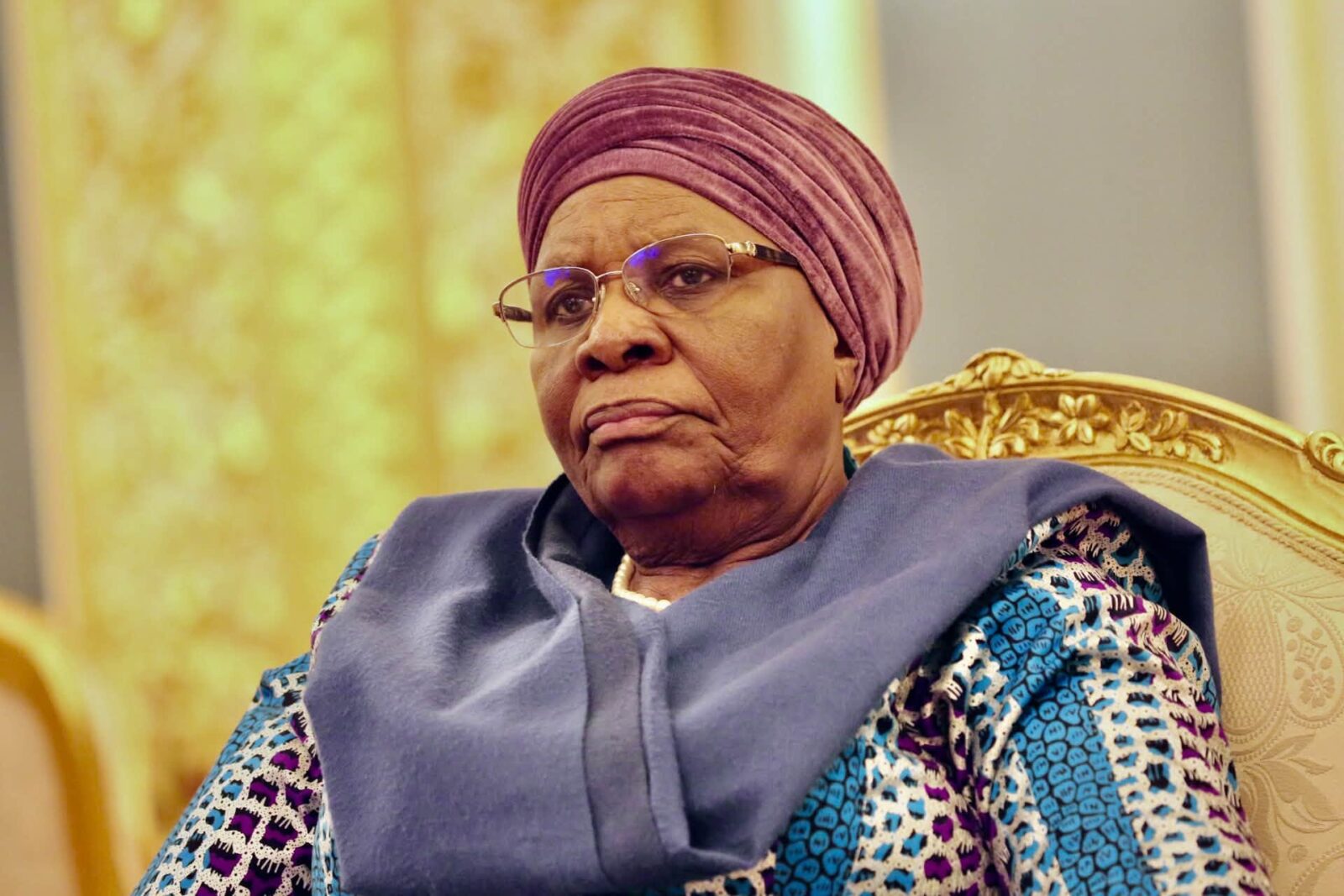
MOSCOW – Namibian President Netumbo Nandi-Ndaitwah has called for stronger economic cooperation between Africa and Russia, saying the continent must move beyond the political solidarity that supported its liberation struggles towards partnerships that deliver industrialisation, technology transfer, investment and greater control over natural resources.
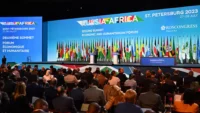
Speaking to RT in an exclusive interview on the sidelines of the Russia-Africa Summit in Moscow, Nandi-Ndaitwah discussed Namibia’s priorities in its relationship with Russia, the need for reform of the United Nations Security Council, Africa’s mineral wealth, historical justice and the impact of Western sanctions on developing countries.
The president, who attended the previous Russia-Africa Summit in 2023 as Namibia’s foreign minister, returned to Moscow in 2026 as head of state, describing the engagement as an important opportunity to strengthen the longstanding relationship between Russia and African countries.
She said Russia had supported African liberation movements long before independence, including Namibia’s struggle against colonial rule and apartheid.
“Before our continent is independence and specifically I can stand for Namibia. The people of Russia have been with us.”
She recalled that Russian support helped African liberation movements gain access to international platforms and negotiations, contributing to the eventual achievement of independence.
According to Nandi-Ndaitwah, the next phase of that relationship must focus on economic independence, particularly through trade, investment and the development of local industries.
“So, the main purpose of this summit is really to build in that long standing foundation, which is more political for us now to move into economic with particular reference to trade and investment because the the independence we fought for we fought for our people to enjoy their natural resources.”
She said Africa’s development must be driven by the ability of its countries to process their resources, develop industries and ensure that ordinary citizens benefit from the wealth generated within their borders.
The president said industrialisation, value addition and natural resource beneficiation were central themes of the discussions in Moscow.
She argued that African countries should become equal partners in global economic development rather than remain suppliers of unprocessed raw materials.
Moscow education shaped her leadership
Nandi-Ndaitwah also reflected on her personal connection with Russia, dating back to the liberation struggle when she was a member of Namibia’s Swapo movement.
She joined Swapo in 1966 and later studied in Moscow at the Lenin Higher Komsomol School, where she received training focused on youth mobilisation and development.
Asked how the experience influenced her political outlook, she said education had played a significant role in shaping her leadership and commitment to young people.
“And uh I can say with confidence that what I have learned when I was studying here in Moscow at the Lenin High Consommal School It has really made a lasting impact in my life.”
She explained that her studies concentrated on the work and projects of the young communist movement, particularly how to organise young people, address their needs and create opportunities for their participation in national development.
The experience, she said, continues to influence her approach to governance.
“To the extent that even the Swap Youth League they have given me a honoral membership to the Swap Youth League. And that is long time even before I become a deputy prime minister. They just realize because it’s what is in me.”
Her administration has consequently placed young people at the centre of several national priorities, including education, sports, the creative industries and entrepreneurship.
Nandi-Ndaitwah said one of her first major decisions after taking office was to subsidise higher education at both public and private universities.
Her government also established a youth development fund intended to support young Namibians, particularly innovators and entrepreneurs, enabling them to participate in the country’s economic transformation.
Energy and technology drive Namibia’s priorities
The president identified energy, agriculture, technology, science and mathematics as important areas for cooperation with Russia.
These sectors were also discussed during the recent Intergovernmental Commission meeting in Windhoek, where Namibia outlined areas in which Russian expertise and investment could contribute to its development ambitions.
She explained that agriculture required significant scientific knowledge, including an understanding of soil conditions, fertilisers and appropriate seed varieties.
For Namibia, strengthening agricultural skills and technology is particularly important as the country seeks to improve productivity and develop its domestic economy.
Energy, meanwhile, is essential to the country’s industrialisation ambitions, particularly because Namibia possesses substantial mineral resources that require processing.
“Now, Namibia is is a mineral-based country. And we talk about value addition. Value addition, you can only do it in industries. And you need energy for that purpose.”
She added that technological development was equally important in an increasingly digital global economy.
The government wants cooperation in these areas to expand economic opportunities, create employment and ensure that the benefits of development are shared more broadly among Namibians.
Nandi-Ndaitwah said employment creation remained a critical part of the country’s economic strategy, linking industrial growth with improved living standards.
Namibia and Russia explore nuclear energy
On civil nuclear cooperation between Namibia and Russia, the president said discussions were still at an early stage but remained part of a longer-term process.
She identified energy and water as essential requirements for Namibia’s industrial development, noting that the country was among the world’s major uranium producers.
Uranium is a key raw material used in nuclear energy production, giving Namibia a potential strategic role in the global nuclear energy industry.
“Yeah, we have decided that to really industrialize our country, our economy, energy, and water are very essential.”
She said Namibia understood the importance of developing its energy capacity and would continue exploring opportunities for cooperation with Russia.
“So we are in uh we we we are at the initial stage, but uh it’s a it’s a process that we know that we are not going to stop now that we have started it.”
Namibia demands permanent UN Security Council seat
Nandi-Ndaitwah also addressed the campaign to reform the United Nations, particularly the composition and decision-making powers of the Security Council.
Namibia is a member of the African Union’s Committee of Ten, commonly known as the C10, which was mandated to lead the continent’s campaign for comprehensive UN reform.
The initiative seeks to correct what African governments regard as the continent’s historical exclusion from permanent representation in the Security Council.
The president said Africa’s position was clear: the continent must receive permanent membership with the same privileges and authority enjoyed by existing permanent members.
She argued that the United Nations had changed considerably since its establishment, with membership expanding while Africa’s influence and representation remained disproportionate to its size and importance.
“And one of the most critical issue when it comes to the Security Council is the issue of permanent member with a veto. And that’s where Africa we are saying we need need to have a seat in a permanent base if the if the veto with all the powers. So, that one we are not going to compromise.”
She rejected proposals that would retain the existing five permanent members without addressing Africa’s exclusion from the decision-making structure.
According to Nandi-Ndaitwah, simply expanding membership without giving African countries equivalent powers would not constitute meaningful reform.
“So, we really need if we are reforming, we must reform in totality so that the the globe can be fairly represented. And Africa which is such that a big constituency in the United Nations cannot be left out. So if there will be a veto, we should also have a veto.”
Africa must coordinate mineral investment rules
The Namibian leader also discussed the barriers preventing African countries from processing their natural resources domestically, arguing that international trade arrangements and limited technical capacity continued to constrain development.
She criticised aspects of the World Trade Organization’s rules, saying they did not adequately support developing economies in maximising the benefits of their resources.
Nandi-Ndaitwah pointed to the African Continental Free Trade Area (AfCFTA), whose secretariat is based in Ghana, as an important instrument for improving the continent’s economic position.
She said African countries needed to coordinate their policies and strengthen their bargaining power when negotiating with international investors and multinational companies.
Namibia, which has been independent for 36 years, was still dealing with the consequences of apartheid, including inequalities in education and skills development.
She said these historical challenges had affected the country’s ability to develop the technical expertise required to process its mineral resources.
As part of its response, Namibia is seeking foreign investors willing to establish processing facilities locally while training Namibian workers to eventually assume greater responsibilities.
The president said Russian companies were welcome to invest in Namibia, provided their projects contributed to local industrial development and skills transfer.
“So, as we are inviting investors to come in, for example, we say the Russian investors come into Namibia, set up processing plant. Then we need our own people to be trained so that they cannot just be continuing to be lazy, but for them to take over.”
She said African countries also needed a common approach to investment negotiations to prevent multinational companies from exploiting differences in national policies.
If one country imposed stronger conditions on investors while another offered less demanding arrangements, companies could simply move their operations elsewhere.
Nandi-Ndaitwah said coordinated African positions would make it easier for governments to negotiate agreements that deliver better economic returns.
She proposed bringing African technical experts together to develop common negotiating positions before governments engage multinational corporations.
Local ownership central to foreign investment
Addressing concerns about excessive dependence on foreign companies, the president said Namibia wanted investors to enter into genuine joint ventures with local businesses.
She explained that the government would not dictate which Namibian company an investor should partner with, but would require foreign investors to identify local partners.
Those partnerships, she said, must go beyond nominal ownership arrangements and provide Namibians with meaningful participation in company management and decision-making.
“First, we are also looking for when you are coming to invest, we are talking about joint venture. The government will not tell you that this is the person you should partner, but you must find a Namibian partner. And that partner must be true partnership.”
She said local partners should participate in management structures, contribute to decisions and benefit from training programmes.
The objective is to develop Namibian expertise and enable local companies and professionals to expand into other sectors of the economy over time.
The approach is particularly relevant to Namibia’s deposits of critical minerals, including lithium, uranium and copper, which have attracted growing international interest.
Government develops value addition policy
Nandi-Ndaitwah said her administration had adopted a National Development Plan (NDP) last year, setting targets for mineral processing and domestic ownership by 2030.
The plan seeks to increase processed mineral exports to 57 per cent and domestic ownership to 60 per cent.
She said the government was working towards finalising a policy on value addition to establish clear expectations for investors and businesses operating in the country’s mining sector.
The policy will define what value addition should mean for different minerals, including uranium, copper and lithium.
She said this would give investors greater clarity about the government’s expectations when establishing mining and processing operations in Namibia.
“Where we are now, we have almost finalized our policy on value addition so that it’s very clear to everybody that when we talk about value addition, what are we talking about?”
Nandi-Ndaitwah expressed hope that the policy would be ready early next year, allowing businesses and potential investors to understand the requirements attached to mineral development.
Germany’s genocide settlement remains contested
The president also addressed Namibia’s long-running dispute with Germany over the 1904 to 1908 genocide committed against the Ovaherero and Nama people during German colonial rule.
Germany has acknowledged responsibility for the atrocities and proposed development funding, but the nature and administration of the financial arrangement have remained contentious.
Asked why Namibia considered the proposed arrangement insufficient as a formal reparations settlement, Nandi-Ndaitwah explained that the money was intended specifically for descendants of genocide victims in seven affected regions.
She said the proposed funding, amounting to 1.1 billion, was separate from Germany’s ordinary development assistance to Namibia.
The president rejected the suggestion that the arrangement was simply a development cooperation programme.
“Germany is not offering us a development corporation. Germany is is an antonym for the genocide that is committed in Namibia.”
She explained that the proposed resources were intended to address the consequences of the genocide among communities descended from the victims rather than benefit the entire Namibian population.
According to her, Germany had also indicated that additional resources would be made available to the descendants of those affected.
Nandi-Ndaitwah said the money would not be distributed directly to individuals because the intended beneficiaries were descendants rather than the original victims.
Instead, the descendants would determine how the resources should be managed and utilised through a dedicated structure.
She said neither the Namibian nor German government would directly administer the proposed arrangement.
The descendants would be responsible for establishing a special vehicle to oversee the funds and determine how they should be used to address the historical damage caused by German colonial rule.
Namibia opposes unilateral sanctions
The president defended Namibia’s opposition to unilateral sanctions and blockades imposed by Western countries against nations including Cuba, Venezuela and Zimbabwe.
She said the country’s position was guided by its Constitution, which calls for disputes and international tensions to be resolved through negotiations.
Nandi-Ndaitwah described collective punishment through economic restrictions as inhumane, particularly when populations suffer because of disagreements between governments.
“Yes, the the it is not really shaped because uh is uh Namibia’s, uh, we are very clear in how we feel and how our constitution direct us on how to manage a conflict in international arena.”
She said Namibia would continue engaging Western countries despite disagreeing with some of their foreign policy decisions.
The president pointed out that the United States and several Western countries maintained diplomatic missions in Namibia, while Namibia also maintained diplomatic representation abroad.
She said bilateral relations could continue without requiring Namibia to support policies it considered unjust.
Referring to the international opposition to the US embargo against Cuba, she cited a recent United Nations resolution in which most member states rejected the continuation of the restrictions.
For Namibia, she said, the issue was one of principle, particularly the need to respect national sovereignty and peaceful coexistence.
She argued that the United Nations was established to provide a platform for member states to resolve disputes through dialogue rather than impose their political preferences on other countries.
African solidarity needed against economic pressure
Asked whether the growing use of sanctions and economic restrictions could threaten other countries in the Global South, Nandi-Ndaitwah described the trend as dangerous.
She said developing countries needed to strengthen cooperation and expand their domestic economic activities to withstand external pressure.
“Yes, it’s a very dangerous trend.”
She argued that countries with stronger economic partnerships and productive capacity would be better positioned to withstand embargoes and sanctions.
Without such cooperation, she warned, vulnerable economies could struggle to withstand external pressure and become increasingly dependent on decisions made elsewhere.
The president said African countries and other developing nations needed to work together to strengthen their economic resilience.
Russia remains a strategic partner for Africa
Nandi-Ndaitwah welcomed comments describing Africa as the continent of the future, saying Russia had recognised the continent’s potential long before the current international interest in its resources and markets.
She said Russian support for African liberation movements demonstrated that Moscow’s interest in Africa was not a recent development.
“Definitely, Africa is a continent of the future and Russia is not seeing it today.”
She said Russia’s historical relationship with African countries had continued to develop and was now being reinforced through economic cooperation.
For Namibia, the relationship offers opportunities to attract investment, access technical expertise and develop sectors that remain important to its national development ambitions.
President rejects negative perceptions of Russia
Towards the end of the interview, Nandi-Ndaitwah was asked to respond to perceptions that Russia was an unsafe or undesirable destination, particularly among audiences exposed to negative portrayals in Western mainstream media.
Drawing on her experience in Moscow and the activities surrounding the summit, she said visiting delegations had an opportunity to see the country’s development and identify areas where African economies could benefit from cooperation.
She referred to an exhibition she had visited the previous day, where she observed developments in agriculture, energy, manufacturing, education, healthcare and technology.
The president said Namibia’s Minister of Agriculture had accompanied her to Moscow and was actively engaging Russian officials and institutions to explore possible areas of cooperation.
She described agriculture as Namibia’s number one priority and said the Russian exhibition had demonstrated opportunities for technical assistance and training.
“Starting with agriculture which is in Namibia is a priority number one and I tell you I brought our minister for agriculture here.”
She said the minister had been holding discussions with Russian officials, including representatives of the Ministry of Agriculture.
Nandi-Ndaitwah also pointed to energy cooperation, saying Namibia faced shortages and was therefore pursuing a mixed energy approach to improve supply.
She welcomed what she had learned about Russia’s own approach to combining different energy sources.
The president further described Russia’s industrial and technological capabilities as areas from which Namibia could learn.
She cited developments in education, noting the presence of students from different nationalities who travel to Russia for academic opportunities.
Healthcare was another sector that attracted her attention, particularly the use of digital systems to connect medical facilities and enable patients to receive diagnoses and treatment through centralised technological platforms.
She described a medical system demonstrated during the exhibition in which diagnostic information could be transmitted to a central facility, allowing doctors elsewhere to assess patients and provide assistance.
Nandi-Ndaitwah also spoke about the importance of technological and information sovereignty, saying countries needed the capacity to manage their own information systems and technological infrastructure.
She argued that control over information and technology was increasingly important in protecting citizens from harmful external influences.
For Namibia, she said, Russia offered opportunities for learning, technical cooperation and investment across several sectors.
She concluded by inviting Russian companies to explore investment opportunities in Namibia, saying her government remained open to foreign investment and welcomed Russian businesses alongside investors from other countries.






Leave a comment