


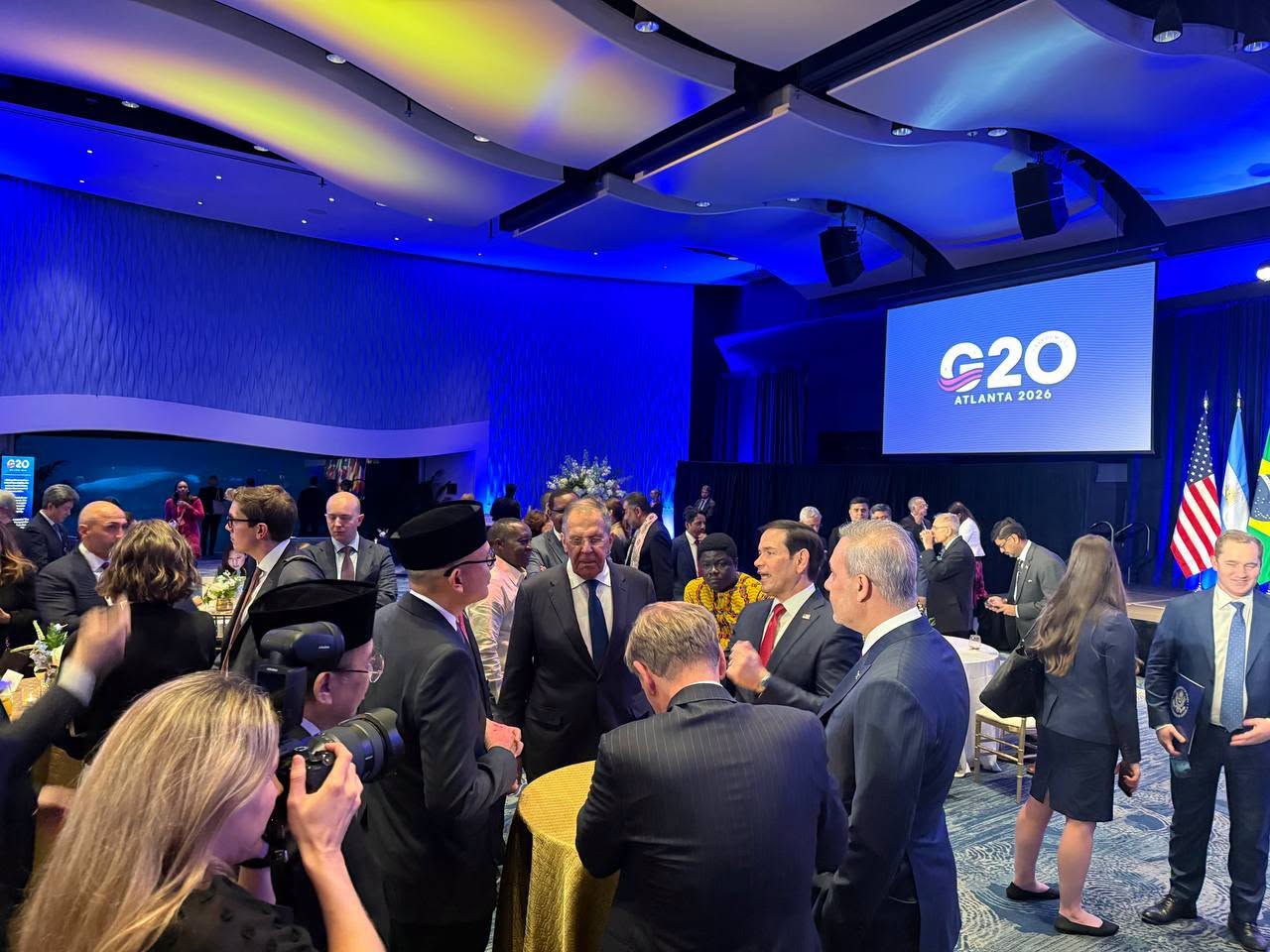
ATLANTA, United States – Russian Foreign Minister Sergey Lavrov has used the G20 Foreign Ministers’ meeting in Atlanta to call for changes to global economic governance, greater respect for multipolarity and an end to what Moscow describes as the politicisation of international trade, energy supplies and shipping routes.
Lavrov led the Russian delegation at the ministerial meeting, which concluded on October 31, 2026, under the United States’ G20 presidency. Discussions brought together representatives of the world’s major economies to examine the relationship between geopolitical tensions and global economic challenges ahead of the G20 Leaders’ Summit scheduled for December in Miami.
According to Russia’s Ministry of Foreign Affairs, the discussions covered energy and food security, international supply chains, maritime transport and the wider consequences of geopolitical instability for the global economy.
Lavrov presented Moscow’s position on the growing pressures affecting international trade, arguing that energy and food supplies should be allowed to move freely without discriminatory restrictions.
He also called for reforms to international economic governance, stronger multipolar cooperation and action against what Russia considers unfair competition and neo-colonial practices.
The Russian delegation raised concerns about sanctions, the seizure of national assets and the interception of commercial vessels, describing these practices as obstacles to the normal functioning of international commerce.
Moscow also presented itself as a dependable supplier of energy resources, agricultural commodities and fertilisers, particularly to countries facing supply shortages.
Russia’s transport and logistics infrastructure also featured in the discussions, including opportunities to expand the Northern Sea Route, which Moscow considers an important alternative shipping corridor connecting markets in Europe and Asia.
The Russian delegation further promoted President Vladimir Putin’s proposal for a Greater Eurasian Partnership and efforts to develop a common security framework across Eurasia.
Lavrov backs US approach to G20 discussions
Speaking to journalists after the ministerial meeting, Lavrov welcomed Washington’s stated intention to keep the G20 focused on economic matters rather than allowing political disagreements to dominate its work.
He said Russia supported the American presidency’s decision to prioritise issues agreed upon by participating countries as preparations continue for the December summit in Miami.
“We support the US Presidency’s fundamental commitment to depoliticizing discussions and focusing on the topics initially agreed upon as the G20 agenda. This year, this is, of course, the preparatory stage for the Miami summit in December.”
Lavrov identified energy, food security, innovation and supply chains as central issues requiring collective attention, particularly as geopolitical conflicts and sanctions continue to affect international markets.
He also welcomed the participation of the African Union in the G20 process, noting that decisions taken by the group have consequences well beyond its membership.
According to Lavrov, the G20 represents 20 major participants, including the European Union and African Union, whose combined economic influence means that its decisions affect countries across the world.
He said the American presidency’s pragmatic approach could help members reach agreements despite their competing national interests.
On the question of whether the G20 needs to be replaced or restructured through a new international platform, Lavrov rejected the creation of additional formats as a solution to existing disagreements.
He argued that the organisation remains sufficiently representative of the global economy and industrial production, including agricultural output.
Lavrov also credited previous presidencies held by BRICS members with producing decisions that were subsequently implemented, expressing hope that Washington’s leadership could deliver similar outcomes.
South Africa’s participation raises questions
The Russian foreign minister also addressed controversy surrounding the possible inclusion of Poland as a permanent G20 participant following an invitation from Washington.
Lavrov said Moscow had not experienced direct pressure over the matter but questioned the diplomatic procedure used to invite the Polish representative.
He argued that decisions concerning participation in the G20 should follow the established principle of consensus, including agreement on the admission of new members and the participation of existing members.
South Africa’s position featured prominently in his response, with Lavrov saying that several participants had called for the country to retain its regular and equal place in the forum.
He questioned Poland’s economic credentials for permanent membership, arguing that the country did not represent a sufficiently distinct economic constituency to justify additional European representation.
Lavrov also challenged the argument that Poland should represent Eastern Europe, saying the European Union and NATO already have established representation through countries such as France, Germany and the United Kingdom.
He argued that the G20 should better reflect changes in the global economy, particularly the growing influence of countries in the Global South and East in international finance, trade, manufacturing and energy.
The Russian minister said Moscow would work towards restoring what it considers the proper consensus-based framework for the organisation.
Lavrov meets Rubio and other foreign ministers
On the sidelines of the Atlanta meeting, Lavrov held bilateral contacts with several counterparts, including US Secretary of State Marco Rubio, India’s External Affairs Minister Subrahmanyam Jaishankar, Saudi Arabia’s Foreign Minister Faisal bin Farhan Al Saud, Indonesia’s Foreign Minister Arrmanatha Nasir and Japan’s Foreign Minister Toshimitsu Motegi.
His engagement with Rubio included discussions on bilateral relations and cooperation within international organisations, including the United Nations, G20 and Asia-Pacific Economic Cooperation (APEC).
Lavrov described the exchange with the American secretary of state as constructive, although brief because of Rubio’s responsibilities as host of the ministerial meeting.
He said differences between Washington and Moscow should not prevent cooperation where their interests overlap.
The Russian minister recalled that Rubio had acknowledged during their first meeting in Riyadh in February 2025 that Russian and American national interests would frequently differ.
However, Lavrov argued that areas of common interest should be translated into mutually beneficial projects, while disagreements should not be allowed to escalate into confrontation.
He also criticised European governments for maintaining what he described as an increasingly confrontational approach towards Moscow.
Referring to German Foreign Minister Johann Wadephul, Lavrov recalled that the German official had previously requested a meeting with him in New York but later indicated that he would not be photographed alongside the Russian minister.
Lavrov described this approach as “family photo diplomacy”, arguing that diplomatic engagement should focus on resolving substantive disagreements rather than public appearances.
Russian energy trade and US sanctions
Questions surrounding Russian fuel exports and American sanctions also featured prominently during the press conference.
Lavrov responded to concerns raised by US Senator Richard Blumenthal, who had questioned the legality of Russian fuel supplies and warned shipping companies against participating in such transactions.
The Russian foreign minister acknowledged that American legislation restricts imports of Russian fuel but argued that Moscow was not responsible for determining how Washington applies its domestic laws.
He said Russia remained willing to supply energy resources to international markets where commercially beneficial arrangements could be reached.
Lavrov also rejected suggestions that a recent diesel fuel arrangement between Russia and the United States represented a major breakthrough in bilateral relations.
He pointed out that Washington continued to maintain sanctions introduced under former President Joe Biden while imposing additional restrictions on Russian energy companies Lukoil and Rosneft.
He further accused Western governments of continuing military assistance to Ukraine through European partners and raised concerns about intelligence cooperation supporting Ukrainian military operations.
The minister also said there had been no meaningful progress on the return of Russian diplomatic property in the United States, although discussions between experts were continuing.
Lavrov cited US Treasury Secretary Scott Bessent’s assessment of the diesel arrangement, recalling his statement: “There is no breakthrough; this is an exception. All sanctions remain.”
He cautioned against interpreting isolated commercial agreements as evidence of a fundamental improvement in relations, saying Russia needed to protect its economic sovereignty and develop its own capabilities.
Abu Dhabi negotiations and Ukraine
The proposed negotiations in Abu Dhabi between Russia, Ukraine and the United States were another major subject during the press conference.
Lavrov said he and Rubio were not directly responsible for preparing the negotiations, explaining that President Putin had appointed a separate delegation to handle the discussions.
He identified Russian Presidential Aide Yury Ushakov and Kremlin spokesperson Dmitry Peskov as officials who had previously referred to a possible mid-November timeframe.
The minister said the specific dates would be announced once the arrangements had been finalised.
Asked whether Russia’s position on the conflict in Ukraine had changed, Lavrov said Moscow’s objectives remained the same as those outlined when it launched its military operation.
He argued that Russia would not accept what it considers military threats to its national security, discrimination against Russian speakers in Ukraine or the promotion of Nazi ideology and practices.
Lavrov also praised the Trump administration for what he described as its willingness to consider the underlying causes of the conflict and the military realities on the ground.
He referred to agreements reached between Russian and American representatives at the Anchorage summit in August 2025, saying Moscow had supported the American proposals but that Washington had been unable to secure Kyiv’s acceptance.
He blamed European governments for attempting to persuade Trump to abandon the initiative.
Regarding the proposed Abu Dhabi discussions, Lavrov said the negotiations would proceed, although he questioned Ukraine’s willingness to approach the process constructively.
He cited Ukrainian President Volodymyr Zelenskyy’s public statements about developing longer-range missiles capable of striking Russian territory, including areas deep inside the country.
The Russian minister also responded to questions about a possible face-to-face meeting between Putin and Zelenskyy.
He rejected suggestions that the Russian president was unwilling to meet his Ukrainian counterpart, saying Putin had repeatedly expressed readiness for direct talks.
Lavrov recalled Putin’s position that Zelenskyy could travel to Moscow for negotiations, with the Russian leader offering guarantees of his personal safety.
Asked whether a meeting could take place during the G20 summit, Lavrov questioned why Ukraine’s president would be expected to attend an event involving G20 members when Ukraine is not part of the organisation.
European involvement in peace negotiations
Lavrov also addressed growing discussions within Europe about becoming more directly involved in negotiations aimed at ending the conflict in Ukraine.
He referred to a telephone conversation between Finnish President Alexander Stubb, Norwegian Prime Minister Jonas Gahr Støre and Putin, which reportedly generated controversy among European political leaders.
He suggested that European governments were seeking a place in the negotiations rather than allowing the diplomatic process to be led primarily by Russia and the United States.
However, he questioned what additional contribution European leaders could bring, given their previous involvement in agreements relating to Ukraine.
Lavrov cited three historical episodes to support his criticism.
The first was the February 2014 agreement between then Ukrainian President Viktor Yanukovych and opposition representatives, which was guaranteed by France, Germany and Poland. He accused the opposition of abandoning the agreement the following morning and criticised the European guarantors for failing to respond.
He then referred to the Minsk Agreements of February 2015, which were signed by representatives of Ukraine, Russia, France and Germany, including Putin and then Ukrainian President Petro Poroshenko.
Lavrov argued that France and Germany later acknowledged that they had not intended to ensure the agreements were implemented.
His third example was the December 2019 Normandy Four meeting in Paris, hosted by French President Emmanuel Macron, which included Russia, Ukraine, France and Germany.
According to Lavrov, the participating leaders agreed on the need to implement the Minsk framework, including provisions for special status for the Donbas region within Ukraine’s Constitution.
He questioned the credibility of European governments seeking to act as guarantors in future negotiations, given their previous roles in these diplomatic initiatives.
Russia watches US midterm elections
The anticipated impact of the American midterm elections on relations between Washington and Moscow also came up during the media briefing.
Asked about criticism of Russia by former US president Barack Obama and former secretary of state Hillary Clinton, Lavrov declined to predict how the elections would affect bilateral relations.
He said Moscow would assess the composition and actions of the new Congress once it had been established, adding that Russia would continue to protect its national interests through diplomatic engagement with American political institutions.
He rejected speculation about future developments, saying the Russian government would respond to the political realities as they emerged.
Possible Putin, Trump and Xi meeting
The prospect of a trilateral meeting involving Putin, Trump and Chinese President Xi Jinping during the upcoming APEC summit in Shenzhen, China, was also raised.
Lavrov said the proposal had received a positive response in all three capitals.
He explained that China, as the host of the APEC summit, was responsible for handling the organisational arrangements and that further details would depend on consultations between the parties.
The Russian minister said such a meeting would be particularly relevant under the current international circumstances.
The APEC summit is scheduled for November in Shenzhen, providing another potential opportunity for engagement among the three major powers.







Leave a comment