


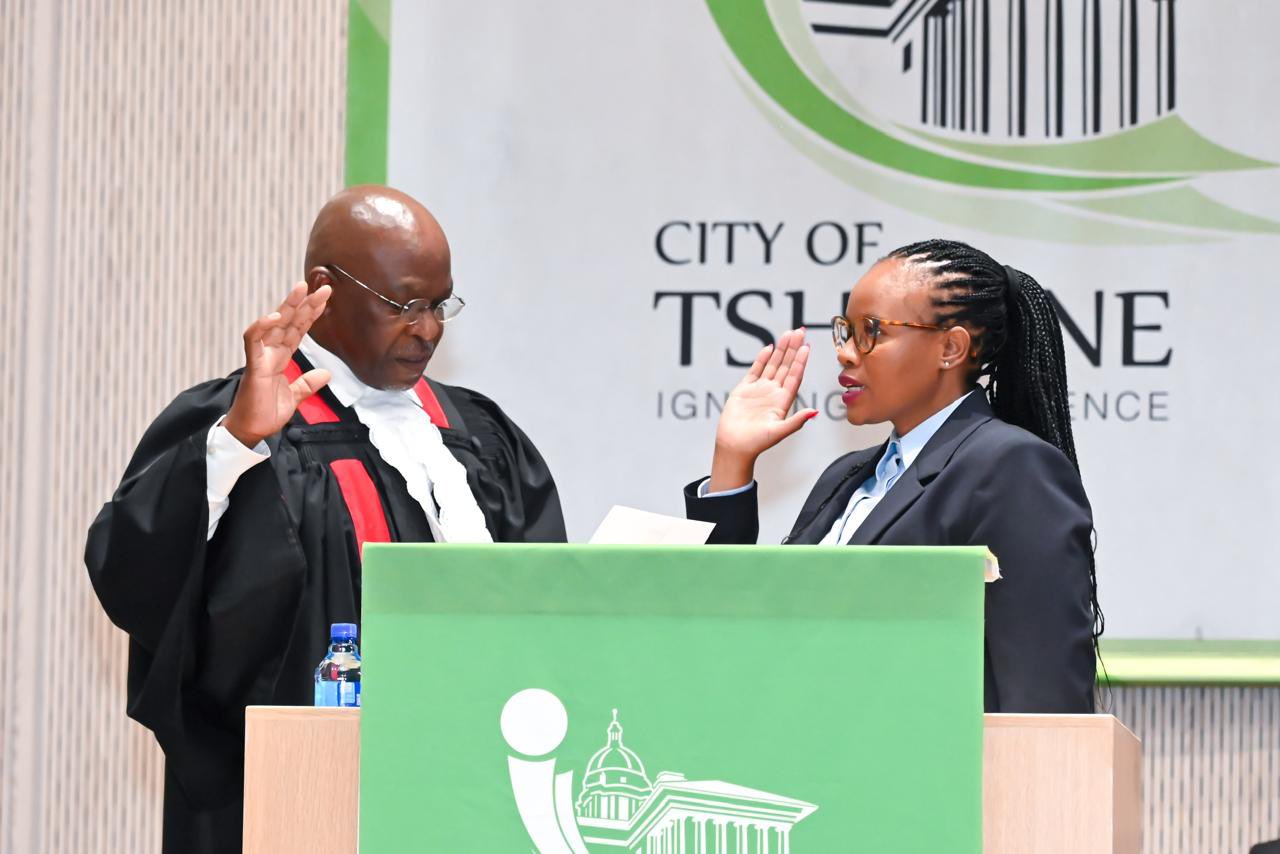
Pretoria – ActionSA’s Nasiphi Moya has been re-elected executive mayor of the City of Tshwane, while the Economic Freedom Fighters’ (EFF) Omphile Maotwe has secured the deputy mayor position, following a decisive council vote on Thursday, 26 November 2026.
Moya received 115 votes against 87 secured by Democratic Alliance (DA) candidate Cilliers Brink during the inaugural sitting of the newly constituted Tshwane Metropolitan Council. The election was conducted through a secret ballot, with 209 votes recorded and seven abstentions.
Her victory followed the formation of a coalition involving ActionSA, the African National Congress (ANC), the EFF and the uMkhonto weSizwe (MK) Party, which has secured a working majority in the metropolitan municipality.
Following Moya’s election, Maotwe was unanimously elected deputy executive mayor after no other candidate was nominated for the position.
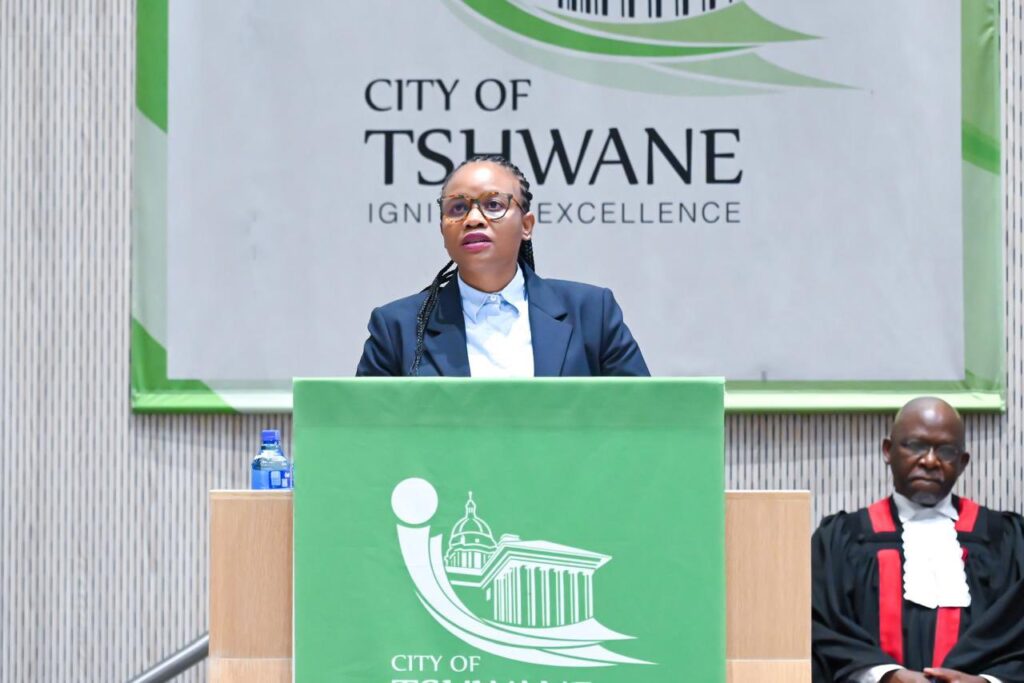
Announcing the outcome, council speaker Naeem Patel said the Municipal Structures Act required him to declare the sole nominated candidate elected.
“Schedule 3, Item 3 of the Municipal Structures Act dictates that where there is only one candidate nominated, I must declare that candidate elected. I now, in terms of this section, declare Councillor Omphile Maotwe of the EFF as the new deputy executive mayor of the City of Tshwane Metropolitan Council,” Patel said.
Patel had himself secured the position of council speaker earlier in the sitting, giving the ANC control of the legislature’s presiding office.
His election followed a failed attempt by the DA and Freedom Front Plus (FF Plus) to postpone the selection of the metropolitan municipality’s new leadership.
According to city manager Johann Mettler, 88 councillors supported the postponement proposal, while 199 voted against it, allowing the election process to proceed.
Patel contested the speakership against FF Plus councillor Willie Spies and the DA’s Pogiso Glen Mthimunye. A total of 209 votes were cast, with no spoilt ballots. Patel received 119 votes, compared with 71 for Mthimunye and 19 for Spies.
All 214 councillors had been sworn into office at the beginning of Thursday’s proceedings at the Tshwane House Council Chamber.
Coalition pushes DA into opposition
The new leadership arrangement marks a significant political shift in Gauteng’s administrative capital, with the DA moving into opposition despite emerging as the largest party in the 2026 local government elections.
The coalition comprising ActionSA, the ANC, EFF and MK Party commands 109 seats in the 214-member council, one more than the 108 required for an outright majority.
ActionSA is the largest partner in the arrangement, holding 48 seats after securing 22.07% of the municipal vote. The ANC follows with 44 seats and 20.22%, while the EFF contributes 13 seats and the MK Party four.
The DA, which secured 34.37% of the vote and 74 council seats, will serve as the official opposition.
The coalition was confirmed ahead of the council sitting by ActionSA National Chairperson Michael Beaumont, who indicated that additional political parties could join the arrangement in the future.
The outcome follows weeks of political negotiations in which parties sought to determine the leadership of Gauteng’s three metropolitan municipalities: Tshwane, Johannesburg and Ekurhuleni.
The DA secured the largest share of votes across all three metros but failed to obtain an outright majority or attract sufficient support from other major parties to form governing coalitions.
Negotiations between the DA and ActionSA proved particularly difficult because of longstanding political disagreements between the two parties.
ActionSA had demanded that the DA withdraw its mayoral candidates in Johannesburg and Tshwane, Helen Zille and Cilliers Brink, respectively, before negotiations could proceed.
The DA rejected the demand, describing it as extortionist, and instead proposed a confidence-and-supply arrangement under which ActionSA would exercise full control of Tshwane. ActionSA subsequently rejected that proposal.
Meanwhile, the ANC’s National Executive Committee had already taken a position against entering into coalition arrangements with the DA, describing such a partnership as a “last resort”.
With ActionSA and the ANC unable to secure majorities independently, the EFF and MK Party became essential to the coalition negotiations. Their eventual participation produced the grouping that has now taken control of Tshwane.
Tshwane council composition
The distribution of seats in the newly constituted 214-member council reflects the political balance that shaped the coalition negotiations.
| Political party | Vote share | Seats |
|---|---|---|
| Democratic Alliance | 34.37% | 74 |
| ActionSA | 22.07% | 48 |
| African National Congress | 20.22% | 44 |
| Freedom Front Plus | 7.63% | 17 |
| Economic Freedom Fighters | 5.77% | 13 |
| uMkhonto weSizwe Party | 1.96% | 4 |
| South African Communist Party | 1.19% | 3 |
| Patriotic Alliance | 0.65% | 2 |
| RISE Mzansi | 0.57% | 1 |
| Security Personnel Party of South Africa | 0.52% | 1 |
| African Independent Congress | 0.42% | 1 |
| African Christian Democratic Party | 0.32% | 1 |
| Afrika Mayibuye Party | 0.31% | 1 |
| African Transformation Movement | 0.27% | 1 |
| Build One South Africa | 0.22% | 1 |
| Service Delivery Party | 0.19% | 1 |
| United Africans Transformation | 0.18% | 1 |
| Total | 100% | 214 |
The political developments in Tshwane are also expected to provide an indication of the likely direction of coalition negotiations in Johannesburg and Ekurhuleni, where council leadership votes are scheduled for Friday, 27 November 2026.








Leave a comment