


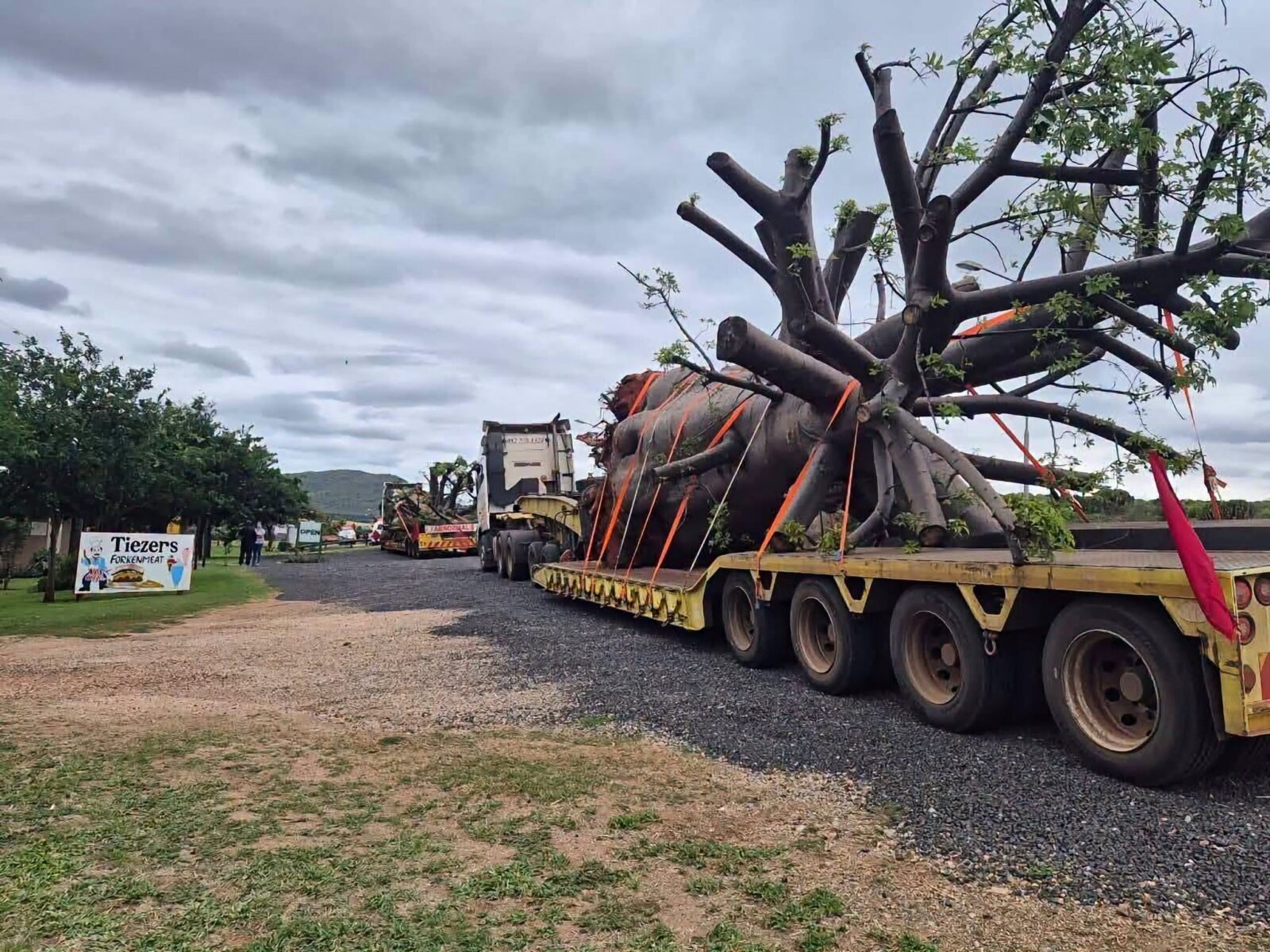
Johannesburg – Environmentalists in South Africa are racing to save five centuries-old baobab trees after they were uprooted and prepared for export to Georgia, in an operation that has raised concerns about the protection of Africa’s natural heritage.
The five trees, weighing a combined 20 tonnes, arrived at a reserve in Timbavati in north-eastern South Africa on Wednesday, 18 November 2026, where conservationists are preparing to replant them and support their recovery.
The baobabs had remained stranded in a warehouse in Durban since July after authorities intercepted them over concerns that they had been removed and transported without the necessary permits.
South Africa’s Department of Forestry, Fisheries and the Environment confirmed that the trees were intended for a buyer in Georgia but did not disclose the identity of the purchaser.
The incident has revived memories of a controversial operation in Kenya four years ago, when eight baobabs were uprooted for export to Shekvetili Dendrological Park in Georgia. The park belongs to Bidzina Ivanishvili, a wealthy Georgian businessman and former prime minister who has assembled a collection of enormous, ancient trees transported from different locations by boat across the Black Sea.
The proposed export of the Kenyan baobabs initially faced opposition from environmentalists, who described the practice as biopiracy. However, the shipment was eventually permitted to proceed.
Experts say the commercial export of baobabs for ornamental purposes remains uncommon because of the considerable difficulties involved in extracting, transporting and successfully replanting the trees.
David Newton, programme office director for East and Southern Africa at Traffic, an organisation that monitors international trade in wild animals and plants, said: “It is very unusual to see baobabs being used as ornamental plants … mainly because they are exceptionally difficult to dig out of the ground and transport, and then to successfully re-establish.”
Sarah Venter, founder of the Baobab Foundation, has been leading efforts to rescue and replant the South African trees. She believes they have a reasonable chance of survival if they are returned to the ground quickly.
The timing of the operation is particularly important because baobabs enter a dormant period during South Africa’s winter months, generally between May and October, when they shed their leaves. This period provides a suitable opportunity to relocate the trees with less disruption to their natural growth cycle.
However, the arrival of spring in November brings renewed growth, making the rescue operation increasingly urgent.
“As soon as spring starts [in November], the trees use their water to flush their new leaves, and that’s when we need to get them into the ground as soon as possible,” Venter said.
The operation has encountered logistical difficulties because of the unusual size and weight of the trees, which require specialised heavy-duty trucks designed to transport abnormal loads.
The five baobabs weigh between 19 and 29 tonnes individually, with some measuring up to 4.5 metres (15 feet) in diameter and reaching heights of 12.5 metres.
Their relocation requires careful handling to minimise damage to their trunks, roots and other vital structures.
Known across Africa as the tree of life, the baobab is protected under South African law. Cutting down or disturbing the trees requires official authorisation, making the circumstances surrounding their removal a matter of environmental and legal concern.
Beyond their impressive physical size, baobabs provide habitats for numerous species and play an important role in maintaining biodiversity.
Wambui Ippolito, a Kenyan landscape designer, lecturer and horticulturist, described the trees as essential ecological structures that support wildlife.
“A baobab isn’t just part of an ecosystem, it is an ecosystem in itself,” she said. “These trees are biodiversity anchors.”
Their hollow trunks and cavities provide shelter for several animals, including bats, bush babies, grey-headed parrots and the southern ground hornbill. Their fruits also serve as a food source for elephants, monkeys and warthogs.
Ippolito said the importance of baobabs extends beyond their environmental contribution, with the trees holding deep cultural and historical significance for communities across the African continent.
“It has always been a sacred tree in Africa. It doesn’t matter where you go: Senegal, Mali, Ghana – wherever you go, if there is a community around a baobab tree, that tree is sacred,” she said.
“Somebody’s great-great-great-great-great-grandparents sat under that tree, and it is part of human history in that area.”
Conservationists say the trees’ relatively shallow root systems could assist their recovery after relocation. According to Venter, baobab roots can regenerate relatively quickly, and the trees do not need to be planted particularly deep.
Once they have been replanted, the five trees will be secured with supporting cables to prevent them from falling while their root systems become established. Electric fencing will also be installed around them to protect them from elephants, which could otherwise damage the recovering trees.
The baobabs are estimated to be between 200 and 300 years old, although their natural lifespan can extend considerably further.
“Baobabs easily reach 1,000 years old, so they’ve got a few hundred years ahead of them if they survive,” Venter said.
Meanwhile, a criminal case has been opened against the owner of a landscaping company allegedly responsible for harvesting and transporting the trees without the required authorisation.














Leave a comment